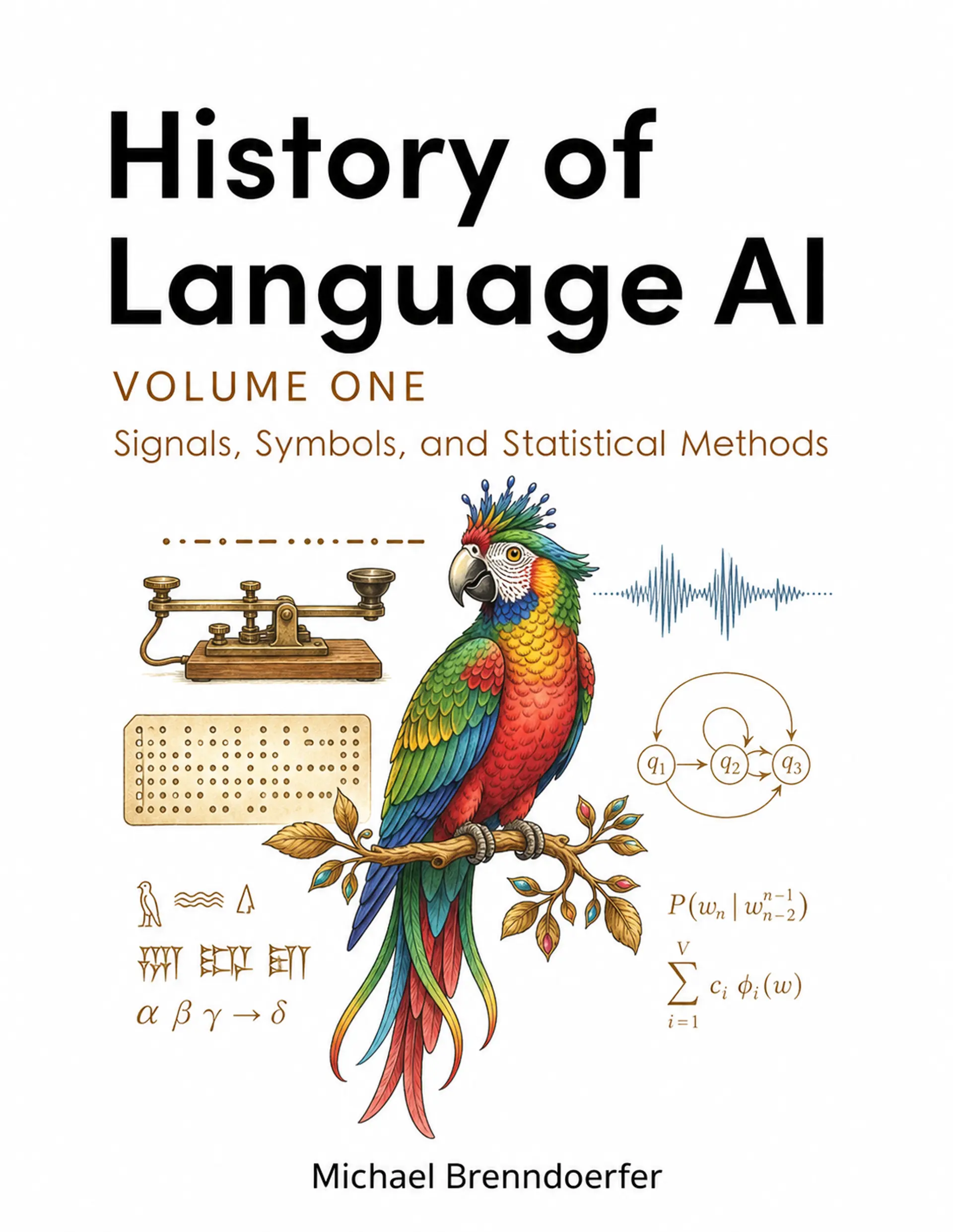
Signals, Symbols, and Statistical Methods
From Shannon and Turing through symbolic systems, speech recognition, statistical machine translation, recurrent networks, and the statistical turn.
Part of History of Language AI. The online chapters are free to read; the PDF edition is yours to keep, with future updates included.
Understand how today’s language AI came to be.
Follow the ideas, experiments, and technical decisions that shaped the field. Connecting modern systems to their predecessors gives you a clearer view of what changed, what endured, and why the methods we use today took the forms they did.
See what you’ll learnWhat you will learn
- Explain how information theory, formal linguistics, and symbolic programs framed the earliest language-AI problems.
- Trace the shift from hand-written rules to corpora, probability, and trainable statistical systems.
- Connect hidden Markov models, backpropagation, recurrent networks, and benchmarks to later language-model development.
Who this volume is for
- Readers who want the foundations and historical context behind modern natural-language processing.
Prerequisites: This volume starts at the beginning and assumes no prior history of NLP or machine learning.
Volume 1 PDF edition
Own this 324-page edition
Keep the PDF for offline reading, with future updates included. The corresponding chapters stay free online.
- Carefully typeset PDF
- Future updates and errata included
- Online chapters remain free to read
Volume 1 of 3 · Available now
$14
one-timeVersion 2026.08.2 · 324 pages · secure checkout via Stripe
Delivered by email · Free updates included
Want the complete book?
All 3 volumes in one complete PDF. Save $8 vs. buying available volumes separately.
Buy the complete book · $34Reader verdict
5.0
out of 5
12 five-star reader reviews
Genuine feedback, with names abbreviated for privacy.
Meet the community“I am enjoying reading your writings. I appreciate the effort you put into it. I want to drop a note of thanks. Thank you!”
“I would like to thank you for your work. Specifically, the chapter: 'LIME Explainability: Complete Guide to Local Interpretable Model-Agnostic Explanations' was extremely helpful for me in understanding LIME and communicating to colleagues. Your work is inspiring and valuable. Thank you for doing it.”
“I just came across your website where your books are available for free to read. Thank you so much for making this available to the public. This will help a lot of people.”
“I came across your collection of online handbooks covering quantitative finance, AI, and machine learning. I wanted to reach out and thank you for making such high-quality material openly available. They are incredibly helpful for my CFA Level II review and for brushing up ahead of ML interviews.”
“Thanks for putting cool stuff out into the world.”
“Really appreciate the way you have explained the concepts. Simple to understand, yet builds up knowledge exponentially, all while reinforcing it with examples repeatedly. I've read the last two chapters `74.Self-attention & 75.Q,K,V` and I've to admit, my concepts have never been clearer. You really are doing an amazing job breaking down maths and complex concepts like a story!”
“Thank you Michael. It's top!”
“I read a few of your blogs on NLP and oh WOW, they really are something, now I exactly know how all of the terms Entropy, Cross-entropy and how it is connected to Perplexity, will definitely read more of your blogs.”
“Your writing feels like a treasure trove of great material. So, thank you for compiling everything on your website!”
“Thanks so much for establishing such an amazing community. I appreciate the opportunity to be a learner and a contributor to the community.”
“I found your book Language AI Handbook's explanations of Transformer architectures and production deployment strategies to be exceptionally clear and insightful”
“I came across one of your books, Language AI Handbook, and man, I'm loving it. I've read many books but have never found such a comprehensive book on large models that covers everything from start to finish with such depth.”
Read all 12 reader reviews
“I would like to thank you for your work. Specifically, the chapter: 'LIME Explainability: Complete Guide to Local Interpretable Model-Agnostic Explanations' was extremely helpful for me in understanding LIME and communicating to colleagues. Your work is inspiring and valuable. Thank you for doing it.”
“Really appreciate the way you have explained the concepts. Simple to understand, yet builds up knowledge exponentially, all while reinforcing it with examples repeatedly. I've read the last two chapters `74.Self-attention & 75.Q,K,V` and I've to admit, my concepts have never been clearer. You really are doing an amazing job breaking down maths and complex concepts like a story!”
“Thanks so much for establishing such an amazing community. I appreciate the opportunity to be a learner and a contributor to the community.”
“I just came across your website where your books are available for free to read. Thank you so much for making this available to the public. This will help a lot of people.”
“I am enjoying reading your writings. I appreciate the effort you put into it. I want to drop a note of thanks. Thank you!”
“Thank you Michael. It's top!”
“Thanks for putting cool stuff out into the world.”
“I found your book Language AI Handbook's explanations of Transformer architectures and production deployment strategies to be exceptionally clear and insightful”
“Your writing feels like a treasure trove of great material. So, thank you for compiling everything on your website!”
“I came across your collection of online handbooks covering quantitative finance, AI, and machine learning. I wanted to reach out and thank you for making such high-quality material openly available. They are incredibly helpful for my CFA Level II review and for brushing up ahead of ML interviews.”
“I read a few of your blogs on NLP and oh WOW, they really are something, now I exactly know how all of the terms Entropy, Cross-entropy and how it is connected to Perplexity, will definitely read more of your blogs.”
“I came across one of your books, Language AI Handbook, and man, I'm loving it. I've read many books but have never found such a comprehensive book on large models that covers everything from start to finish with such depth.”
Exact contents
31 chapters across 2 parts
Every linked chapter is free to read online.
Signals & Symbols
- 01Shannon's N-gram Model (1948)
Claude Shannon's foundational work on information theory that introduced n-gram models, laying the groundwork for statistical language processing
- 02The Turing Test (1950)
Alan Turing's foundational challenge for Language AI: Can a machine engage in conversations indistinguishable from those of a human?
- 03Georgetown-IBM Machine Translation Demo (1954)
The first public demonstration of machine translation, where an IBM system automatically translated Russian sentences into English, spurring early interest in computational language processing
- 04The Perceptron (1957)
Frank Rosenblatt's revolutionary perceptron algorithm, the first artificial neural network that could learn to classify patterns, establishing the foundation for modern deep learning
- 05Chomsky's Syntactic Structures (1957)
Noam Chomsky's generative grammar introduced formal models of syntax, revolutionizing linguistic theory and establishing computational approaches to understanding language structure
- 06MADALINE Neural Networks (1962)
Bernard Widrow and Marcian Hoff's MADALINE demonstrated how multiple adaptive linear elements could solve practical engineering problems in signal processing and pattern recognition
- 07ELIZA (1966)
Joseph Weizenbaum's groundbreaking chatbot that simulated a Rogerian psychotherapist using pattern matching and the first practical attempt at the Turing Test
- 08Viterbi Algorithm (1967)
Dynamic-programming decoder for HMMs that became foundational for speech recognition and part-of-speech tagging
- 09SHRDLU (1968)
Terry Winograd's revolutionary system that demonstrated genuine language understanding through action in a simulated blocks world
- 10Vector Space Model & TF-IDF (1968)
Gerard Salton's foundational work on statistical information retrieval using vector representations and term frequency-inverse document frequency weighting, laying foundations for distributional semantics and modern search
- 11Conceptual Dependency Theory (1969)
Schank's semantic representation using primitive actions to capture sentence meaning independent of syntax
- 12The Transition to Statistical Methods (1970s)
The transition from rule-based to statistical methods, with the rise of corpus linguistics and the development of statistical language models
- 13Hidden Markov Models (1970s)
How HMMs revolutionized speech recognition through probabilistic modeling of hidden states and observable outputs, establishing data-driven approaches in NLP
- 14Augmented Transition Networks (1970)
William Woods's procedural parsing formalism that extended finite-state machines with registers, recursion, and actions, enabling natural language parsing with integrated syntactic and semantic processing
- 15Montague Semantics (1973)
Richard Montague's formal semantics bridged logic and natural language, establishing compositional approaches to meaning that influenced computational semantics
- 16Chinese Room Argument (1980)
John Searle's famous thought experiment challenged the notion that syntactic symbol-manipulation alone could yield true understanding, shaping debates about meaning and machine intelligence
The Statistical Turn
- 01Lesk Algorithm (1983)
Michael Lesk's word sense disambiguation algorithm used dictionary definition overlaps to resolve ambiguous word meanings, establishing early approaches to semantic disambiguation
- 02Backpropagation (1986)
Rumelhart, Hinton, and Williams' backpropagation algorithm solved the credit assignment problem, enabling training of deep neural networks and modern language AI
- 03Katz Back-off (1987)
Slava Katz's elegant solution to handling unseen word sequences by backing off to shorter n-grams, making statistical language modeling practical for real-world applications
- 04Time Delay Neural Networks (1987)
Alex Waibel's TDNN introduced weight sharing across time and temporal convolutions, revolutionizing sequential data processing and laying the groundwork for modern CNNs and RNNs
- 05Convolutional Neural Networks (1988)
Yann LeCun's CNN revolutionized feature learning with automatic pattern detection, translation invariance, and parameter sharing, establishing principles that would later transform language AI through text CNNs and attention mechanisms
- 06IBM Statistical Machine Translation (1991)
IBM researchers revolutionized translation by introducing statistical approaches that learned from parallel text data, establishing data-driven learning, word alignment, and probabilistic modeling that transformed all of NLP
- 07Penn Treebank (1993)
The full Penn Treebank release provided large-scale syntactic annotations that became the standard benchmark for parsing, enabling data-driven approaches to dominate syntactic analysis
- 08BM25 (1994)
The Okapi BM25 probabilistic retrieval scoring function became the gold standard for information retrieval and remains a crucial baseline in modern RAG systems
- 09WordNet (1995)
Princeton's WordNet represented words as an interconnected semantic network of synsets and relationships, establishing that meaning is relational and influencing everything from word sense disambiguation to modern embeddings
- 10Recurrent Neural Networks (1995)
RNNs revolutionized sequence processing with neural networks that maintain memory through recurrent connections, enabling speech recognition and language modeling while establishing the sequential processing paradigm that would lead to LSTMs and transformers
- 11Maximum Entropy & SVMs in NLP (1996)
Feature-based discriminative models including Maximum Entropy and Support Vector Machines became dominant for NER, POS tagging, and parsing, establishing supervised learning as the standard approach
- 12Long Short-Term Memory (1997)
Hochreiter and Schmidhuber solved the vanishing gradient problem with LSTMs, introducing gated memory mechanisms that could selectively remember and forget information, enabling practical sequence modeling and establishing principles that would influence all future architectures
- 13Statistical Parsers (1997)
Collins and Charniak's head-driven statistical parsers marked the end of purely rule-based dominance in syntactic analysis, demonstrating that data-driven methods could achieve superior accuracy
- 14FrameNet (1998)
The FrameNet project introduced frame semantics resources that expanded beyond WordNet's synsets, capturing richer semantic relationships and event structures in language
- 15LSA & Topic Models (1999)
Latent Semantic Analysis, PMI-based methods, and later LDA (2003) introduced distributional and topic-based semantics, establishing unsupervised approaches to meaning before neural embeddings
Choose the edition that fits your next step
Volume 1: Signals, Symbols, and Statistical Methods
324 pages focused on this subject, with future updates included.
$14
Choose this volumeThe complete History of Language AI book
All volumes together, with future updates included.
$34
Buy the complete bookExplore the other volumes
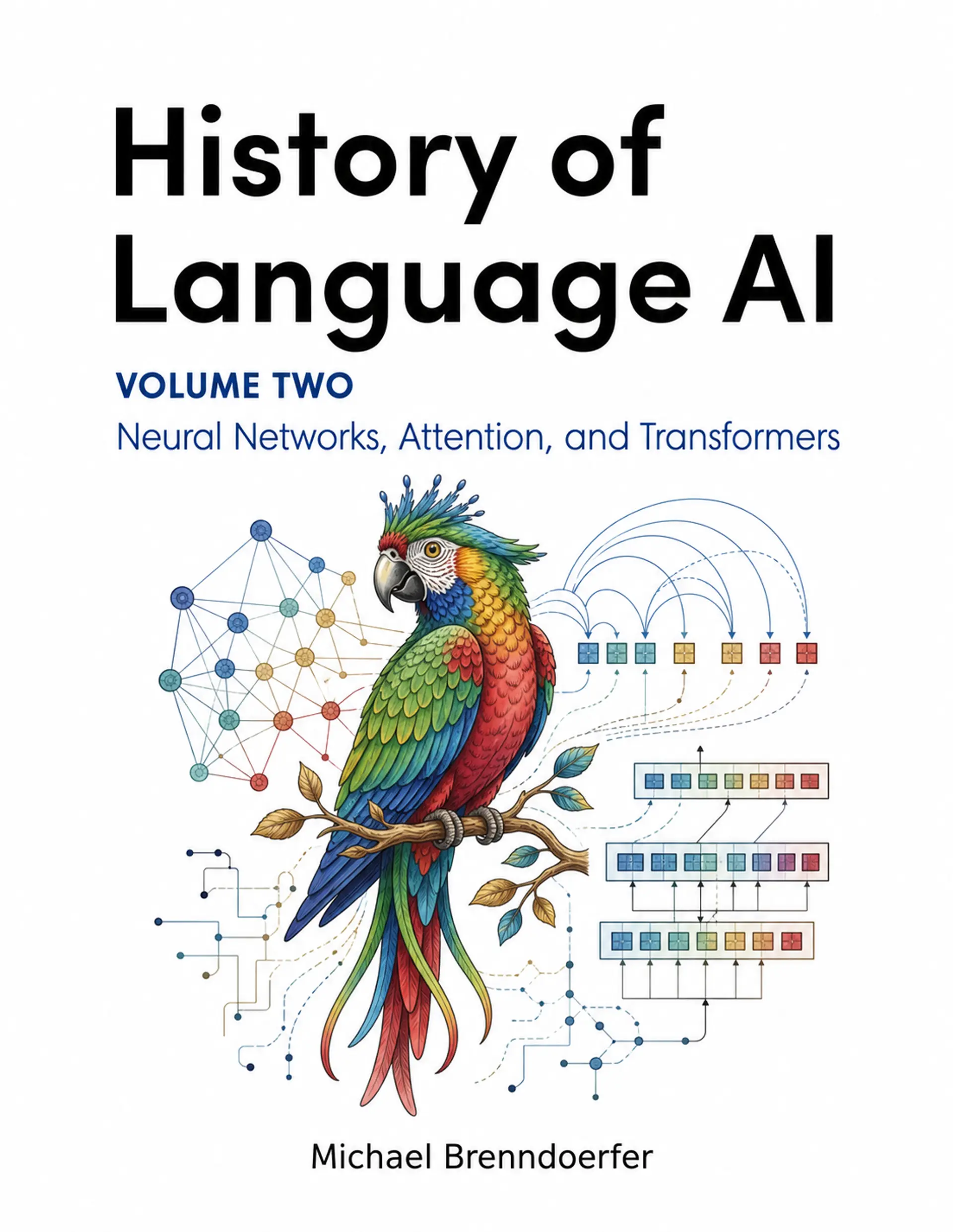
Volume 2 · 319 pages
Neural Networks, Attention, and Transformers
Structured Learning & Benchmarks · Deep Learning Arrives · Transformers & Pretraining
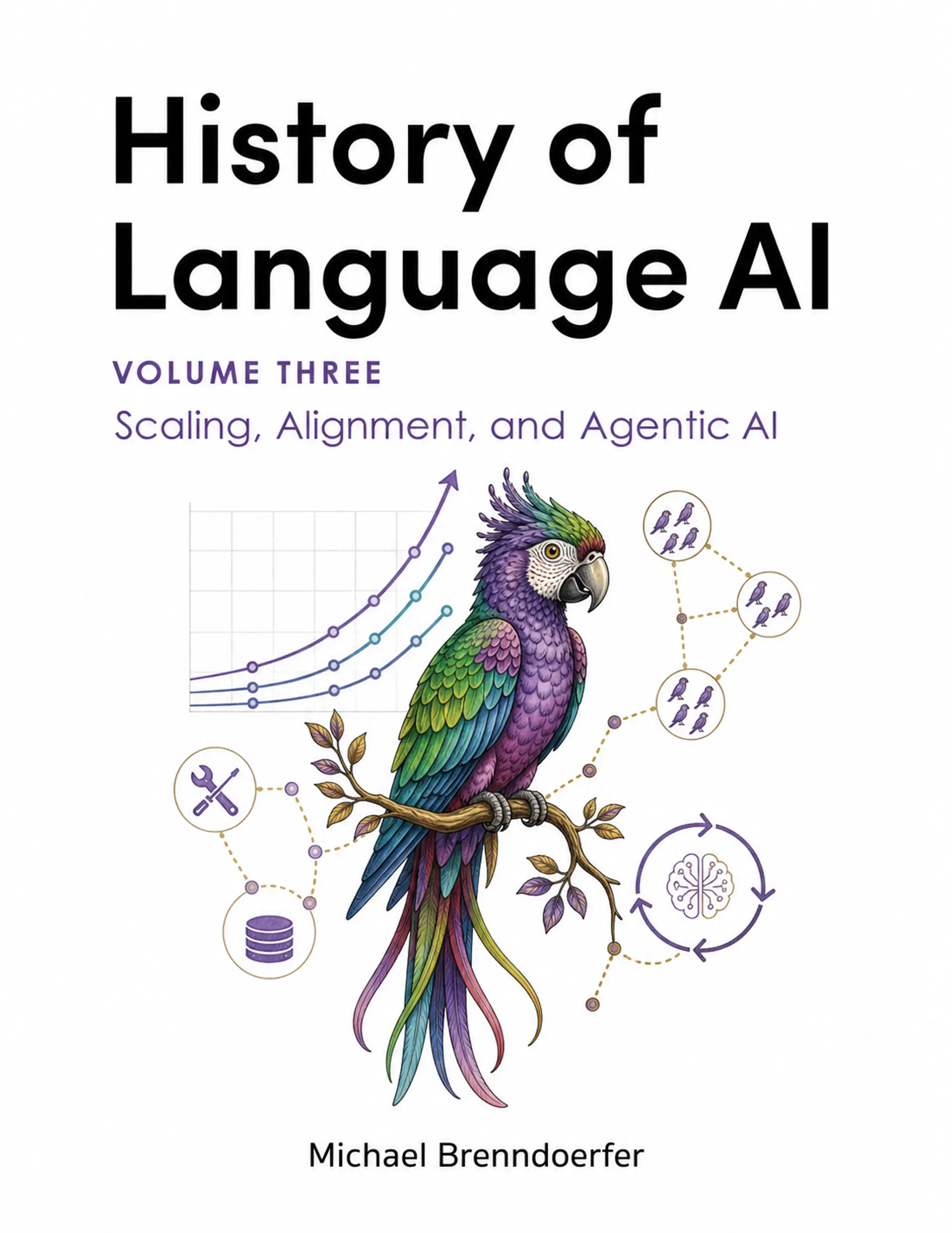
Volume 3 · 338 pages
Scaling, Alignment, and Agentic AI
Scaling & Retrieval · Multimodal & Instruction Era · Open Models & Alignment · Agents & Long Context
Author and edition details
About the author and this edition

Michael Brenndoerfer
Michael has spent more than a decade working across software engineering, data, AI, and business. He writes to understand difficult ideas more deeply and to share what he learns in a clear, practical way.
- Edition
- First edition
- Published
- Last reviewed
Version history
Kept current, not frozen in time
Each PDF purchase includes future editions. When the book changes, the updated copy appears in My books at no extra cost.
Current release
Edition 2026.08.2
Editorial improvements.
Earlier releases2
2026.08.1
Editorial improvements throughout the book, with clearer explanations, refined presentation, and improved plots and visualizations.
2026.08.0
Initial complete-book and three-volume PDF release with perpetual updates.