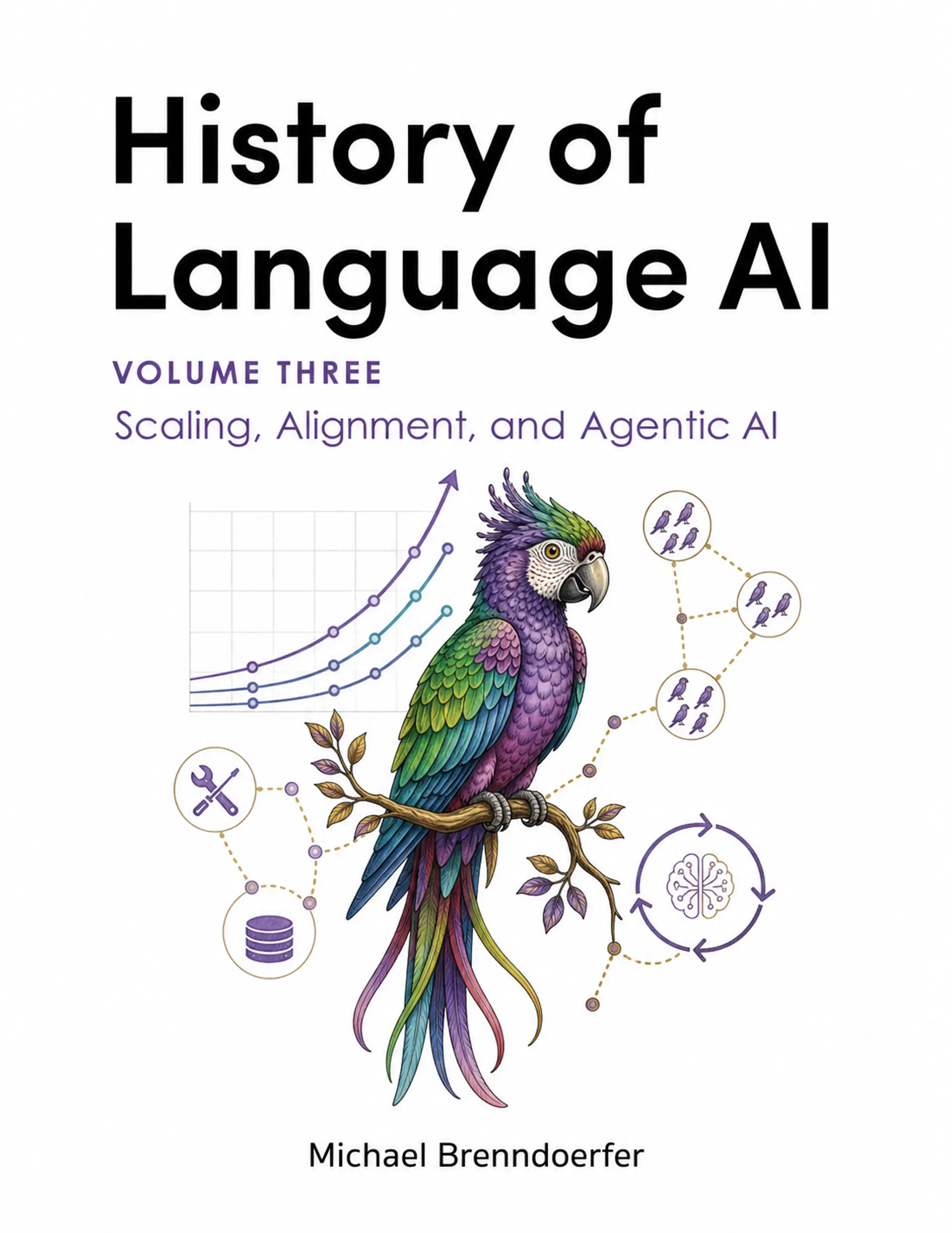
Scaling, Alignment, and Agentic AI
Scaling laws, retrieval, multimodal models, instruction tuning, open models, alignment, long context, reasoning, and the rise of agents.
Part of History of Language AI. The online chapters are free to read; the PDF edition is yours to keep, with future updates included.
Understand how today’s language AI came to be.
Follow the ideas, experiments, and technical decisions that shaped the field. Connecting modern systems to their predecessors gives you a clearer view of what changed, what endured, and why the methods we use today took the forms they did.
See what you’ll learnWhat you will learn
- Connect scaling, retrieval, and data choices to the capabilities of foundation models.
- Trace instruction tuning, alignment, open-model development, multimodality, and modern evaluation.
- Place long-context reasoning and agentic systems inside the broader historical arc of language AI.
Who this volume is for
- Readers who want a technically grounded history of foundation models, alignment, and agentic AI.
Prerequisites: Readable on its own; familiarity with transformers is helpful and is developed historically in Volume 2.
Volume 3 PDF edition
Own this 338-page edition
Keep the PDF for offline reading, with future updates included. The corresponding chapters stay free online.
- Carefully typeset PDF
- Future updates and errata included
- Online chapters remain free to read
Volume 3 of 3 · Available now
$14
one-timeVersion 2026.08.2 · 338 pages · secure checkout via Stripe
Delivered by email · Free updates included
Want the complete book?
All 3 volumes in one complete PDF. Save $8 vs. buying available volumes separately.
Buy the complete book · $34Reader verdict
5.0
out of 5
12 five-star reader reviews
Genuine feedback, with names abbreviated for privacy.
Meet the community“I am enjoying reading your writings. I appreciate the effort you put into it. I want to drop a note of thanks. Thank you!”
“I would like to thank you for your work. Specifically, the chapter: 'LIME Explainability: Complete Guide to Local Interpretable Model-Agnostic Explanations' was extremely helpful for me in understanding LIME and communicating to colleagues. Your work is inspiring and valuable. Thank you for doing it.”
“I just came across your website where your books are available for free to read. Thank you so much for making this available to the public. This will help a lot of people.”
“I came across your collection of online handbooks covering quantitative finance, AI, and machine learning. I wanted to reach out and thank you for making such high-quality material openly available. They are incredibly helpful for my CFA Level II review and for brushing up ahead of ML interviews.”
“Thanks for putting cool stuff out into the world.”
“Really appreciate the way you have explained the concepts. Simple to understand, yet builds up knowledge exponentially, all while reinforcing it with examples repeatedly. I've read the last two chapters `74.Self-attention & 75.Q,K,V` and I've to admit, my concepts have never been clearer. You really are doing an amazing job breaking down maths and complex concepts like a story!”
“Thank you Michael. It's top!”
“I read a few of your blogs on NLP and oh WOW, they really are something, now I exactly know how all of the terms Entropy, Cross-entropy and how it is connected to Perplexity, will definitely read more of your blogs.”
“Your writing feels like a treasure trove of great material. So, thank you for compiling everything on your website!”
“Thanks so much for establishing such an amazing community. I appreciate the opportunity to be a learner and a contributor to the community.”
“I found your book Language AI Handbook's explanations of Transformer architectures and production deployment strategies to be exceptionally clear and insightful”
“I came across one of your books, Language AI Handbook, and man, I'm loving it. I've read many books but have never found such a comprehensive book on large models that covers everything from start to finish with such depth.”
Read all 12 reader reviews
“I would like to thank you for your work. Specifically, the chapter: 'LIME Explainability: Complete Guide to Local Interpretable Model-Agnostic Explanations' was extremely helpful for me in understanding LIME and communicating to colleagues. Your work is inspiring and valuable. Thank you for doing it.”
“Really appreciate the way you have explained the concepts. Simple to understand, yet builds up knowledge exponentially, all while reinforcing it with examples repeatedly. I've read the last two chapters `74.Self-attention & 75.Q,K,V` and I've to admit, my concepts have never been clearer. You really are doing an amazing job breaking down maths and complex concepts like a story!”
“Thanks so much for establishing such an amazing community. I appreciate the opportunity to be a learner and a contributor to the community.”
“I just came across your website where your books are available for free to read. Thank you so much for making this available to the public. This will help a lot of people.”
“I am enjoying reading your writings. I appreciate the effort you put into it. I want to drop a note of thanks. Thank you!”
“Thank you Michael. It's top!”
“Thanks for putting cool stuff out into the world.”
“I found your book Language AI Handbook's explanations of Transformer architectures and production deployment strategies to be exceptionally clear and insightful”
“Your writing feels like a treasure trove of great material. So, thank you for compiling everything on your website!”
“I came across your collection of online handbooks covering quantitative finance, AI, and machine learning. I wanted to reach out and thank you for making such high-quality material openly available. They are incredibly helpful for my CFA Level II review and for brushing up ahead of ML interviews.”
“I read a few of your blogs on NLP and oh WOW, they really are something, now I exactly know how all of the terms Entropy, Cross-entropy and how it is connected to Perplexity, will definitely read more of your blogs.”
“I came across one of your books, Language AI Handbook, and man, I'm loving it. I've read many books but have never found such a comprehensive book on large models that covers everything from start to finish with such depth.”
Exact contents
45 chapters across 4 parts
Every linked chapter is free to read online.
Scaling & Retrieval
- 01Scaling Laws (2020)
Kaplan et al. discovered power-law scaling relationships between model size, data, compute, and performance, enabling prediction of model capabilities and optimal resource allocation
- 02GPT-3 & In-Context Learning (2020)
GPT-3's 175B parameters demonstrated emergent few-shot learning capabilities, showing that sufficiently large models could perform tasks from examples without fine-tuning
- 03Dense Passage Retrieval & RAG (2020)
DPR, REALM, and RAG established dense retrieval and retrieval-augmented generation, combining neural search with language generation for grounded, knowledge-intensive tasks
Multimodal & Instruction Era
- 01Mixture-of-Experts at Scale (2021)
GShard and Switch Transformer demonstrated that sparse mixture-of-experts architectures could scale to trillions of parameters with efficient computation through conditional routing
- 02CLIP (2021)
OpenAI's CLIP trained vision and language encoders jointly on image-text pairs, enabling zero-shot image classification and launching the multimodal foundation model era
- 03Codex (2021)
OpenAI's Codex demonstrated that language models fine-tuned on code could generate functional programs from natural language descriptions, powering GitHub Copilot
- 04Instruction Tuning (2021)
Fine-tuning technique that trained language models to follow explicit natural language instructions, enabling zero-shot generalization and making models practical for real-world use
- 05Multi-Vector Retrievers (2021)
Token-level contextualized matching systems like ColBERT that encoded queries and documents as collections of token vectors, enabling fine-grained matching that combined semantic understanding with lexical precision
- 06The Pile (2021)
EleutherAI's diverse 825GB training dataset became a crucial open resource for training large language models, democratizing access to high-quality pretraining data
- 07DALL·E (2021)
First large text-to-image Transformer that generated novel, coherent images directly from prompts
- 08Foundation Models Report (2021)
Stanford's CRFM formalized 'foundation models' and framed their opportunities and risks, shaping discourse and research agendas
- 09InstructGPT & RLHF (2022)
InstructGPT applied reinforcement learning from human feedback at scale, aligning GPT-3 with human preferences and establishing RLHF as the standard alignment approach
- 10Chinchilla Scaling Laws (2022)
DeepMind's Chinchilla showed that models should be trained on far more data than previously thought, establishing that compute-optimal training requires balanced scaling of parameters and data
- 11HELM (2022)
Stanford's Holistic Evaluation of Language Models framework assessed models across accuracy, robustness, bias, toxicity, and efficiency, establishing comprehensive evaluation standards
- 12Chain-of-Thought Prompting (2022)
Wei et al. showed that prompting models to generate reasoning steps dramatically improved performance on complex tasks, establishing prompting as a crucial capability
- 13ChatGPT (2022)
OpenAI's ChatGPT, a conversational AI interface built on GPT-3.5, was released to the public and quickly gained millions of users, demonstrating the practicality and widespread appeal of large language model chatbots in everyday tasks
- 14BLOOM (2022)
The BigScience collaboration released BLOOM, a 176-billion-parameter open-access multilingual language model, marking the first time a model of that scale was made openly available to researchers and the public as an alternative to proprietary LLMs
- 15PaLM (2022)
Google's 540B Pathways model demonstrated powerful few-shot reasoning, multilinguality, and code abilities at unprecedented scale
- 16Flamingo (2022)
DeepMind's few-shot vision-language model used gated cross-attention to set SOTA across many image-text tasks without task-specific fine-tuning
- 17DALL·E 2 (2022)
CLIP-guided diffusion delivered high-quality text-to-image synthesis with editing (in-painting) and variations
- 18Stable Diffusion (2022)
Open-source latent diffusion democratized text-to-image generation on consumer GPUs
- 19Whisper (2022)
Large-scale, multilingual ASR trained on ~680k hours delivered robust transcription and speech-to-text translation across 90+ languages
- 20FlashAttention (2022)
IO-aware exact attention made long-context training/inference far faster and more memory-efficient
Open Models & Alignment
- 01LLaMA (2023)
Meta's LLaMA family of efficient open models democratized large language model research, enabling academic and small-scale experimentation with state-of-the-art architectures
- 02Open LLM Wave (2023)
MPT, Falcon, Mistral, and other open models created a competitive ecosystem of high-quality base models, accelerating innovation and reducing dependence on proprietary systems
- 03QLoRA (2023)
QLoRA enabled efficient fine-tuning of quantized models using 4-bit precision, making it possible to adapt large language models on consumer GPUs with limited memory
- 04Function Calling & Tool Use (2023)
Models gained ability to reliably call functions and APIs with structured outputs, enabling practical agent systems that interact with external tools and environments
- 05Multimodal LLMs (2023)
GPT-4V, LLaVA, and other vision-language models unified text and image understanding, enabling models to reason about and generate descriptions of visual content
- 06Constitutional AI (2023)
Anthropic's Constitutional AI systematized safety training through principle-based self-critique, offering an alternative approach to alignment beyond pure preference learning
- 07BIG-bench & MMLU (2023)
Expanded evaluation suites tested broader reasoning, knowledge, and specialized capabilities, revealing strengths and limitations across diverse domains
- 08GPT-4 (2023)
Multimodal LLM with markedly improved reliability and reasoning, achieving top-percentile performance on professional and academic exams
Agents, Long Context & Real-Time AI
- 01Mixtral & Sparse MoE (2024)
Mistral's Mixtral family demonstrated that sparse mixture-of-experts could achieve better quality per compute unit through efficient expert routing
- 02Long Context at Scale (2024)
Models supporting 1M+ token contexts emerged, with techniques combining extended attention mechanisms, recursive retrieval, and efficient memory management
- 03Structured Outputs (2024)
JSON mode and constrained decoding became standard features, ensuring models generate valid structured data for reliable integration with production systems
- 04Hybrid Retrieval (2024)
Hybrid systems combined sparse retrieval for fast candidate generation with dense retrieval for semantic reranking, leveraging complementary strengths of both paradigms to create more effective retrieval solutions
- 05PEFT Beyond LoRA (2024)
Advanced parameter-efficient fine-tuning methods including AdaLoRA, DoRA, VeRA, and other innovations extended LoRA with adaptive rank allocation, magnitude-direction decomposition, and parameter sharing for improved efficiency and performance
- 06Continuous Post-Training (2025)
Incremental model updates using parameter-efficient fine-tuning and continual learning techniques, enabling models to stay current and adapt continuously without expensive full retraining
- 07Mixture of Experts at Scale (2024)
Major advances in MoE architectures enabled efficient scaling of intelligence through dynamic task routing to specialized subnetworks
- 08Agentic AI Systems (2024)
AI systems gained the ability to act autonomously, plan multi-step tasks, and use tools to achieve complex goals without human intervention
- 09Multimodal Integration (2024)
Breakthrough in seamless processing and understanding across text, images, audio, and video within unified model architectures
- 10DeepSeek R1 (2025)
Advanced reasoning model achieved competitive capabilities on complex logical and mathematical tasks despite hardware constraints
- 11GPT-4o (2025)
Unified multimodal fluency with real-time speech, vision, text, and memory enabled near-human latency and expressiveness in AI interactions
- 12V-JEPA 2 (2025)
Meta's vision-based joint embedding predictive architectures moved toward embodied, world-modeling AI that learns through interaction and prediction
- 13AI Co-Scientist Systems (2025)
Autonomous AI systems capable of independent hypothesis generation, experimental design, and scientific discovery without human intervention
- 14Specialized LLMs for Low-Resource Languages (2025)
Advanced training pipelines achieved near-English performance for African, Indigenous, and regional languages, enabling digital inclusion for billions of speakers
Choose the edition that fits your next step
Volume 3: Scaling, Alignment, and Agentic AI
338 pages focused on this subject, with future updates included.
$14
Choose this volumeThe complete History of Language AI book
All volumes together, with future updates included.
$34
Buy the complete bookExplore the other volumes
Author and edition details
About the author and this edition

Michael Brenndoerfer
Michael has spent more than a decade working across software engineering, data, AI, and business. He writes to understand difficult ideas more deeply and to share what he learns in a clear, practical way.
- Edition
- First edition
- Published
- Last reviewed
Version history
Kept current, not frozen in time
Each PDF purchase includes future editions. When the book changes, the updated copy appears in My books at no extra cost.
Current release
Edition 2026.08.2
Editorial improvements.
Earlier releases2
2026.08.1
Editorial improvements throughout the book, with clearer explanations, refined presentation, and improved plots and visualizations.
2026.08.0
Initial complete-book and three-volume PDF release with perpetual updates.