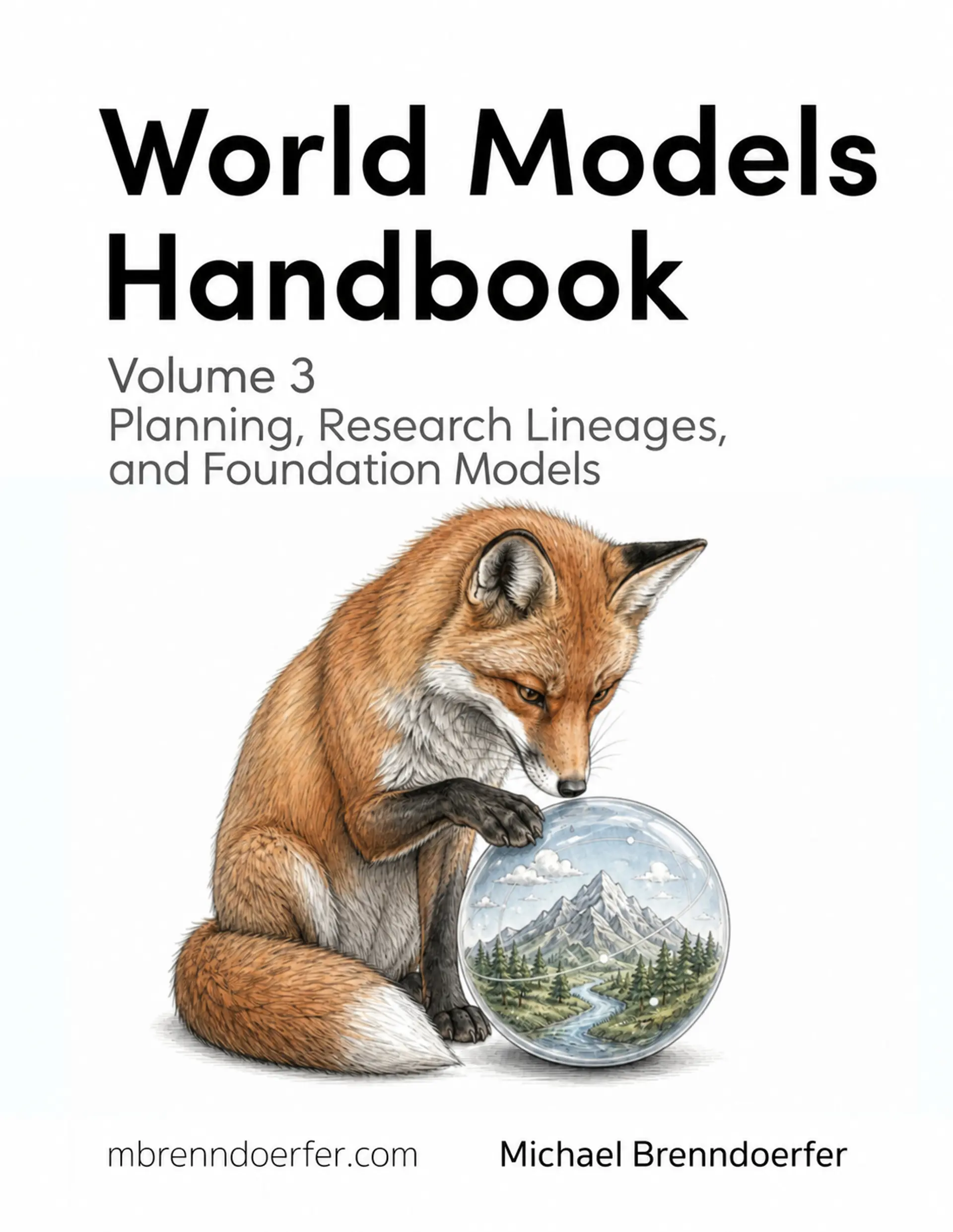
Planning, Research Lineages, and Foundation Models
Use imagined futures for planning, then compare influential research systems and the capabilities claimed for foundation and world-action models.
Part of World Models Handbook. The online chapters are free to read; the PDF edition is yours to keep, with future updates included.
Build the understanding to reason about world models.
Learn how a system can represent its environment and use predictions to make decisions. The handbook connects the underlying ideas to architectures, planning methods, and evaluation, helping you reason about what a world model can do and where its limits lie.
See what you’ll learnWhat you will learn
- Choose planning and policy-learning methods for a learned model.
- Understand the distinct assumptions behind PILCO, Dreamer, MuZero, and TD-MPC.
- Assess action conditioning and control claims in foundation models.
Who this volume is for
- AI and robotics engineers, researchers, graduate students, reinforcement learning practitioners, and technically curious readers who want a coherent path from foundational state estimation and control to modern generative world models.
Prerequisites: A working understanding of reinforcement learning and learned dynamics. Volumes 1 and 2 provide the shared foundations.
Volume 3 PDF + code
Own this 701-page edition
Keep the PDF and companion notebooks for offline reading, with future updates included. The corresponding chapters stay free online.
- Carefully typeset PDF
- Companion notebooks included
- Future updates and errata included
- Online chapters remain free to read
Volume 3 of 4 · Available now
$29
one-timeVersion 2026.10.0 · 701 pages · secure checkout via Stripe
Delivered by email · Free updates included
Want the complete library?
Access to every volume, delivered as separate PDFs. Companion notebooks included. Save $37 vs. buying available volumes separately.
Get all-volume access · $79On Michael’s writing
Feedback on Michael’s writing
Genuine feedback, with names abbreviated for privacy.
These comments concern Michael’s online writing and other handbooks, not this new PDF edition.
Meet the community“I am enjoying reading your writings. I appreciate the effort you put into it. I want to drop a note of thanks. Thank you!”
“I would like to thank you for your work. Specifically, the chapter: 'LIME Explainability: Complete Guide to Local Interpretable Model-Agnostic Explanations' was extremely helpful for me in understanding LIME and communicating to colleagues. Your work is inspiring and valuable. Thank you for doing it.”
“I just came across your website where your books are available for free to read. Thank you so much for making this available to the public. This will help a lot of people.”
“I found your book Language AI Handbook's explanations of Transformer architectures and production deployment strategies to be exceptionally clear and insightful”
“Your writing feels like a treasure trove of great material. So, thank you for compiling everything on your website!”
“Really appreciate the way you have explained the concepts. Simple to understand, yet builds up knowledge exponentially, all while reinforcing it with examples repeatedly. I've read the last two chapters `74.Self-attention & 75.Q,K,V` and I've to admit, my concepts have never been clearer. You really are doing an amazing job breaking down maths and complex concepts like a story!”
“Thank you Michael. It's top!”
“I read a few of your blogs on NLP and oh WOW, they really are something, now I exactly know how all of the terms Entropy, Cross-entropy and how it is connected to Perplexity, will definitely read more of your blogs.”
“I came across your collection of online handbooks covering quantitative finance, AI, and machine learning. I wanted to reach out and thank you for making such high-quality material openly available. They are incredibly helpful for my CFA Level II review and for brushing up ahead of ML interviews.”
“Thanks so much for establishing such an amazing community. I appreciate the opportunity to be a learner and a contributor to the community.”
“Thanks for putting cool stuff out into the world.”
“I came across one of your books, Language AI Handbook, and man, I'm loving it. I've read many books but have never found such a comprehensive book on large models that covers everything from start to finish with such depth.”
Read all 12 reader reviews
“I would like to thank you for your work. Specifically, the chapter: 'LIME Explainability: Complete Guide to Local Interpretable Model-Agnostic Explanations' was extremely helpful for me in understanding LIME and communicating to colleagues. Your work is inspiring and valuable. Thank you for doing it.”
“Really appreciate the way you have explained the concepts. Simple to understand, yet builds up knowledge exponentially, all while reinforcing it with examples repeatedly. I've read the last two chapters `74.Self-attention & 75.Q,K,V` and I've to admit, my concepts have never been clearer. You really are doing an amazing job breaking down maths and complex concepts like a story!”
“Thanks so much for establishing such an amazing community. I appreciate the opportunity to be a learner and a contributor to the community.”
“I just came across your website where your books are available for free to read. Thank you so much for making this available to the public. This will help a lot of people.”
“I am enjoying reading your writings. I appreciate the effort you put into it. I want to drop a note of thanks. Thank you!”
“Thank you Michael. It's top!”
“Thanks for putting cool stuff out into the world.”
“I found your book Language AI Handbook's explanations of Transformer architectures and production deployment strategies to be exceptionally clear and insightful”
“Your writing feels like a treasure trove of great material. So, thank you for compiling everything on your website!”
“I came across your collection of online handbooks covering quantitative finance, AI, and machine learning. I wanted to reach out and thank you for making such high-quality material openly available. They are incredibly helpful for my CFA Level II review and for brushing up ahead of ML interviews.”
“I read a few of your blogs on NLP and oh WOW, they really are something, now I exactly know how all of the terms Entropy, Cross-entropy and how it is connected to Perplexity, will definitely read more of your blogs.”
“I came across one of your books, Language AI Handbook, and man, I'm loving it. I've read many books but have never found such a comprehensive book on large models that covers everything from start to finish with such depth.”
Exact contents
18 chapters across 3 parts
Every linked chapter is free to read online.
Part VII: Planning and Agency
- 01Sampling-Based Planning and Model Predictive Control
Develops the topic through random shooting and cross-entropy methods, model predictive control, receding horizons and replanning, and constraints, warm starts, and real-time budgets.
- 02Differentiable Planning
Develops the topic through backpropagation through dynamics, gradient-based action optimization, differentiable value and cost functions, and stability under long rollout gradients.
- 03Search and Belief-Space Planning
Develops the topic through tree search and Monte Carlo tree search, planning under partial observability, belief trees and information gathering, and learned search guidance.
- 04Policies Learned in Imagination
Develops the topic through latent imagined rollouts, actor-critic learning inside a model, value expansion and synthetic experience, and regularizing policies against model errors.
- 05Active Perception, Dual Control, and Exploration
Develops the topic through actions that improve both knowledge and reward, information gain and uncertainty reduction, curiosity and intrinsic motivation, and exploration with safety constraints.
- 06Hierarchical, Symbolic, Language, and Multi-Agent Planning
Develops the topic through skills, options, and temporal abstraction, symbolic abstractions and task planning, language-conditioned goals and plans, and coordination, opponents, and nested beliefs.
Part VIII: Decision-Centric Research Lineages
- 01PILCO, PETS, Ensembles, and MBPO
Develops the topic through probabilistic dynamics and data efficiency, trajectory sampling with ensembles, uncertainty-aware model predictive control, and short model rollouts for policy optimization.
- 02World Models, SimPLe, and PlaNet
Develops the topic through variational latent dynamics, controller learning in dreams, video prediction for Atari, and latent planning with learned state-space models.
- 03The Dreamer Family
Develops the topic through recurrent state-space representations, latent imagination and actor-critic learning, DreamerV2 and discrete latents, and DreamerV3 and cross-domain scaling.
- 04MuZero and Value-Equivalent Models
Develops the topic through representation, dynamics, and prediction networks, planning without reconstructing observations, value equivalence and task sufficiency, and search targets and reanalysis.
- 05TD-MPC and Control-Centric Representations
Develops the topic through joint latent dynamics and value learning, temporal-difference model predictive control, short-horizon planning with terminal values, and TD-MPC2 and multi-task control.
- 06Offline and Conservative Model-Based RL
Develops the topic through learning from fixed datasets, out-of-distribution actions and model uncertainty, pessimism and conservative objectives, and policy constraints and offline evaluation.
Part IX: Foundation and World-Action Models
- 01Tokenized Game and Environment Models
Develops the topic through discrete environment tokenization, large autoregressive dynamics models, interactive generation and action interfaces, and transfer across games and environments.
- 02Pretrained Visual Models and DINO-WM
Develops the topic through frozen visual representations as state, feature-space dynamics prediction, action-conditioned latent rollouts, and generalization with pretrained encoders.
- 03Video Generators as Candidate World Models
Develops the topic through video prediction and temporal coherence, prompt and action controllability, physical plausibility versus visual realism, and tests of memory, causality, and intervention.
- 04Genie and Interactive Generated Environments
Develops the topic through latent action discovery, playable environment generation, interactive video rollouts, and evaluation of control and consistency.
- 05Cosmos and Omnimodal World Foundation Models
Develops the topic through physical AI data and tokenization, multimodal generative dynamics, conditioning, guardrails, and customization, and foundation-model infrastructure for simulation.
- 06Vision-Language-Action and World-Action Models
Develops the topic through joint perception, language, and control, action tokenization and robot policies, predictive models paired with action models, and embodiment transfer and closed-loop evaluation.
Choose the edition that fits your next step
Volume 3: Planning, Research Lineages, and Foundation Models
701 pages focused on this subject, with future updates included.
$29
Choose this volumeThe complete World Models Handbook library
All-volume access with separate volume PDFs and future updates. No combined PDF.
$79
Get all-volume accessExplore the other volumes
Volume 1 · 608 pages
Foundations, Control, and Representations
The World-Model Idea · Inference, Decisions, and Control · Representing Agents and Worlds
Volume 2 · 637 pages
Physics, Architectures, and Learning
Space, Physics, and Causality · World-Model Architectures · Learning World Models at Scale
Volume 4 · 713 pages
Applications, Evaluation, and Reliable Deployment
Application Domains · Evaluation and Understanding · Reliable World Models
Author and edition details
About the author and this edition

Michael Brenndoerfer
Michael has spent more than a decade working across software engineering, data, AI, and business. He writes to understand difficult ideas more deeply and to share what he learns in a clear, practical way.
- Edition
- First edition
- Published
- Last reviewed
Version history
Kept current, not frozen in time
Library access includes every future volume and update. When a volume changes, its updated PDF appears in My books at no extra cost.
Current release
Edition 2026.10.0
First edition: 72 chapters across four standalone volume PDFs, with executable companion notebooks and perpetual updates.