World Models Handbook
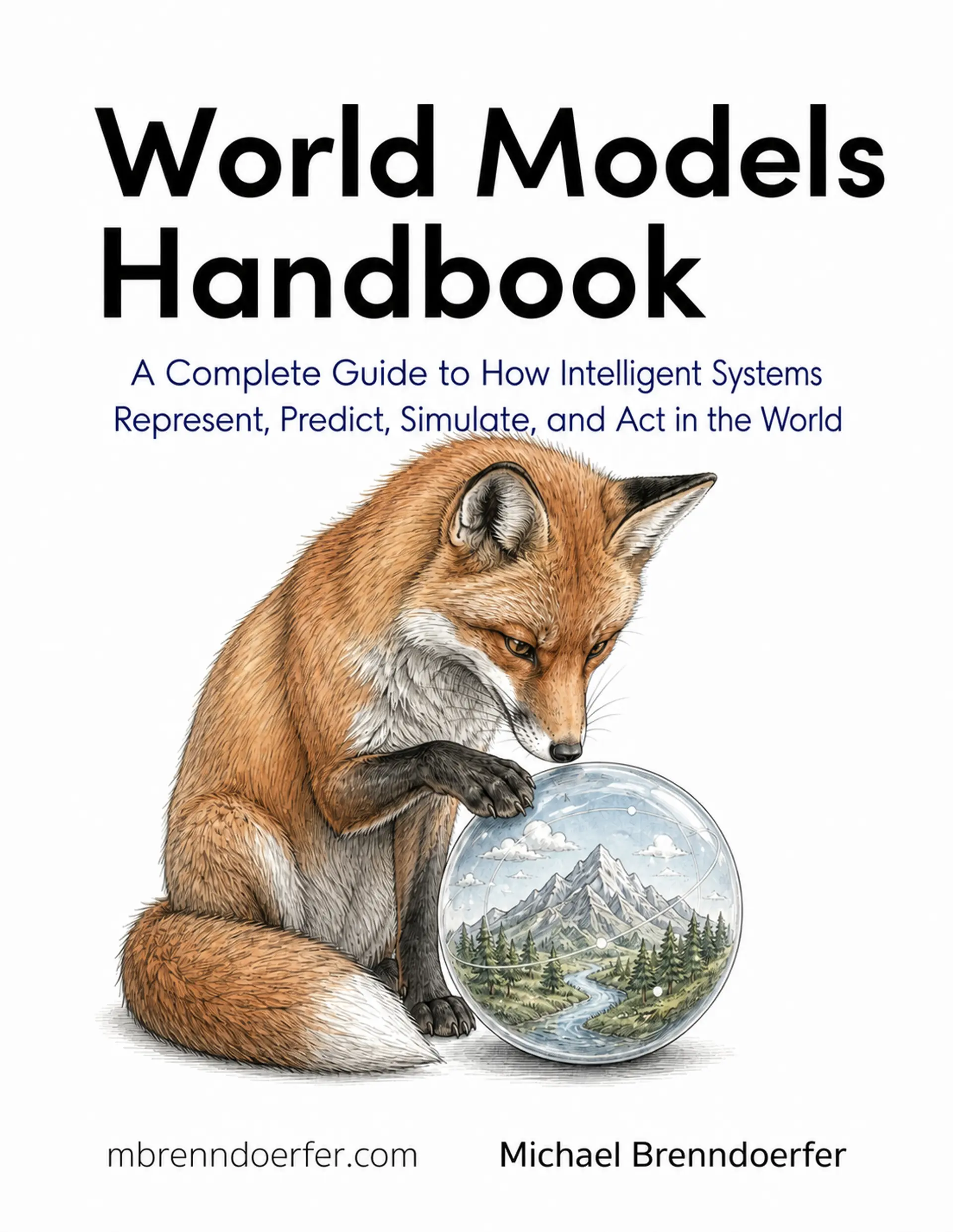
Read World Models Handbook free online
The World Models Handbook explains how an intelligent system can build an internal model of its environment, update that model from observations, use it to imagine possible futures, and choose what to do next. It connects ideas that are often taught separately across control, reinforcement learning, robotics, generative modeling, and cognitive science.
We begin with a small end-to-end world model, then develop the foundations: dynamical systems, partial observability, Bayesian filtering, system identification, state abstraction, uncertainty, physics, and causality. This gives every later architecture and research lineage a common vocabulary.
Author and edition details
About the author and this edition

Michael Brenndoerfer
Michael has spent more than a decade working across software engineering, data, AI, and business. He writes to understand difficult ideas more deeply and to share what he learns in a clear, practical way.
- Edition
- First edition
- Published
- Last reviewed
Key Topics
Track Your Progress
Sign in to mark chapters as complete, track quiz scores, and see your reading journey
The World-Model Idea
Inference, Decisions, and Control
Representing Agents and Worlds
Space, Physics, and Causality
World-Model Architectures
Learning World Models at Scale
Planning and Agency
Decision-Centric Research Lineages
Foundation and World-Action Models
Application Domains
Evaluation and Understanding
Reliable World Models
The whole book, beautifully typeset, yours forever.
All ~2,659 pages across 4 standalone volume PDFs
4 focused volume PDFs, delivered separately.
Companion notebooks for every volume, with locked dependencies
All future expansions, updates, and errata, free, forever
Downloadable editions for durable offline reading
$79
instead of $116 for the 4 volumes bought separately
Secure checkout via Stripe · PDF and notebook links delivered to your inbox
On Michael’s writing
Feedback on Michael’s writing
Genuine feedback, with names abbreviated for privacy.
These comments concern Michael’s online writing and other handbooks, not this new PDF edition.
Meet the community“I am enjoying reading your writings. I appreciate the effort you put into it. I want to drop a note of thanks. Thank you!”
“Your writing feels like a treasure trove of great material. So, thank you for compiling everything on your website!”
“I came across your collection of online handbooks covering quantitative finance, AI, and machine learning. I wanted to reach out and thank you for making such high-quality material openly available. They are incredibly helpful for my CFA Level II review and for brushing up ahead of ML interviews.”
Read the other 9 reader reviews
“I would like to thank you for your work. Specifically, the chapter: 'LIME Explainability: Complete Guide to Local Interpretable Model-Agnostic Explanations' was extremely helpful for me in understanding LIME and communicating to colleagues. Your work is inspiring and valuable. Thank you for doing it.”
“Really appreciate the way you have explained the concepts. Simple to understand, yet builds up knowledge exponentially, all while reinforcing it with examples repeatedly. I've read the last two chapters `74.Self-attention & 75.Q,K,V` and I've to admit, my concepts have never been clearer. You really are doing an amazing job breaking down maths and complex concepts like a story!”
“Thanks so much for establishing such an amazing community. I appreciate the opportunity to be a learner and a contributor to the community.”
“I just came across your website where your books are available for free to read. Thank you so much for making this available to the public. This will help a lot of people.”
“Thank you Michael. It's top!”
“Thanks for putting cool stuff out into the world.”
“I found your book Language AI Handbook's explanations of Transformer architectures and production deployment strategies to be exceptionally clear and insightful”
“I read a few of your blogs on NLP and oh WOW, they really are something, now I exactly know how all of the terms Entropy, Cross-entropy and how it is connected to Perplexity, will definitely read more of your blogs.”
“I came across one of your books, Language AI Handbook, and man, I'm loving it. I've read many books but have never found such a comprehensive book on large models that covers everything from start to finish with such depth.”
Prefer to start with a single volume?



Buy 3 volumes and all-volume access unlocks free. Already own volumes? Upgrade to all-volume access and you only pay the difference.
Table of Contents
Part I: The World-Model Idea
6 chapters
Part I: The World-Model Idea
Building a First World Model
Develops the topic through a minimal latent dynamics model, prediction, reconstruction, and rollout, planning with imagined trajectories, and the complete training and evaluation loop.
What Is a World Model?
Develops the topic through operational and philosophical definitions, models of observations, states, dynamics, and agents, prediction versus simulation, and boundaries with generative models and simulators.
The World-Model Qualification Test
Develops the topic through state sufficiency, counterfactual prediction, action conditioning, and decision usefulness and closed-loop evidence.
Taxonomies of World Models
Develops the topic through explicit and implicit models, pixel, token, latent, object, and symbolic state, deterministic and stochastic dynamics, and task-specific and general-purpose models.
Intellectual and Cognitive History
Develops the topic through internal models in neuroscience and cognitive science, cybernetics and control, AI planning and model-based learning, and modern generative and foundation models.
Mathematical and Dynamical Foundations
Develops the topic through random variables and conditional distributions, state transitions and trajectories, fixed points, stability, and attractors, and information, compression, and sufficient statistics.
Part II: Inference, Decisions, and Control
6 chapters
Part II: Inference, Decisions, and Control
Markov and Partially Observable Decision Processes
Develops the topic through MDPs, POMDPs, and controlled dynamical systems, states, actions, observations, rewards, and horizons, Markov assumptions and their failure, and policies, returns, and value functions.
Bayesian Filtering and Belief States
Develops the topic through Bayes filters and recursive state estimation, Kalman and extended Kalman filters, particle filters, and learned belief-state updates.
System Identification
Develops the topic through identifiability and excitation, parametric and nonparametric dynamics, subspace and prediction-error methods, and neural system identification from trajectories.
Classical Planning and Optimal Control
Develops the topic through state-space search, dynamic programming and Bellman equations, linear-quadratic control, and trajectory optimization and constraints.
Control as Inference and Active Inference
Develops the topic through probabilistic control objectives, optimality variables and graphical models, free energy and expected free energy, and connections and distinctions between frameworks.
Model-Based Reinforcement Learning
Develops the topic through learning versus using a dynamics model, planning, policy optimization, and value learning, sample efficiency and model bias, and Dyna-style integration of real and imagined data.
Part III: Representing Agents and Worlds
6 chapters
Part III: Representing Agents and Worlds
Observations, Sensors, and Multimodal Data
Develops the topic through vision, audio, language, touch, and proprioception, sensor calibration and synchronization, missing, delayed, and noisy observations, and multimodal fusion and alignment.
Sufficient State and State Abstraction
Develops the topic through predictive and control-sufficient state, bisimulation and behavioral equivalence, minimal state and nuisance invariance, and task-aware representation learning.
Latent-Variable Representations
Develops the topic through autoencoders and variational inference, discrete and continuous latents, posterior collapse and information bottlenecks, and latent geometry and semantic organization.
Temporal State and Memory
Develops the topic through recurrent memory and temporal context, short-term versus long-term state, episodic and external memory, and non-Markov environments and state aliasing.
Object-Centric and Relational Worlds
Develops the topic through object discovery and slot representations, relations, graphs, and message passing, identity, permanence, and tracking, and interaction networks and compositional scenes.
Self-Models, Body Schemas, and Affordances
Develops the topic through agent-environment boundaries, body schemas and kinematic state, capabilities, constraints, and affordances, and modeling other agents and theory of mind.
Part IV: Space, Physics, and Causality
6 chapters
Part IV: Space, Physics, and Causality
Geometry, Mapping, and 3D/4D State
Develops the topic through coordinate systems and camera geometry, depth, pose, and scene flow, SLAM, occupancy, and semantic maps, and neural fields and dynamic 3D representations.
Physical Dynamics and Constraints
Develops the topic through rigid and deformable dynamics, contact, friction, and collision, conservation laws and symmetries, and physics priors and constraint enforcement.
Causal Models and Interventions
Develops the topic through structural causal models, interventions and counterfactuals, causal representation learning, and confounding, invariance, and transportability.
Structured Simulators and Neural Operators
Develops the topic through differentiable simulators, graph-based physical models, neural differential equations, and operator learning for fields and PDEs.
Stochasticity and Uncertainty
Develops the topic through aleatoric and epistemic uncertainty, multimodal futures, ensembles, Bayesian models, and distributions, and calibration and uncertainty propagation.
Compositionality and Systematic Generalization
Develops the topic through factorized mechanisms, recombining objects, relations, and skills, out-of-distribution composition, and measuring systematic generalization.
Part V: World-Model Architectures
6 chapters
Part V: World-Model Architectures
Recurrent State-Space Models
Develops the topic through deterministic and stochastic hidden state, recurrent state-space models, posterior inference and prior dynamics, and multi-step latent rollout.
Transformers and Neural State-Space Architectures
Develops the topic through attention over trajectories, causal sequence modeling, long-context memory and efficient recurrence, and transformer and state-space hybrids.
Autoregressive Token World Models
Develops the topic through visual, action, and multimodal tokenizers, next-token dynamics, spatiotemporal token layouts, and exposure bias and long-horizon generation.
Diffusion and Flow World Models
Develops the topic through conditional denoising dynamics, diffusion over states and trajectories, flow matching and continuous-time generation, and controllability, latency, and sampling tradeoffs.
Predictive Embeddings, JEPA, and Energy-Based Models
Develops the topic through predicting representations instead of pixels, joint-embedding predictive architectures, energy functions and compatibility learning, and collapse prevention and target encoders.
Hierarchical, Hybrid, and Omnimodal Models
Develops the topic through multiple temporal and spatial scales, neural-symbolic and simulator hybrids, shared state across modalities, and modular experts and routing.
Part VI: Learning World Models at Scale
6 chapters
Part VI: Learning World Models at Scale
Predictive and Generative Objectives
Develops the topic through reconstruction and likelihood objectives, contrastive and masked prediction, multi-step and overshooting losses, and balancing representation, dynamics, and reward losses.
Actions, Inverse Dynamics, and Latent Actions
Develops the topic through action-conditioned transitions, inverse dynamics and controllability, learning actions from unlabeled video, and latent action alignment with real controls.
Interaction Data and Passive Observation
Develops the topic through agent-collected trajectories, observational video and internet data, coverage, behavior policy, and interventions, and combining passive and embodied experience.
Data Curation and Synthetic Data
Develops the topic through trajectory quality and diversity, deduplication, filtering, and balancing, simulation and procedural generation, and data mixtures, provenance, and contamination.
Online, Offline, and Continual Learning
Develops the topic through batch and streaming updates, distribution shift and replay, catastrophic forgetting, and continual adaptation without unsafe drift.
Pretraining, Post-Training, Scaling, and Adaptation
Develops the topic through scaling data, parameters, context, and compute, task adaptation and instruction conditioning, preference and control-oriented post-training, and transfer across embodiments and domains.
Part VII: Planning and Agency
6 chapters
Part VII: Planning and Agency
Sampling-Based Planning and Model Predictive Control
Develops the topic through random shooting and cross-entropy methods, model predictive control, receding horizons and replanning, and constraints, warm starts, and real-time budgets.
Differentiable Planning
Develops the topic through backpropagation through dynamics, gradient-based action optimization, differentiable value and cost functions, and stability under long rollout gradients.
Search and Belief-Space Planning
Develops the topic through tree search and Monte Carlo tree search, planning under partial observability, belief trees and information gathering, and learned search guidance.
Policies Learned in Imagination
Develops the topic through latent imagined rollouts, actor-critic learning inside a model, value expansion and synthetic experience, and regularizing policies against model errors.
Active Perception, Dual Control, and Exploration
Develops the topic through actions that improve both knowledge and reward, information gain and uncertainty reduction, curiosity and intrinsic motivation, and exploration with safety constraints.
Hierarchical, Symbolic, Language, and Multi-Agent Planning
Develops the topic through skills, options, and temporal abstraction, symbolic abstractions and task planning, language-conditioned goals and plans, and coordination, opponents, and nested beliefs.
Part VIII: Decision-Centric Research Lineages
6 chapters
Part VIII: Decision-Centric Research Lineages
PILCO, PETS, Ensembles, and MBPO
Develops the topic through probabilistic dynamics and data efficiency, trajectory sampling with ensembles, uncertainty-aware model predictive control, and short model rollouts for policy optimization.
World Models, SimPLe, and PlaNet
Develops the topic through variational latent dynamics, controller learning in dreams, video prediction for Atari, and latent planning with learned state-space models.
The Dreamer Family
Develops the topic through recurrent state-space representations, latent imagination and actor-critic learning, DreamerV2 and discrete latents, and DreamerV3 and cross-domain scaling.
MuZero and Value-Equivalent Models
Develops the topic through representation, dynamics, and prediction networks, planning without reconstructing observations, value equivalence and task sufficiency, and search targets and reanalysis.
TD-MPC and Control-Centric Representations
Develops the topic through joint latent dynamics and value learning, temporal-difference model predictive control, short-horizon planning with terminal values, and TD-MPC2 and multi-task control.
Offline and Conservative Model-Based RL
Develops the topic through learning from fixed datasets, out-of-distribution actions and model uncertainty, pessimism and conservative objectives, and policy constraints and offline evaluation.
Part IX: Foundation and World-Action Models
6 chapters
Part IX: Foundation and World-Action Models
Tokenized Game and Environment Models
Develops the topic through discrete environment tokenization, large autoregressive dynamics models, interactive generation and action interfaces, and transfer across games and environments.
Pretrained Visual Models and DINO-WM
Develops the topic through frozen visual representations as state, feature-space dynamics prediction, action-conditioned latent rollouts, and generalization with pretrained encoders.
Video Generators as Candidate World Models
Develops the topic through video prediction and temporal coherence, prompt and action controllability, physical plausibility versus visual realism, and tests of memory, causality, and intervention.
Genie and Interactive Generated Environments
Develops the topic through latent action discovery, playable environment generation, interactive video rollouts, and evaluation of control and consistency.
Cosmos and Omnimodal World Foundation Models
Develops the topic through physical AI data and tokenization, multimodal generative dynamics, conditioning, guardrails, and customization, and foundation-model infrastructure for simulation.
Vision-Language-Action and World-Action Models
Develops the topic through joint perception, language, and control, action tokenization and robot policies, predictive models paired with action models, and embodiment transfer and closed-loop evaluation.
Part X: Application Domains
6 chapters
Part X: Application Domains
Games and Learned Game Engines
Develops the topic through Atari, board games, and open worlds, learned simulators and playable generation, long-horizon consistency and rules, and agents trained inside generated games.
Robotic Manipulation
Develops the topic through object state and contact-rich dynamics, grasping, pushing, and dexterous control, visual foresight and action-conditioned video, and task planning with learned affordances.
Locomotion, Humanoids, and Navigation
Develops the topic through body dynamics and terrain interaction, whole-body control, spatial memory and goal navigation, and cross-embodiment and sim-to-real transfer.
Autonomous Driving
Develops the topic through bird's-eye-view and occupancy state, other-agent behavior prediction, closed-loop driving simulation, and rare events, safety, and planning.
Digital and Software Environments
Develops the topic through web, desktop, and code execution state, GUI and API transition models, long-horizon task simulation, and verifiable actions and environment feedback.
Scientific, Medical, and Social Worlds
Develops the topic through molecular, climate, and materials dynamics, physiology and treatment response, economic and social simulation, and domain constraints, uncertainty, and misuse risk.
Part XI: Evaluation and Understanding
6 chapters
Part XI: Evaluation and Understanding
The World-Model Evaluation Ladder
Develops the topic through one-step prediction, open-loop rollout, counterfactual intervention, and closed-loop planning and transfer.
Perceptual and Generative Evaluation
Develops the topic through reconstruction and predictive accuracy, perceptual quality and distributional metrics, diversity, sharpness, and multimodality, and human judgment and learned evaluators.
State, Physics, Causality, and Memory Evaluation
Develops the topic through state probing and representation quality, object permanence and temporal consistency, physical rule and constraint tests, and interventions, counterfactuals, and causal fidelity.
Planning, Control, and Policy Evaluation
Develops the topic through task return and sample efficiency, planning horizon and compute tradeoffs, model exploitation and policy ranking, and zero-shot, few-shot, and cross-domain transfer.
Datasets, Benchmarks, and Experimental Design
Develops the topic through benchmark taxonomies and coverage, train-test leakage and dataset shift, ablations, baselines, and statistical power, and reproducibility and compute reporting.
Interpretability and World-Model Debugging
Develops the topic through latent probes and concept analysis, rollout visualization and error localization, causal interventions on representations, and distinguishing perception, dynamics, and planner failures.
Part XII: Reliable World Models
6 chapters
Part XII: Reliable World Models
Failure Modes and Model Exploitation
Develops the topic through compounding rollout error, model bias and objective misspecification, planner exploitation and adversarial trajectories, and state aliasing, forgetting, and hallucinated dynamics.
Robustness, Calibration, and Safe Control
Develops the topic through distribution shift and stress testing, calibrated uncertainty and abstention, risk-sensitive and constrained planning, and fallback policies and runtime assurance.
Security, Ethics, Privacy, and Governance
Develops the topic through data poisoning and model extraction, privacy in recorded environments, dual-use simulation and deceptive affordances, and documentation, access control, and accountability.
Training and Inference Systems
Develops the topic through distributed training and sequence parallelism, data, checkpoint, and experiment infrastructure, rollout serving, caching, and batching, and latency, memory, and energy optimization.
Sim-to-Real Deployment and Continual Correction
Develops the topic through reality gaps and domain randomization, hardware-in-the-loop validation, online monitoring and residual correction, and safe data collection and update policies.
Frontier Questions and Research Roadmaps
Develops the topic through general-purpose versus embodiment-specific worlds, causal, compositional, and persistent memory, evaluation beyond visual prediction, and open research programs and practical project paths.
Reference
Citation details
Cite or share this article.
Stay up to date
Get articles, book updates, and news delivered to your inbox.
No spam, unsubscribe anytime.
Join the community
Sign in to remove popups, track your reading progress, and join the discussion.