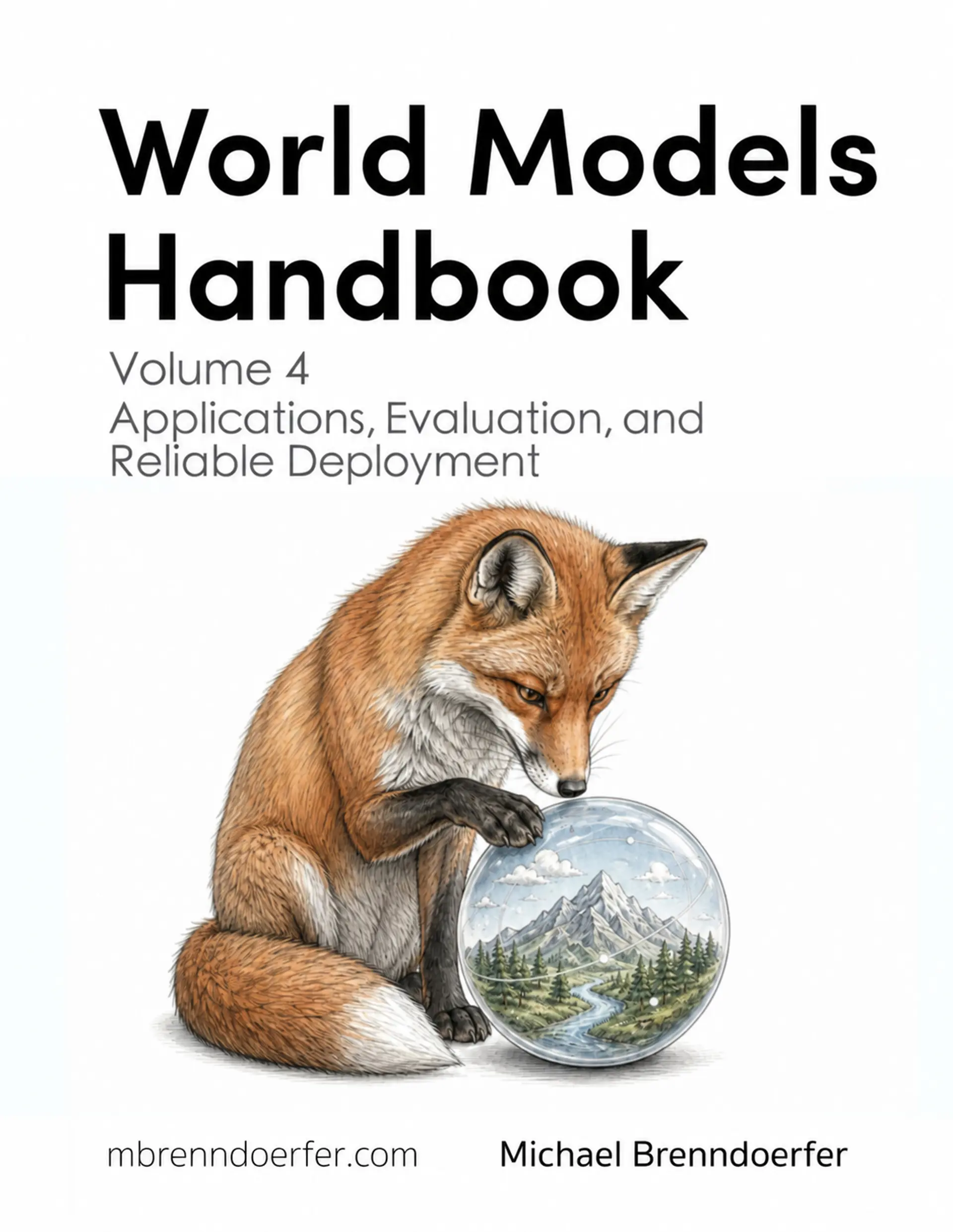
Applications, Evaluation, and Reliable Deployment
Evaluate world models in applications and under distribution shift, then design deployment safeguards around the failures a planner can exploit.
Part of World Models Handbook. The online chapters are free to read; the PDF edition is yours to keep, with future updates included.
Build the understanding to reason about world models.
Learn how a system can represent its environment and use predictions to make decisions. The handbook connects the underlying ideas to architectures, planning methods, and evaluation, helping you reason about what a world model can do and where its limits lie.
See what you’ll learnWhat you will learn
- Match evaluation evidence to an application's decision requirements.
- Diagnose uncertainty, interpretability, and model-exploitation failures.
- Design infrastructure, safety controls, and sim-to-real validation.
Who this volume is for
- AI and robotics engineers, researchers, graduate students, reinforcement learning practitioners, and technically curious readers who want a coherent path from foundational state estimation and control to modern generative world models.
Prerequisites: Familiarity with model-based planning and evaluation. Read Volume 3 for the systems and planning methods used in the examples.
Volume 4 PDF + code
Own this 713-page edition
Keep the PDF and companion notebooks for offline reading, with future updates included. The corresponding chapters stay free online.
- Carefully typeset PDF
- Companion notebooks included
- Future updates and errata included
- Online chapters remain free to read
Volume 4 of 4 · Available now
$29
one-timeVersion 2026.10.0 · 713 pages · secure checkout via Stripe
Delivered by email · Free updates included
Want the complete library?
Access to every volume, delivered as separate PDFs. Companion notebooks included. Save $37 vs. buying available volumes separately.
Get all-volume access · $79On Michael’s writing
Feedback on Michael’s writing
Genuine feedback, with names abbreviated for privacy.
These comments concern Michael’s online writing and other handbooks, not this new PDF edition.
Meet the community“I am enjoying reading your writings. I appreciate the effort you put into it. I want to drop a note of thanks. Thank you!”
“I would like to thank you for your work. Specifically, the chapter: 'LIME Explainability: Complete Guide to Local Interpretable Model-Agnostic Explanations' was extremely helpful for me in understanding LIME and communicating to colleagues. Your work is inspiring and valuable. Thank you for doing it.”
“I just came across your website where your books are available for free to read. Thank you so much for making this available to the public. This will help a lot of people.”
“I found your book Language AI Handbook's explanations of Transformer architectures and production deployment strategies to be exceptionally clear and insightful”
“Your writing feels like a treasure trove of great material. So, thank you for compiling everything on your website!”
“Really appreciate the way you have explained the concepts. Simple to understand, yet builds up knowledge exponentially, all while reinforcing it with examples repeatedly. I've read the last two chapters `74.Self-attention & 75.Q,K,V` and I've to admit, my concepts have never been clearer. You really are doing an amazing job breaking down maths and complex concepts like a story!”
“Thank you Michael. It's top!”
“I read a few of your blogs on NLP and oh WOW, they really are something, now I exactly know how all of the terms Entropy, Cross-entropy and how it is connected to Perplexity, will definitely read more of your blogs.”
“I came across your collection of online handbooks covering quantitative finance, AI, and machine learning. I wanted to reach out and thank you for making such high-quality material openly available. They are incredibly helpful for my CFA Level II review and for brushing up ahead of ML interviews.”
“Thanks so much for establishing such an amazing community. I appreciate the opportunity to be a learner and a contributor to the community.”
“Thanks for putting cool stuff out into the world.”
“I came across one of your books, Language AI Handbook, and man, I'm loving it. I've read many books but have never found such a comprehensive book on large models that covers everything from start to finish with such depth.”
Read all 12 reader reviews
“I would like to thank you for your work. Specifically, the chapter: 'LIME Explainability: Complete Guide to Local Interpretable Model-Agnostic Explanations' was extremely helpful for me in understanding LIME and communicating to colleagues. Your work is inspiring and valuable. Thank you for doing it.”
“Really appreciate the way you have explained the concepts. Simple to understand, yet builds up knowledge exponentially, all while reinforcing it with examples repeatedly. I've read the last two chapters `74.Self-attention & 75.Q,K,V` and I've to admit, my concepts have never been clearer. You really are doing an amazing job breaking down maths and complex concepts like a story!”
“Thanks so much for establishing such an amazing community. I appreciate the opportunity to be a learner and a contributor to the community.”
“I just came across your website where your books are available for free to read. Thank you so much for making this available to the public. This will help a lot of people.”
“I am enjoying reading your writings. I appreciate the effort you put into it. I want to drop a note of thanks. Thank you!”
“Thank you Michael. It's top!”
“Thanks for putting cool stuff out into the world.”
“I found your book Language AI Handbook's explanations of Transformer architectures and production deployment strategies to be exceptionally clear and insightful”
“Your writing feels like a treasure trove of great material. So, thank you for compiling everything on your website!”
“I came across your collection of online handbooks covering quantitative finance, AI, and machine learning. I wanted to reach out and thank you for making such high-quality material openly available. They are incredibly helpful for my CFA Level II review and for brushing up ahead of ML interviews.”
“I read a few of your blogs on NLP and oh WOW, they really are something, now I exactly know how all of the terms Entropy, Cross-entropy and how it is connected to Perplexity, will definitely read more of your blogs.”
“I came across one of your books, Language AI Handbook, and man, I'm loving it. I've read many books but have never found such a comprehensive book on large models that covers everything from start to finish with such depth.”
Exact contents
18 chapters across 3 parts
Every linked chapter is free to read online.
Part X: Application Domains
- 01Games and Learned Game Engines
Develops the topic through Atari, board games, and open worlds, learned simulators and playable generation, long-horizon consistency and rules, and agents trained inside generated games.
- 02Robotic Manipulation
Develops the topic through object state and contact-rich dynamics, grasping, pushing, and dexterous control, visual foresight and action-conditioned video, and task planning with learned affordances.
- 03Locomotion, Humanoids, and Navigation
Develops the topic through body dynamics and terrain interaction, whole-body control, spatial memory and goal navigation, and cross-embodiment and sim-to-real transfer.
- 04Autonomous Driving
Develops the topic through bird's-eye-view and occupancy state, other-agent behavior prediction, closed-loop driving simulation, and rare events, safety, and planning.
- 05Digital and Software Environments
Develops the topic through web, desktop, and code execution state, GUI and API transition models, long-horizon task simulation, and verifiable actions and environment feedback.
- 06Scientific, Medical, and Social Worlds
Develops the topic through molecular, climate, and materials dynamics, physiology and treatment response, economic and social simulation, and domain constraints, uncertainty, and misuse risk.
Part XI: Evaluation and Understanding
- 01The World-Model Evaluation Ladder
Develops the topic through one-step prediction, open-loop rollout, counterfactual intervention, and closed-loop planning and transfer.
- 02Perceptual and Generative Evaluation
Develops the topic through reconstruction and predictive accuracy, perceptual quality and distributional metrics, diversity, sharpness, and multimodality, and human judgment and learned evaluators.
- 03State, Physics, Causality, and Memory Evaluation
Develops the topic through state probing and representation quality, object permanence and temporal consistency, physical rule and constraint tests, and interventions, counterfactuals, and causal fidelity.
- 04Planning, Control, and Policy Evaluation
Develops the topic through task return and sample efficiency, planning horizon and compute tradeoffs, model exploitation and policy ranking, and zero-shot, few-shot, and cross-domain transfer.
- 05Datasets, Benchmarks, and Experimental Design
Develops the topic through benchmark taxonomies and coverage, train-test leakage and dataset shift, ablations, baselines, and statistical power, and reproducibility and compute reporting.
- 06Interpretability and World-Model Debugging
Develops the topic through latent probes and concept analysis, rollout visualization and error localization, causal interventions on representations, and distinguishing perception, dynamics, and planner failures.
Part XII: Reliable World Models
- 01Failure Modes and Model Exploitation
Develops the topic through compounding rollout error, model bias and objective misspecification, planner exploitation and adversarial trajectories, and state aliasing, forgetting, and hallucinated dynamics.
- 02Robustness, Calibration, and Safe Control
Develops the topic through distribution shift and stress testing, calibrated uncertainty and abstention, risk-sensitive and constrained planning, and fallback policies and runtime assurance.
- 03Security, Ethics, Privacy, and Governance
Develops the topic through data poisoning and model extraction, privacy in recorded environments, dual-use simulation and deceptive affordances, and documentation, access control, and accountability.
- 04Training and Inference Systems
Develops the topic through distributed training and sequence parallelism, data, checkpoint, and experiment infrastructure, rollout serving, caching, and batching, and latency, memory, and energy optimization.
- 05Sim-to-Real Deployment and Continual Correction
Develops the topic through reality gaps and domain randomization, hardware-in-the-loop validation, online monitoring and residual correction, and safe data collection and update policies.
- 06Frontier Questions and Research Roadmaps
Develops the topic through general-purpose versus embodiment-specific worlds, causal, compositional, and persistent memory, evaluation beyond visual prediction, and open research programs and practical project paths.
Choose the edition that fits your next step
Volume 4: Applications, Evaluation, and Reliable Deployment
713 pages focused on this subject, with future updates included.
$29
Choose this volumeThe complete World Models Handbook library
All-volume access with separate volume PDFs and future updates. No combined PDF.
$79
Get all-volume accessExplore the other volumes
Volume 1 · 608 pages
Foundations, Control, and Representations
The World-Model Idea · Inference, Decisions, and Control · Representing Agents and Worlds
Volume 2 · 637 pages
Physics, Architectures, and Learning
Space, Physics, and Causality · World-Model Architectures · Learning World Models at Scale

Volume 3 · 701 pages
Planning, Research Lineages, and Foundation Models
Planning and Agency · Decision-Centric Research Lineages · Foundation and World-Action Models
Author and edition details
About the author and this edition

Michael Brenndoerfer
Michael has spent more than a decade working across software engineering, data, AI, and business. He writes to understand difficult ideas more deeply and to share what he learns in a clear, practical way.
- Edition
- First edition
- Published
- Last reviewed
Version history
Kept current, not frozen in time
Library access includes every future volume and update. When a volume changes, its updated PDF appears in My books at no extra cost.
Current release
Edition 2026.10.0
First edition: 72 chapters across four standalone volume PDFs, with executable companion notebooks and perpetual updates.