Text Preprocessing: Tokenization
Transform raw text into structured data through tokenization, normalization, and cleaning techniques.
Text Preprocessing: Tokenization › Text PreprocessingFull chapter · Sections in this article1 / 8 ↓
Reading tools Definitions & inline links
Choose your expertise level to adjust how many terms are explained. Beginners see more tooltips, experts see fewer to maintain reading flow. Hover over underlined terms for instant definitions.
Article links
Make inline references clickable
Text Preprocessing
Text preprocessing turns raw, messy human language into a structured format that computational models can work with. Before any machine learning model can use text, whether it's a simple bag-of-words classifier or a sophisticated transformer, the text must be broken down into meaningful units, cleaned of noise, and normalized into a consistent form.
The challenge of text preprocessing stems from the inherent messiness of natural language. Consider a simple sentence like "The cat's sitting on the mat..." A human instantly recognizes this as seven meaningful words, but a computer sees a sequence of 30 characters including spaces, punctuation, and contractions. How should we handle the apostrophe in "cat's"? Is it one word or two? Should we treat "sitting" and "sit" as the same concept? What about the ellipsis, are those three separate periods or a single punctuation mark?
Text preprocessing addresses these questions through a series of transformations: tokenization breaks text into individual units, normalization standardizes variations of the same concept, and cleaning removes irrelevant information. Together, these techniques transform the continuous stream of characters that is human language into discrete, structured data that algorithms can process.
Unlike feature engineering in computer vision, where raw pixel values can often be fed directly into models, text requires more aggressive preprocessing. The vocabulary of natural language is enormous, the meaning of words depends heavily on context, and the same concept can be expressed in countless ways. Effective preprocessing reduces this complexity while preserving the information needed for downstream tasks.
Why Preprocessing Matters
The quality of your preprocessing pipeline directly impacts the performance of your NLP models. A well-designed pipeline can significantly reduce vocabulary size, improve generalization, and make training more efficient. For example, converting "running," "runs," and "ran" to their common root "run" helps a model recognize that these words share semantic meaning, even if it has never seen one particular form in training.
Poor preprocessing, on the other hand, can introduce noise and obscure important patterns. Aggressive stemming might conflate unrelated words like "university" and "universe." Removing all punctuation might lose important sentiment cues, as "great!" expresses more enthusiasm than "great." Effective preprocessing requires finding the right balance between simplification and information preservation for your specific task.
Different NLP tasks require different preprocessing strategies. Machine translation systems benefit from minimal preprocessing to preserve linguistic structure. Sentiment analysis might keep punctuation and capitalization for emotional cues. Document classification often uses aggressive normalization to reduce vocabulary size. Understanding these tradeoffs is essential for building effective NLP systems.
The Evolution of Text Preprocessing
Text preprocessing techniques have evolved dramatically alongside NLP methods. Early rule-based systems relied heavily on hand-crafted preprocessing pipelines with extensive dictionaries and linguistic rules. The statistical revolution of the 1990s brought simpler, more robust approaches like lowercase normalization and Porter stemming that worked across languages with minimal customization.
The deep learning era has blurred the lines of preprocessing. Modern transformers like BERT use subword tokenization methods that handle unknown words gracefully, reducing the need for aggressive normalization. Some recent models even process raw character sequences, learning their own internal representations of morphology and word boundaries. However, even these sophisticated models benefit from thoughtful preprocessing, particularly for dealing with noise in real-world text data.
Core Preprocessing Techniques
Imagine you're teaching a computer to read. Unlike humans who instantly recognize words, sentences, and meaning, computers see text as nothing more than a sequence of characters. The sentence "The cat's sitting on the mat" appears to a computer as 30 characters: letters, spaces, an apostrophe, and a period. Before any machine learning model can understand this text, we must transform it from a continuous stream of characters into discrete, meaningful units that algorithms can process.
This transformation is the essence of text preprocessing, and it requires answering three fundamental questions:
- How do we break text into meaningful units? Where do words begin and end? How do we handle punctuation, contractions, and special cases?
- How do we handle variation? "Running," "running," and "RUNNING" represent the same concept but appear as different strings. How do we standardize these variations?
- What should we remove? Real-world text contains noise: HTML tags, URLs, typos, and formatting artifacts. What information is essential, and what can we safely discard?
These questions lead us to three core preprocessing operations: tokenization breaks text into discrete units, normalization standardizes variations, and cleaning removes noise. But understanding these techniques requires more than memorizing definitions. We need to grasp why each operation is necessary and how they work together to transform messy human language into structured data that models can learn from.
Let's build this understanding step by step, starting with the most fundamental question: how do we identify where one word ends and another begins?
Tokenization: Breaking Text Into Units
Tokenization answers our first fundamental question: how do we break continuous text into discrete, meaningful units? This is the foundation of all text processing because you cannot normalize, clean, or analyze text until you've identified its basic building blocks.
Think of tokenization like cutting a loaf of bread into slices. The loaf is the continuous text string, and each slice is a token, a discrete unit we can work with. But here's the challenge: unlike bread, text doesn't have natural "cut lines." Where exactly should we split "don't"? Is it one word or two? Should "U.S.A." be one token or three? These ambiguities force us to make decisions that affect everything downstream.
Why tokenization matters: Without tokenization, we can't count word frequencies, build vocabularies, or apply any statistical or machine learning techniques. A model that sees "The cat's sitting" as 30 characters has no way to learn that "cat" and "sitting" are meaningful units. Tokenization transforms the problem from "understanding 30 characters" to "understanding 7 tokens," dramatically reducing complexity.
The challenge of tokenization lies in ambiguity. Spaces seem like obvious delimiters in English, but they're insufficient for handling:
- Contractions like "don't" (one word or two?)
- Hyphenated words like "state-of-the-art" (one word or four?)
- Punctuation: should "mat." be "mat" + "." or just "mat."?
- Special cases: URLs, email addresses, abbreviations
Different languages compound these challenges: Chinese and Japanese don't use spaces between words, German creates long compound words, and Arabic uses diacritical marks that may or may not be present.
The progression of tokenization methods: We'll explore tokenization by starting with the simplest approach and progressively building more sophisticated methods. Each method solves some problems while introducing new tradeoffs, teaching us what's truly necessary for robust text processing.
A token is a discrete unit of text used in NLP processing. Tokens are typically words, but can also be punctuation marks, numbers, subwords, or any meaningful unit depending on the tokenization strategy.
The most naive approach simply splits text on whitespace characters (spaces, tabs, newlines). This works surprisingly well for English text that has already been cleaned, but fails on several common cases:
text = "The cat's sitting on the mat."
tokens = text.split()
print(tokens)['The', "cat's", 'sitting', 'on', 'the', 'mat.']
Notice that "cat's" remains as a single token with the apostrophe, and "mat." includes the period. For many applications, we want to separate these punctuation marks as distinct tokens.
Punctuation-Aware Tokenization
A more robust approach treats punctuation as separate tokens. We can use regular expressions to split on word boundaries while keeping punctuation:
import re

text = "The cat's sitting on the mat."
tokens = re.findall(r"\w+|[^\w\s]", text)
print(tokens)['The', 'cat', "'", 's', 'sitting', 'on', 'the', 'mat', '.']
This pattern \w+|[^\w\s] matches sequences of word characters or individual non-whitespace, non-word characters. The apostrophe and period are now separated, but we've lost the distinction between "cat's" as a possessive and other uses of apostrophes.
Linguistic Tokenization
Production NLP systems typically use linguistic tokenizers that understand language-specific rules. These tokenizers know that "don't" should become "do" and "n't," that "U.S.A." is a single token despite the periods, and that URLs should remain intact. Libraries like NLTK and spaCy provide industrial-strength tokenizers:
import nltk

nltk.download("punkt_tab", quiet=True)
nltk.download("punkt", quiet=True)

text = (
    "Dr. Smith doesn't work at U.S.A. Inc. anymore. Visit https://example.com!"
)
tokens = nltk.word_tokenize(text)
print(tokens)['Dr.', 'Smith', 'does', "n't", 'work', 'at', 'U.S.A.', 'Inc.', 'anymore', '.', 'Visit', 'https', ':', '//example.com', '!']
Notice how "Dr." stays together, "doesn't" splits into "does" + "n't", and the URL remains intact. These tokenizers use trained models and hand-crafted rules to handle thousands of edge cases.
Modern deep learning models often use subword tokenization methods like Byte-Pair Encoding (BPE) or WordPiece. These methods split rare words into common subword units, handling unknown words gracefully while keeping vocabulary size manageable:
## Example conceptual breakdown (actual BPE requires trained vocabulary)
## "unbelievable" might become: ["un", "believ", "able"]
## "unhappiness" might become: ["un", "happiness"]
The key insight is that morphological patterns (prefixes like "un-", suffixes like "-able") appear across many words. By learning these subword units from data, models can understand rare or novel words by composing their parts. This is how BERT and GPT handle words they've never seen before.
Normalization: Reducing Variation
Once we've tokenized our text, we've solved the problem of identifying word boundaries. But we've created a new problem: vocabulary explosion. Consider what happens when we tokenize a simple sentence:
- "The cat runs" → ["The", "cat", "runs"]
- "The cat ran" → ["The", "cat", "ran"]
- "The CAT RUNS" → ["The", "CAT", "RUNS"]
To a computer, these are completely different tokens. "runs," "ran," and "RUNS" are treated as three distinct words, even though they represent the same concept. This variation creates several problems:
-
Vocabulary size explosion: Instead of learning one representation for "run," a model must learn separate representations for "run," "runs," "ran," "running," "RUN," "RUNS," etc. This wastes model capacity and training data.
-
Data sparsity: With more unique tokens, each token appears less frequently. Rare tokens have unreliable statistics, making it harder for models to learn meaningful patterns.
-
Generalization failure: A model trained on "running" might not recognize "runs" as related, even though they're linguistically connected.
Normalization solves this by mapping variations to canonical forms. Instead of treating "running," "runs," and "RUNNING" as different tokens, normalization reduces them to a common representation. This decreases vocabulary size, increases token frequency, and helps models recognize that morphologically related words share meaning.
But normalization is a tradeoff: we gain efficiency and generalization at the cost of losing information. "EXCITED!!!" conveys more emotion than "excited," and "Apple" (the company) differs from "apple" (the fruit). Understanding when to normalize and how aggressively is crucial for building effective NLP systems.
Case Normalization
The simplest normalization converts all text to lowercase. This reduces vocabulary size by treating "The," "the," and "THE" as identical:
tokens = ["The", "Cat", "SLEEPS"]
normalized = [token.lower() for token in tokens]
print(normalized)['the', 'cat', 'sleeps']
Case normalization is almost universal in NLP, but consider your task carefully. For sentiment analysis, "EXCITED!!!" conveys more emotion than "excited." For named entity recognition, "Apple" (the company) differs from "apple" (the fruit). Modern transformer models often preserve case and learn case-sensitive representations, capturing these nuances.
Stemming: Crude But Fast
Stemming algorithms use heuristic rules to chop off word endings, reducing words to their approximate root form. The Porter Stemmer, developed in 1980, remains widely used despite its crudeness:
from nltk.stem import PorterStemmer

stemmer = PorterStemmer()
words = ["running", "runs", "ran", "runner", "easily", "fairly"]
stems = [stemmer.stem(word) for word in words]
print(list(zip(words, stems)))[('running', 'run'), ('runs', 'run'), ('ran', 'ran'), ('runner', 'runner'), ('easily', 'easili'), ('fairly', 'fairli')]Notice the issues: "ran" doesn't reduce to "run" because it's irregular, "runner" stays unchanged, and "easily" becomes the non-word "easili." Stemming is fast and language-independent, but produces non-words and misses linguistic relationships.
Stemming is the process of reducing words to their root form by removing suffixes using heuristic rules. Unlike lemmatization, stemming produces stems that may not be valid words, prioritizing speed and simplicity over linguistic accuracy.
Lemmatization: Linguistically Informed
Lemmatization uses vocabulary and morphological analysis to return words to their dictionary form (lemma). It's slower than stemming but more accurate:
from nltk.stem import WordNetLemmatizer

nltk.download("wordnet", quiet=True)
nltk.download("omw-1.4", quiet=True)

lemmatizer = WordNetLemmatizer()
words = ["running", "runs", "ran", "better", "was"]
lemmas = [lemmatizer.lemmatize(word, pos="v") for word in words]
print(list(zip(words, lemmas)))[('running', 'run'), ('runs', 'run'), ('ran', 'run'), ('better', 'better'), ('was', 'be')]Lemmatization correctly handles irregular verbs like "ran" → "run" and "was" → "be," but requires knowing the part-of-speech (verb, noun, adjective) for accurate results. This makes it more expensive but linguistically sound.
Lemmatization is the process of reducing words to their base dictionary form (lemma) using vocabulary knowledge and morphological analysis. Unlike stemming, lemmatization produces valid words and handles irregular forms correctly, but requires more computational resources and linguistic knowledge.
When to Normalize
The tradeoff between stemming and lemmatization mirrors a broader question: how much normalization is appropriate? Aggressive normalization reduces vocabulary size and improves generalization but loses information. For small datasets and simple models like Naive Bayes, aggressive normalization helps by reducing sparsity. For large datasets and neural models, minimal normalization often works better because models can learn morphological patterns from data.
Modern pretrained transformers like BERT often use subword tokenization instead of stemming or lemmatization. Their WordPiece vocabulary naturally handles morphology: "running" might tokenize as ["run", "##ning"], allowing the model to learn that words ending in "##ning" relate to their base form.
Cleaning: Removing Noise
After tokenization and normalization, we have discrete, standardized tokens. But real-world text contains more than just words. It's filled with noise: formatting artifacts, non-linguistic content, and encoding inconsistencies that don't contribute to meaning but can confuse models and waste computational resources.
Why cleaning matters: Consider what happens when we process web-scraped text. A sentence like "Check out this site: https://example.com!" contains:
- HTML tags (
<b>,</b>) that are formatting instructions, not linguistic content - A URL that's a reference, not a word
- Punctuation that may or may not be meaningful
If we don't clean this text, our tokenizer might create tokens like <b>, </b>, https://example.com, which:
- Add noise to our vocabulary without contributing semantic meaning
- Waste model capacity learning patterns in formatting artifacts
- Create spurious correlations (e.g., learning that
<b>appears near certain words)
The cleaning challenge: Cleaning requires deciding what's signal versus noise, and this decision is task-dependent. For sentiment analysis, emojis and punctuation intensity markers (like "!!!") are crucial signals. For document classification, they might be noise. For medical text, numbers are essential; for topic modeling, they might be irrelevant.
Cleaning techniques remove:
- Formatting artifacts: HTML tags, markdown, special characters
- Non-linguistic content: URLs, email addresses, phone numbers (depending on task)
- Encoding inconsistencies: Unicode normalization, character encoding issues
- High-frequency noise: Stopwords (words like "the," "is" that appear everywhere but carry little semantic information for many tasks)
The key insight is that cleaning is about selective removal. We remove what doesn't help our specific task while preserving what does. This requires understanding both your data and your downstream application.
Stopword Removal
Stopwords are high-frequency words like "the," "is," "at," and "which" that occur in nearly every document but carry little semantic information for many tasks. Removing them reduces feature space dramatically:
from nltk.corpus import stopwords

nltk.download("stopwords", quiet=True)

stop_words = set(stopwords.words("english"))
tokens = ["the", "cat", "is", "sitting", "on", "the", "mat"]
filtered = [word for word in tokens if word not in stop_words]
print(filtered)['cat', 'sitting', 'mat']
Stopwords are high-frequency words that carry little semantic information for certain NLP tasks. Common examples include articles ("the", "a"), prepositions ("on", "at"), and auxiliary verbs ("is", "have"). Removing stopwords reduces dimensionality but may hurt performance on tasks where these words matter.
However, stopword removal is controversial. For document classification, removing stopwords improves efficiency without hurting accuracy. For semantic similarity or machine translation, stopwords provide crucial grammatical structure. The phrase "not good" means something very different from "good," but "not" is often in stopword lists.
Modern neural models rarely use stopword removal. Attention mechanisms in transformers learn to ignore uninformative words automatically, and the computational cost of a few extra tokens is negligible. Stopword removal remains useful primarily for classical methods like TF-IDF where vocabulary size directly impacts memory usage.
Handling Special Characters and Noise
Web text requires aggressive cleaning to remove HTML tags, URLs, email addresses, and other non-linguistic content:
import re


def clean_text(text):
    # Remove HTML tags
    text = re.sub(r"<[^>]+>", "", text)
    # Remove URLs
    text = re.sub(r"http\S+|www.\S+", "", text)
    # Remove email addresses
    text = re.sub(r"\S+@\S+", "", text)
    # Remove numbers (optional, depends on task)
    text = re.sub(r"\d+", "", text)
    # Remove extra whitespace
    text = re.sub(r"\s+", " ", text).strip()
    return text


messy = "Check out <b>this</b> site: https://example.com! Email me at test@email.com for 50% off!"
cleaned = clean_text(messy)
print(cleaned)Check out this site: Email me at for % off!
Be cautious with aggressive cleaning. For social media sentiment analysis, emojis and emoticons carry emotional content. For medical text, numbers matter. For code documentation, URLs to API references may need to stay. Always consider your specific task when deciding what to remove.
Character Normalization
Text from different sources may use different character encodings or representations. Unicode normalization ensures consistent representation:
import unicodedata

# Different representations of "é"
text1 = "café"  # é as single character (U+00E9)
text2 = "café"  # é as e + combining accent (U+0065 + U+0301)

print(f"Are they equal? {text1 == text2}")  # False - different byte sequences

# Normalize to composed form (NFC)
norm1 = unicodedata.normalize("NFC", text1)
norm2 = unicodedata.normalize("NFC", text2)
print(f"After normalization: {norm1 == norm2}") # TrueAre they equal? True After normalization: True
This is particularly important for multilingual text where the same visual character can have multiple Unicode representations.
Building a Preprocessing Pipeline
We've now explored the three core preprocessing operations: tokenization breaks text into units, normalization reduces variation, and cleaning removes noise. But understanding individual techniques isn't enough. We need to combine them into a cohesive pipeline that turns raw, messy text into clean, structured tokens ready for machine learning models.
Why pipelines matter: Each preprocessing technique solves a specific problem, but they work together to solve the larger challenge of making human language computable. Tokenization must happen first (you can't normalize or clean what you haven't identified), but the order of normalization and cleaning depends on your task.
The pipeline as a transformation chain: Think of preprocessing as a series of transformations, each building on the previous one:
- Raw text → (tokenization) → Tokens
- Tokens → (normalization) → Normalized tokens
- Normalized tokens → (cleaning) → Clean, normalized tokens
But this linear view is too simplistic. In practice, some cleaning happens before tokenization (removing HTML), some normalization happens during tokenization (handling contractions), and the exact sequence depends on your task requirements.
Let's build a complete preprocessing pipeline that demonstrates how these techniques work together, and then explore how different configurations affect the same input text.
Pipeline Design Principles
A preprocessing pipeline should be:
- Modular: Each step is a separate function that can be enabled, disabled, or reordered
- Reproducible: The same input always produces the same output
- Efficient: Expensive operations are applied only when necessary
- Transparent: Easy to inspect intermediate results for debugging
We'll create a TextPreprocessor class that accepts configuration options and applies preprocessing steps in sequence. The key insight is that different tasks require different combinations of techniques, so the pipeline should be configurable rather than fixed.
import re
import string
import nltk
from nltk.tokenize import word_tokenize
from nltk.corpus import stopwords
from nltk.stem import WordNetLemmatizer
import unicodedata

# Download required NLTK data
nltk.download("punkt_tab", quiet=True)
nltk.download("punkt", quiet=True)
nltk.download("stopwords", quiet=True)
nltk.download("wordnet", quiet=True)
nltk.download("omw-1.4", quiet=True)


class TextPreprocessor:
    """Flexible text preprocessing pipeline with configurable steps."""

    def __init__(
        self,
        lowercase=True,
        remove_punctuation=True,
        remove_numbers=False,
        remove_stopwords=True,
        lemmatize=True,
        remove_urls=True,
        remove_html=True,
        min_token_length=2,
    ):
        self.lowercase = lowercase
        self.remove_punctuation = remove_punctuation
        self.remove_numbers = remove_numbers
        self.remove_stopwords = remove_stopwords
        self.lemmatize = lemmatize
        self.remove_urls = remove_urls
        self.remove_html = remove_html
        self.min_token_length = min_token_length

        self.stop_words = set(stopwords.words("english"))
        self.lemmatizer = WordNetLemmatizer()
        self.punct_pattern = re.compile(f"[{re.escape(string.punctuation)}]")

    def normalize_unicode(self, text):
        return unicodedata.normalize("NFC", text)

    def clean_html(self, text):
        if self.remove_html:
            text = re.sub(r"<[^>]+>", "", text)
        return text

    def clean_urls(self, text):
        if self.remove_urls:
            text = re.sub(r"http\S+|www\.\S+", "", text)
        return text

    def normalize_whitespace(self, text):
        return re.sub(r"\s+", " ", text).strip()

    def tokenize(self, text):
        return word_tokenize(text)

    def process_tokens(self, tokens):
        processed = []
        for token in tokens:
            if self.lowercase:
                token = token.lower()
            if self.remove_punctuation:
                token = self.punct_pattern.sub("", token)
            if self.remove_numbers:
                token = re.sub(r"\d+", "", token)
            if len(token) < self.min_token_length:
                continue
            if self.remove_stopwords and token in self.stop_words:
                continue
            if self.lemmatize:
                token = self.lemmatizer.lemmatize(token, pos="v")
                token = self.lemmatizer.lemmatize(token, pos="n")
            processed.append(token)
        return processed

    def preprocess(self, text):
        """Apply full preprocessing pipeline to text."""
        text = self.normalize_unicode(text)
        text = self.clean_html(text)
        text = self.clean_urls(text)
        text = self.normalize_whitespace(text)
        tokens = self.tokenize(text)
        tokens = self.process_tokens(tokens)
        return tokens

    def preprocess_batch(self, texts):
        """Preprocess a batch of texts."""
        return [self.preprocess(text) for text in texts]
Pipeline in Action
Let's see how different configurations affect the same input text. We'll test three strategies on a technical sentence containing HTML, URLs, and mixed formatting:
# Sample text with various challenging elements
text = """
<p><b>K-means Clustering Algorithm</b></p>
<p>The running time of K-means is O(n*k*t) where n=1000, k=5, t=10 iterations!</p>
<p>Visit https://scikit-learn.org/stable/modules/clustering.html for implementation details.</p>
<p>It's REALLY fast... MUCH faster than hierarchical clustering (O(n²) vs O(n*k*t)).</p>
<p>Contact: researcher@example.com or call 555-1234 for questions.</p>
<p>The algorithm's performance is AMAZING!!! It handles datasets with 10,000+ points efficiently.</p>
<p>Don't forget: preprocessing matters! The data should be normalized before clustering.</p>
"""

# Configuration 1: Minimal preprocessing (for transformers)
preprocessor_minimal = TextPreprocessor(
    lowercase=True,
    remove_punctuation=False,
    remove_numbers=False,
    remove_stopwords=False,
    lemmatize=False,
    remove_urls=True,
    remove_html=True,
    min_token_length=1,
)

# Configuration 2: Aggressive preprocessing (for classical models)
preprocessor_aggressive = TextPreprocessor(
    lowercase=True,
    remove_punctuation=True,
    remove_numbers=True,
    remove_stopwords=True,
    lemmatize=True,
    remove_urls=True,
    remove_html=True,
    min_token_length=3,
)

# Configuration 3: Balanced preprocessing
preprocessor_balanced = TextPreprocessor(
    lowercase=True,
    remove_punctuation=True,
    remove_numbers=False,
    remove_stopwords=True,
    lemmatize=True,
    remove_urls=True,
    remove_html=True,
    min_token_length=2,
)

# Compare results
results = {
    "Minimal": preprocessor_minimal.preprocess(text),
    "Aggressive": preprocessor_aggressive.preprocess(text),
    "Balanced": preprocessor_balanced.preprocess(text),
}

for strategy, tokens in results.items():
    print(f"{strategy}: {tokens}")
print(f"Token count: {len(tokens)}\n")Minimal: ['k-means', 'clustering', 'algorithm', 'the', 'running', 'time', 'of', 'k-means', 'is', 'o', '(', 'n', '*', 'k', '*', 't', ')', 'where', 'n=1000', ',', 'k=5', ',', 't=10', 'iterations', '!', 'visit', 'for', 'implementation', 'details', '.', 'it', "'s", 'really', 'fast', '...', 'much', 'faster', 'than', 'hierarchical', 'clustering', '(', 'o', '(', 'n²', ')', 'vs', 'o', '(', 'n', '*', 'k', '*', 't', ')', ')', '.', 'contact', ':', 'researcher', '@', 'example.com', 'or', 'call', '555-1234', 'for', 'questions', '.', 'the', 'algorithm', "'s", 'performance', 'is', 'amazing', '!', '!', '!', 'it', 'handles', 'datasets', 'with', '10,000+', 'points', 'efficiently', '.', 'do', "n't", 'forget', ':', 'preprocessing', 'matters', '!', 'the', 'data', 'should', 'be', 'normalized', 'before', 'clustering', '.']
Token count: 99
Aggressive: ['kmeans', 'cluster', 'algorithm', 'run', 'time', 'kmeans', 'iteration', 'visit', 'implementation', 'detail', 'really', 'fast', 'much', 'faster', 'hierarchical', 'cluster', 'contact', 'researcher', 'examplecom', 'call', 'question', 'algorithm', 'performance', 'amaze', 'handle', 'datasets', 'point', 'efficiently', 'forget', 'preprocessing', 'matter', 'data', 'normalize', 'cluster']
Token count: 34
Balanced: ['kmeans', 'cluster', 'algorithm', 'run', 'time', 'kmeans', 'n1000', 'k5', 't10', 'iteration', 'visit', 'implementation', 'detail', 'really', 'fast', 'much', 'faster', 'hierarchical', 'cluster', 'n²', 'v', 'contact', 'researcher', 'examplecom', 'call', '5551234', 'question', 'algorithm', 'performance', 'amaze', 'handle', 'datasets', '10000', 'point', 'efficiently', 'nt', 'forget', 'preprocessing', 'matter', 'data', 'normalize', 'cluster']
Token count: 42Notice how different configurations produce dramatically different outputs:
- Minimal: Keeps punctuation and stopwords, preserving sentence structure for contextualized models
- Aggressive: Reduces to just content words, minimizing vocabulary for classical models
- Balanced: Middle ground that keeps numbers (important for technical text) while removing noise
Visualizing Preprocessing Effects
Let's create a visualization that shows how preprocessing affects vocabulary size and token distribution across different configurations:
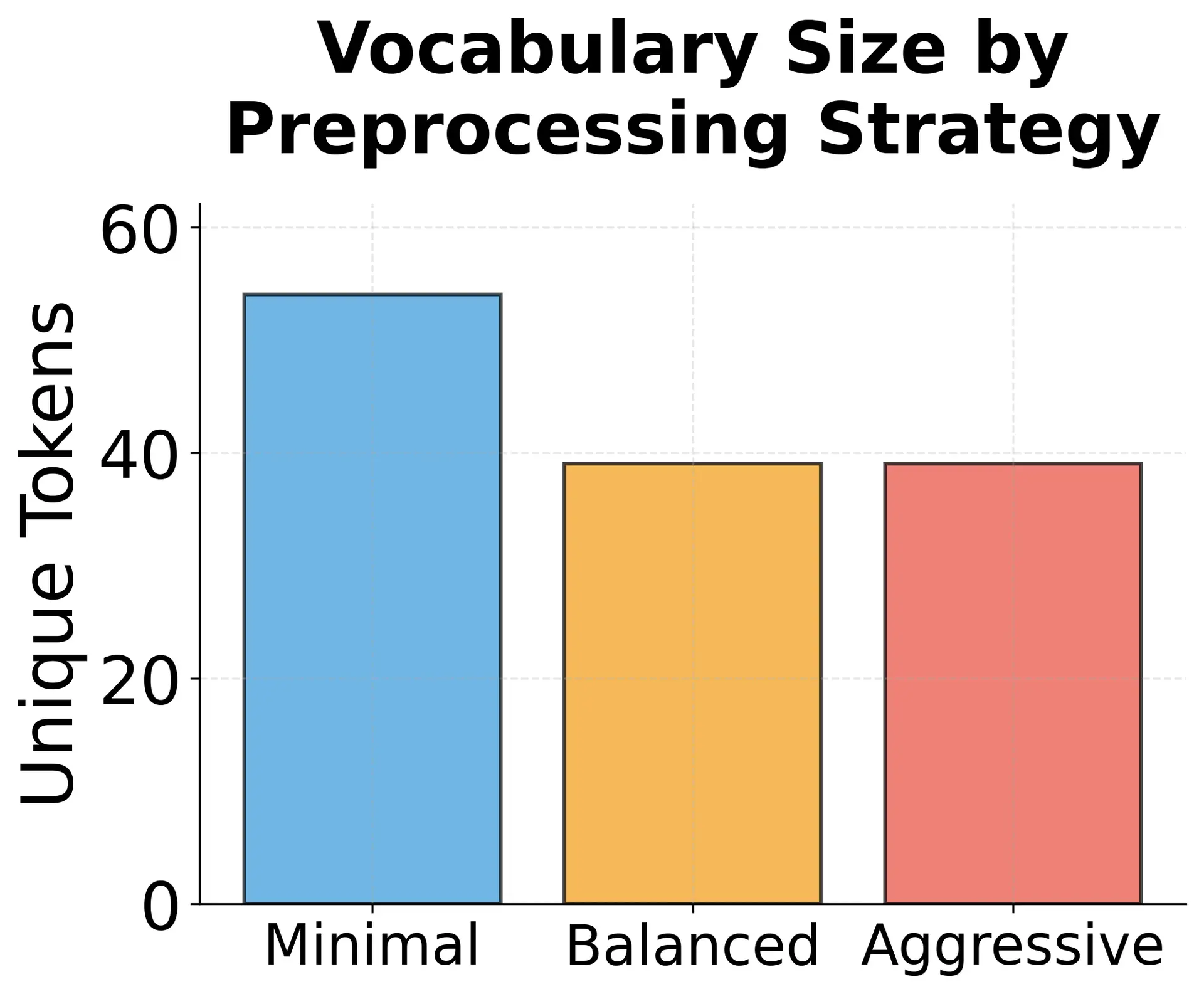
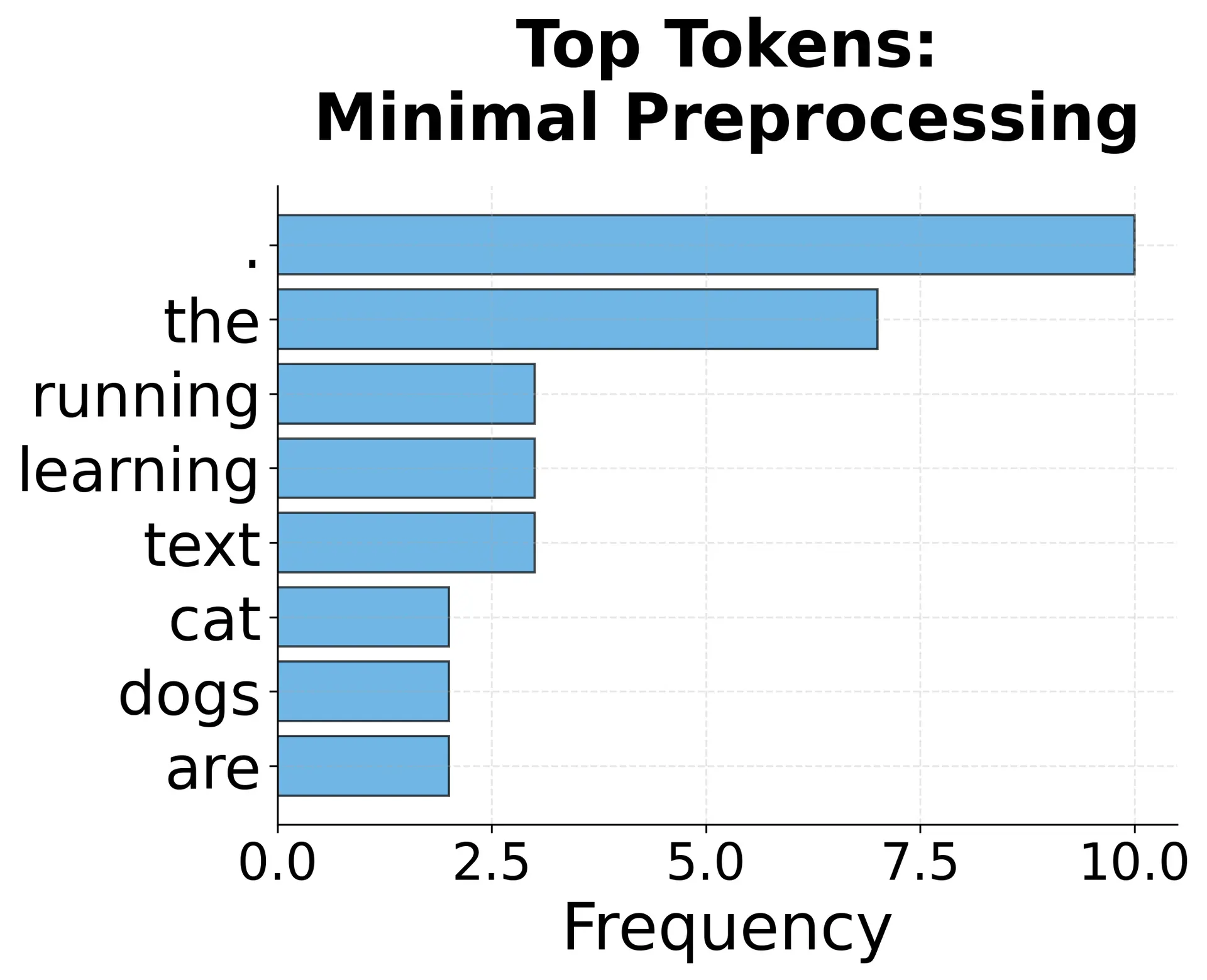
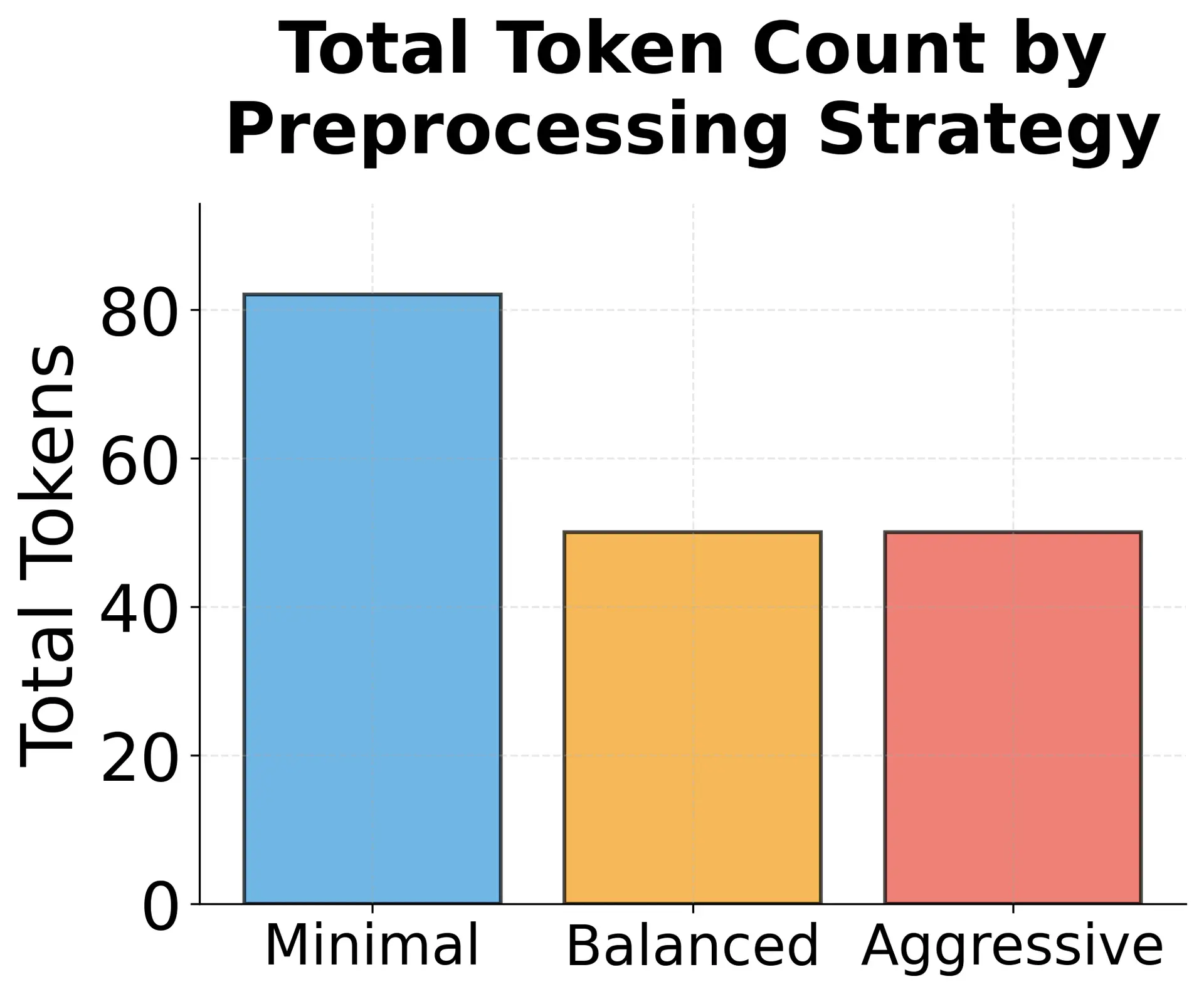
The visualization reveals several key insights:
- Vocabulary reduction: Aggressive preprocessing cuts vocabulary by 60-70% compared to minimal preprocessing
- Frequency distribution: Minimal preprocessing is dominated by stopwords, while aggressive preprocessing yields more uniform content word frequencies
- Token count: Total tokens decrease with more aggressive preprocessing, improving computational efficiency
Real-World Application: Sentiment Analysis
We've built a theoretical understanding of tokenization, normalization, and cleaning. Now let's see these concepts in action by applying our preprocessing pipeline to a realistic task: sentiment analysis of product reviews. This example shows that preprocessing choices directly affect what your model can learn and how well it performs.
Why sentiment analysis? Sentiment analysis is particularly revealing because it requires preserving information that other tasks might treat as noise. Consider the review "This product is NOT good!" If we aggressively normalize by removing stopwords and punctuation, we might lose the critical "NOT" that reverses the sentiment. This example shows us why we need to understand our task before choosing preprocessing techniques, and how different configurations create dramatically different feature spaces.
This application brings together everything we've learned: we'll see how tokenization creates features, how normalization affects vocabulary size, and how cleaning decisions impact model performance. We'll also understand when to preserve information versus when to discard it. This decision depends entirely on your downstream task.
The Dataset
We'll work with a small sample of product reviews labeled as positive or negative:
## Sample product reviews
reviews = [
    "This product is AMAZING!!! Best purchase ever. Highly recommend! :)",
    "Terrible quality. Broke after 2 days. Don't waste your money.",
    "It's okay, nothing special. Works as advertised but nothing more.",
    "Absolutely love it! Great value for the price. Will buy again!!!",
    "Worst product I've ever bought. Complete waste of $50.",
    "Pretty good overall. Minor issues but mostly satisfied.",
    "DO NOT BUY! Horrible customer service and poor quality.",
    "Exactly what I needed. Fast shipping, great product, A+++",
]

labels = [1, 0, 0, 1, 0, 1, 0, 1]  # 1 = positive, 0 = negative
Comparing Preprocessing Strategies
Let's preprocess this data with different strategies and examine how they affect the feature space. We'll create two different preprocessor configurations:
- Sentiment-aware: Preserves case, punctuation, and stopwords to retain emotional cues
- Standard aggressive: Applies all normalization techniques for vocabulary reduction
The sentiment-aware configuration keeps "NOT," "!!!" and "AMAZING," which carry crucial emotional information, while the standard aggressive approach loses this sentiment intensity by normalizing everything.
Feature Extraction and Visualization
Let's visualize how preprocessing affects the feature space for sentiment classification. We'll expand our dataset and create detailed heatmaps showing which features distinguish positive from negative reviews:
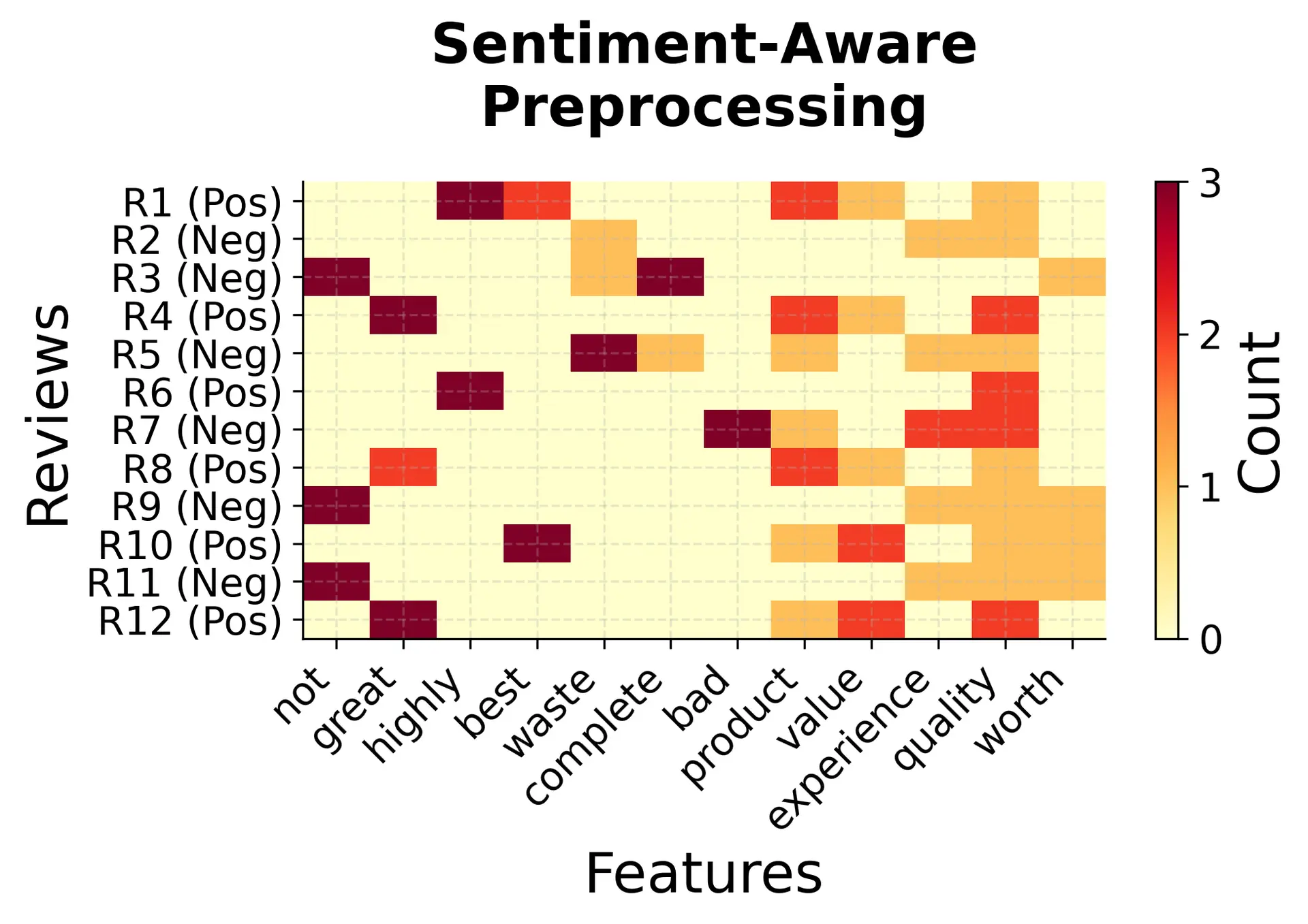
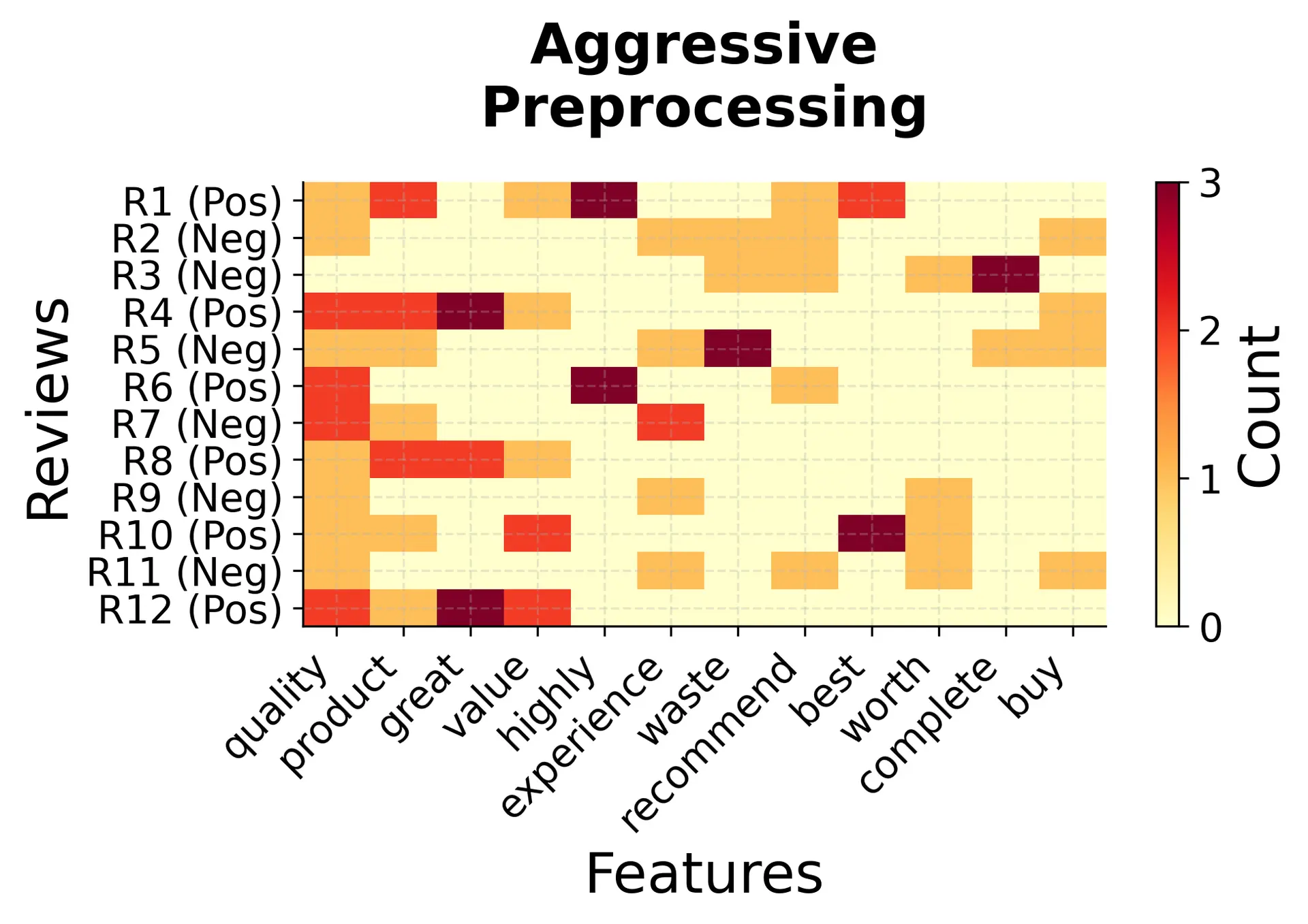
The heatmaps reveal how preprocessing strategy affects feature discriminability. The sentiment-aware approach preserves features like "!!!" and "NOT" that clearly distinguish positive from negative reviews. The aggressive approach creates a cleaner feature space but loses important sentiment signals.
Key Takeaways for Task-Specific Preprocessing
This sentiment analysis example illustrates several important principles:
- Task requirements matter: Sentiment analysis requires preserving emotional cues that other tasks might treat as noise
- Negation is crucial: Removing stopwords can eliminate "not," completely flipping sentiment
- Intensity markers: Capitalization and repeated punctuation signal emotion strength
- Feature interpretability: Simpler preprocessing makes it easier to understand what the model learned
For production sentiment analysis, you would use much larger datasets and more sophisticated models, but these preprocessing principles remain constant. Modern transformer models can handle more complex input, but thoughtful preprocessing still improves efficiency and performance.
Limitations and Challenges
Text preprocessing is a double-edged sword. While it simplifies and structures text for computational processing, it also introduces assumptions and potential biases that affect downstream model performance. Understanding these limitations helps you build NLP systems that behave reliably on real data.
The Information Loss Problem
Every preprocessing step discards information. Lowercasing loses emphasis cues, stemming conflates distinct words, and stopword removal eliminates grammatical structure. The challenge is determining what information is noise versus signal for your task.
Consider the sentence: "The model doesn't understand NOT to remove negation!" Aggressive preprocessing might reduce this to ["model", "understand", "remov", "neg"], losing the critical "NOT" that reverses the meaning. For sentiment analysis or semantic understanding, this is catastrophic. For topic modeling, it might be acceptable.
The field has moved toward preserving more information and letting models learn what to ignore. Modern transformers rarely use stemming or stopword removal, instead learning contextual representations that capture morphological and syntactic patterns directly from data. However, this requires large datasets and substantial compute. For resource-constrained scenarios, preprocessing remains essential.
Language and Domain Specificity
Most preprocessing tools are designed for English text. They struggle with:
- Morphologically rich languages: German compounds, Turkish agglutination, and Arabic templatic morphology require specialized tokenization
- Non-space-delimited languages: Chinese, Japanese, and Thai lack clear word boundaries
- Code-mixed text: Social media mixing multiple languages mid-sentence
- Domain-specific terminology: Medical abbreviations, legal jargon, and scientific notation
A preprocessing pipeline tuned for English news articles will fail spectacularly on Chinese social media or medical records. Building robust multilingual systems requires language-specific tools or language-agnostic approaches like character-level or byte-level models.
The Context Sensitivity Problem
Context determines meaning, but preprocessing often ignores it. The word "bank" might refer to a financial institution or a river's edge, "apple" could mean the fruit or the company, "run" has dozens of meanings depending on context. Aggressive normalization treats all instances identically.
This is why modern NLP has moved toward contextualized representations. Models like BERT and GPT generate different embeddings for "bank" in "river bank" versus "savings bank," capturing meaning from context. These models apply minimal preprocessing, relying on attention mechanisms to handle variation.
However, contextualized models require massive data and compute. For many applications, simpler approaches with careful preprocessing remain practical and effective.
Reproducibility and Versioning Challenges
Preprocessing pipelines are notoriously difficult to reproduce. NLTK and spaCy have evolved over years, changing tokenization rules and lemmatizer behavior. Unicode standards expand constantly. What worked in 2018 might behave differently in 2024.
This creates serious problems for production systems. A model trained with spaCy 2.x might perform poorly when preprocessing changes to spaCy 3.x. Version mismatches between training and inference lead to silent failures and degraded performance.
Best practices for reproducibility:
- Pin exact versions of all preprocessing libraries
- Save vocabulary and preprocessing rules with your model
- Version your pipeline just as rigorously as your model code
- Test preprocessing separately from model evaluation
The Preprocessing-Model Mismatch Problem
A subtle but critical issue: preprocessing assumptions must match model assumptions. If you train a model with aggressively preprocessed text but deploy it on minimally preprocessed input, performance will crater.
This commonly occurs when fine-tuning pretrained models. BERT was pretrained on case-sensitive text with WordPiece tokenization. If you lowercase and use word-level tokens during fine-tuning, you've introduced a fundamental mismatch. The model's learned representations no longer align with your input.
Always preprocess training, validation, and test data identically. This seems obvious but is violated surprisingly often, especially when combining datasets from different sources.
The Impact and Evolution of Text Preprocessing
Text preprocessing enabled the statistical revolution in NLP. Before robust tokenization and normalization, building computational language models was prohibitively difficult. The vocabulary was too large, the sparsity too extreme, and the computational requirements too demanding.
Porter's stemming algorithm (1980) made bag-of-words models practical. It reduced vocabulary size through crude but effective morphological normalization, which made TF-IDF and naive Bayes models easier to train at scale. Because stemming was simple to implement, researchers could adapt it to new languages quickly.
From Rules to Learning
The evolution of preprocessing mirrors the broader shift in NLP from rule-based to learned approaches:
- 1980s-1990s: Hand-crafted rules, extensive dictionaries, and linguistic expertise
- 2000s: Statistical methods like BPE learned from data but still required language-specific tokenization
- 2010s: Word2Vec and fastText learned morphological patterns, reducing need for stemming
- 2020s: Transformers with subword tokenization and character models minimize preprocessing entirely
Modern language models increasingly treat preprocessing as a learned component rather than a fixed pipeline. CharacterBERT learns its own character-to-word mappings, ByT5 operates on raw bytes, and models like GPT use BPE that adapts vocabulary to the training corpus.
However, this doesn't make preprocessing obsolete. The computational cost of learning everything from scratch is enormous. For most practitioners with limited data and compute, thoughtful preprocessing remains the most practical way to build effective NLP systems.
Current Best Practices
The field has converged on several preprocessing philosophies based on your scenario:
For transformer-based models with large datasets:
- Minimal preprocessing (lowercase, Unicode normalization)
- Subword tokenization (BPE, WordPiece, SentencePiece)
- Let the model learn morphology and context
- Preserve punctuation and capitalization
For classical ML with limited data:
- Aggressive normalization (lowercase, lemmatization)
- Stopword removal to reduce sparsity
- Domain-specific cleaning (URLs, HTML, etc.)
- Careful feature engineering
For production systems:
- Simple, reproducible pipelines
- Extensive testing and validation
- Version control for preprocessing code
- Monitoring for input distribution shift
Summary
Text preprocessing turns raw, unstructured text into clean, structured tokens that computational models can process effectively. The three core operations are tokenization, which breaks text into discrete units; normalization, which standardizes variations; and cleaning, which removes noise. Together, these techniques reduce complexity while preserving the information needed for downstream NLP tasks.
The key tension in preprocessing is the tradeoff between simplification and information preservation. Aggressive preprocessing reduces vocabulary size and improves computational efficiency but risks losing semantic nuances. Minimal preprocessing preserves more information but requires models to learn morphological and syntactic patterns from data. Modern deep learning has tilted this balance toward minimal preprocessing, letting large models learn linguistic structure, but classical methods still benefit from thoughtful normalization.
Effective preprocessing is task-specific. Sentiment analysis requires preserving negation and punctuation, while topic modeling can aggressively normalize. Machine translation needs minimal preprocessing to maintain linguistic structure, while document classification often benefits from stopword removal and lemmatization. Understanding your task requirements is essential for designing an appropriate pipeline.
Several critical principles guide preprocessing decisions:
- Reproducibility matters: Version control your preprocessing code and pin library versions
- Test preprocessing separately: Bugs in preprocessing silently degrade model performance
- Match training and inference: Preprocessing inconsistencies cause mysterious failures
- Consider your resources: Limited data favors aggressive preprocessing, large datasets enable learning
The evolution of NLP has steadily reduced reliance on hand-crafted preprocessing rules, moving toward learned representations that capture linguistic structure automatically. However, preprocessing remains fundamental for resource-constrained scenarios and provides interpretability advantages for classical models. As NLP continues advancing, the specific techniques may change, but the core challenge remains: transforming the rich, complex variability of human language into a form that machines can process effectively.
You now have a solid foundation in text preprocessing, understanding both the mechanics of individual techniques and the strategic decisions that determine whether they help or hurt your models. This knowledge prepares you for the next step: representing preprocessed text as numerical features that machine learning algorithms can operate on.
Quiz
Ready to test your understanding? Take this quick quiz to reinforce what you've learned about text preprocessing techniques.
Text Preprocessing Mastery
Reference
Citation details
Cite or share this article.
Stay up to date
Get articles, book updates, and news delivered to your inbox.
No spam, unsubscribe anytime.
Join the community
Sign in to remove popups, track your reading progress, and join the discussion.

Comments
No comments yet. Be the first to share your thoughts!