Text Preprocessing: Tokenization › Real-World Application: Sentiment Analysis
Text Preprocessing: Tokenization › Real-World Application: Sentiment AnalysisOne section · Sections in this article4 / 8 ↓
Reading tools Definitions & inline links
Choose your expertise level to adjust how many terms are explained. Beginners see more tooltips, experts see fewer to maintain reading flow. Hover over underlined terms for instant definitions.
Article links
Make inline references clickable
We've built a theoretical understanding of tokenization, normalization, and cleaning. Now let's see these concepts in action by applying our preprocessing pipeline to a realistic task: sentiment analysis of product reviews. This example shows that preprocessing choices directly affect what your model can learn and how well it performs.
Why sentiment analysis? Sentiment analysis is particularly revealing because it requires preserving information that other tasks might treat as noise. Consider the review "This product is NOT good!" If we aggressively normalize by removing stopwords and punctuation, we might lose the critical "NOT" that reverses the sentiment. This example shows us why we need to understand our task before choosing preprocessing techniques, and how different configurations create dramatically different feature spaces.
This application brings together everything we've learned: we'll see how tokenization creates features, how normalization affects vocabulary size, and how cleaning decisions impact model performance. We'll also understand when to preserve information versus when to discard it. This decision depends entirely on your downstream task.
The Dataset
We'll work with a small sample of product reviews labeled as positive or negative:
## Sample product reviews
reviews = [
    "This product is AMAZING!!! Best purchase ever. Highly recommend! :)",
    "Terrible quality. Broke after 2 days. Don't waste your money.",
    "It's okay, nothing special. Works as advertised but nothing more.",
    "Absolutely love it! Great value for the price. Will buy again!!!",
    "Worst product I've ever bought. Complete waste of $50.",
    "Pretty good overall. Minor issues but mostly satisfied.",
    "DO NOT BUY! Horrible customer service and poor quality.",
    "Exactly what I needed. Fast shipping, great product, A+++",
]

labels = [1, 0, 0, 1, 0, 1, 0, 1]  # 1 = positive, 0 = negative
Comparing Preprocessing Strategies
Let's preprocess this data with different strategies and examine how they affect the feature space. We'll create two different preprocessor configurations:
- Sentiment-aware: Preserves case, punctuation, and stopwords to retain emotional cues
- Standard aggressive: Applies all normalization techniques for vocabulary reduction
The sentiment-aware configuration keeps "NOT," "!!!" and "AMAZING," which carry crucial emotional information, while the standard aggressive approach loses this sentiment intensity by normalizing everything.
Feature Extraction and Visualization
Let's visualize how preprocessing affects the feature space for sentiment classification. We'll expand our dataset and create detailed heatmaps showing which features distinguish positive from negative reviews:
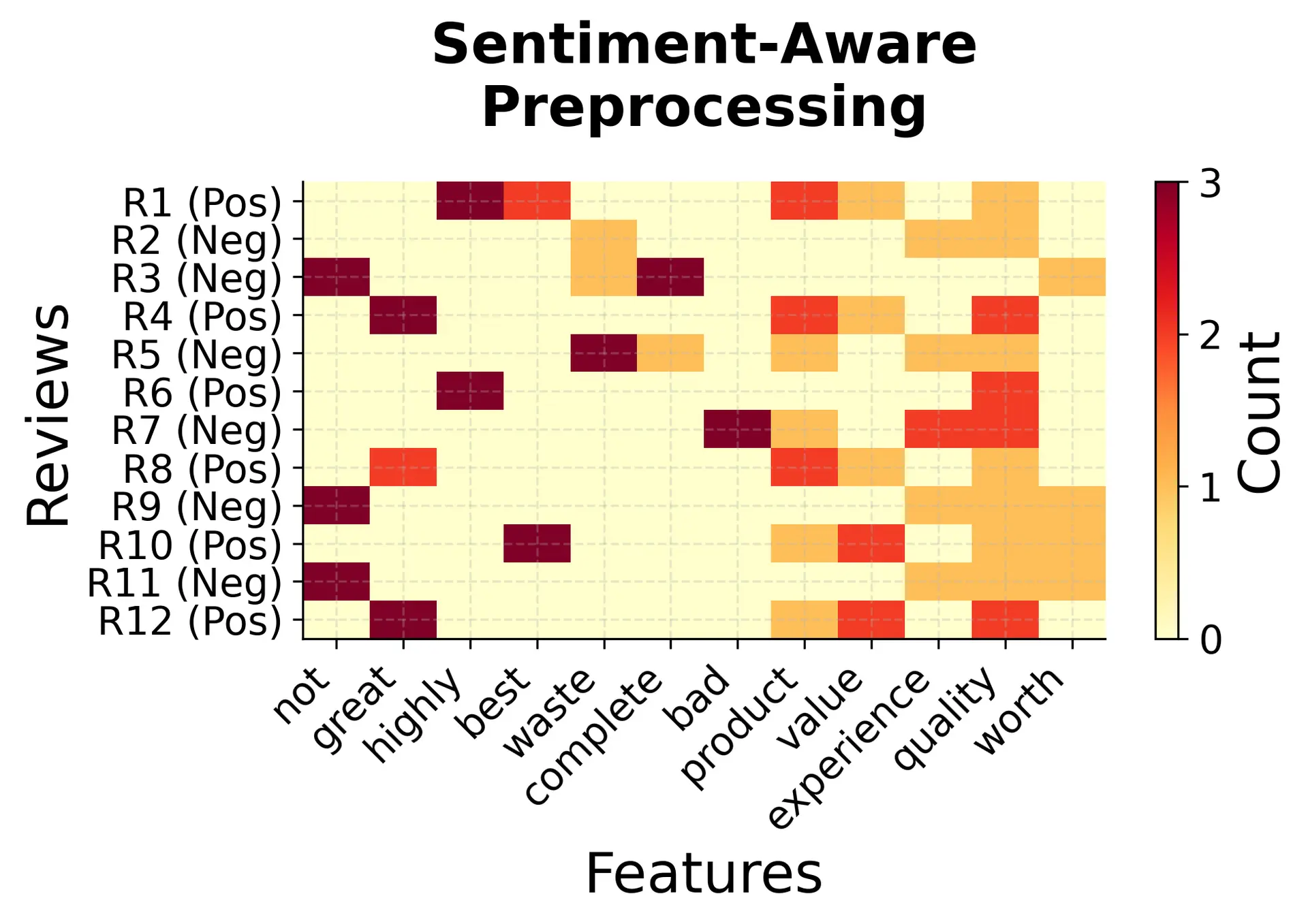
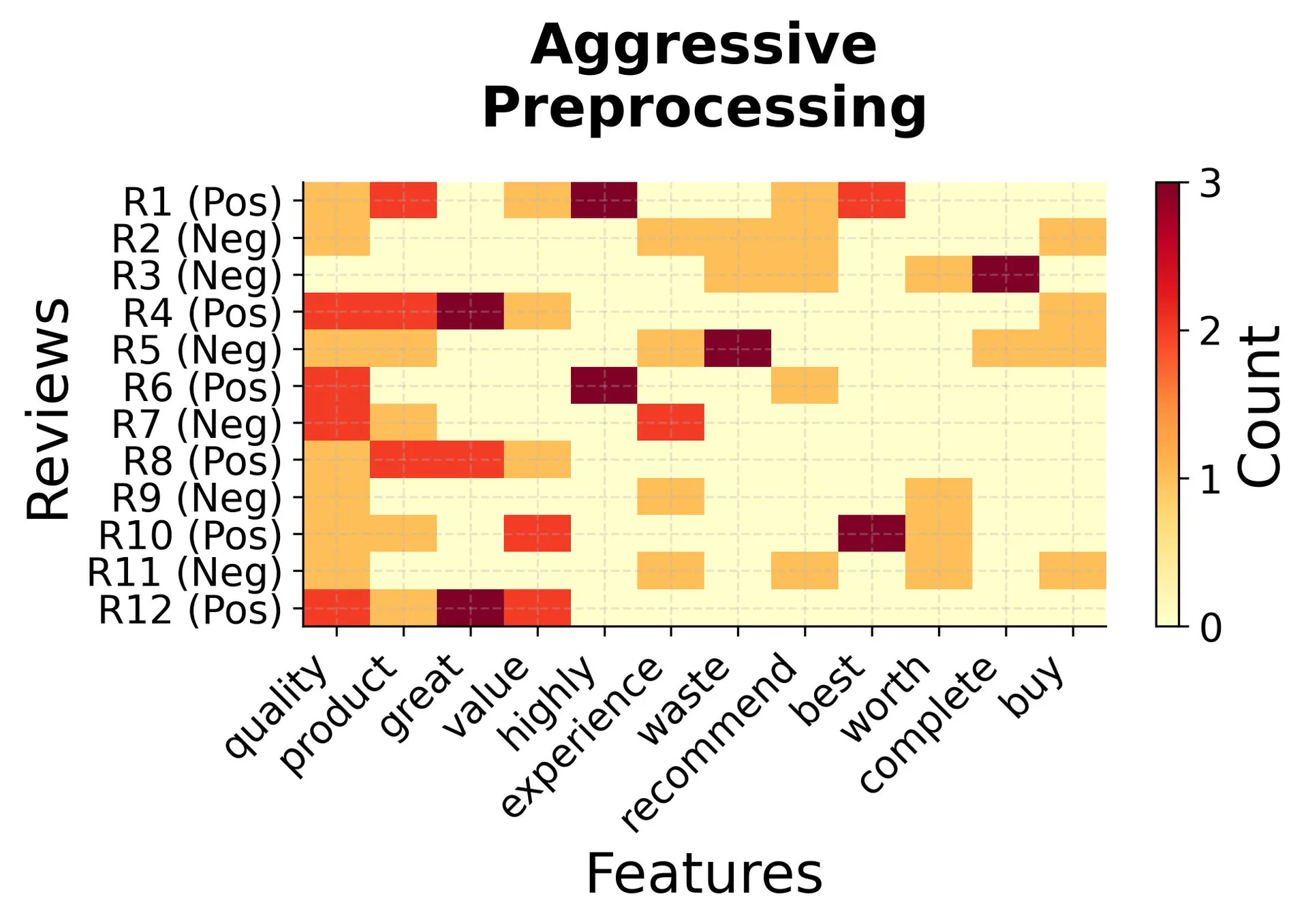
The heatmaps reveal how preprocessing strategy affects feature discriminability. The sentiment-aware approach preserves features like "!!!" and "NOT" that clearly distinguish positive from negative reviews. The aggressive approach creates a cleaner feature space but loses important sentiment signals.
Key Takeaways for Task-Specific Preprocessing
This sentiment analysis example illustrates several important principles:
- Task requirements matter: Sentiment analysis requires preserving emotional cues that other tasks might treat as noise
- Negation is crucial: Removing stopwords can eliminate "not," completely flipping sentiment
- Intensity markers: Capitalization and repeated punctuation signal emotion strength
- Feature interpretability: Simpler preprocessing makes it easier to understand what the model learned
For production sentiment analysis, you would use much larger datasets and more sophisticated models, but these preprocessing principles remain constant. Modern transformer models can handle more complex input, but thoughtful preprocessing still improves efficiency and performance.