

Master option fundamentals including calls, puts, intrinsic value, time value, and put-call parity. Learn payoff diagrams and basic trading strategies.
Choose your expertise level to adjust how many terms are explained. Beginners see more tooltips, experts see fewer to maintain reading flow. Hover over underlined terms for instant definitions.
A financial contract giving the holder the right, but not the obligation, to buy or sell an underlying asset at a specified price (the strike price) on or before a specified date (the expiration date).
The definition above captures the essence of what makes options unique in the world of financial instruments. The phrase "right, but not the obligation" is the key distinguishing feature. When you buy a stock, you must accept whatever price movements occur, both gains and losses. When you buy an option, you can choose to walk away if the price moves against you, losing only the premium you paid for this privilege. This asymmetry between rights and obligations creates the non-linear payoff structures that make options so valuable for both speculation and risk management.
The two fundamental types of options are calls and puts:
- Call option: Gives you the right to buy the underlying asset at the strike price. You profit when the underlying price rises above the strike. Think of a call option as a reservation to purchase: you lock in a buying price today, and if the market price rises above that level, your reservation becomes valuable because you can buy at a discount to the current market.
- Put option: Gives you the right to sell the underlying asset at the strike price. You profit when the underlying price falls below the strike. A put option functions like insurance on a stock position: if the price falls, you can still sell at the higher strike price, limiting your losses.
Every option transaction involves two parties with opposite positions:
- Long position (buyer): You pay the premium upfront and receive the right to exercise. Your maximum loss is limited to the premium paid, which represents the cost of acquiring the optionality. This limited downside combined with potentially unlimited upside for calls makes option buying attractive to those seeking leveraged exposure with defined risk.
- Short position (seller/writer): You receive the premium upfront and assume the obligation to fulfill the contract if exercised. Your potential loss can be substantial or even unlimited. As an option seller, you essentially act as an insurance provider, collecting premiums in exchange for bearing risk. You profit when options expire worthless but face significant exposure when large price moves occur.
Key Option Terminology
Before diving into payoffs and pricing, you need a precise vocabulary for discussing options. The following terms appear throughout derivatives literature and trading platforms.
Contract Specifications
The essential parameters that define an option contract are:
- Underlying asset: The security or instrument on which the option is based. For equity options, this is typically 100 shares of stock per contract.
- Strike price (K): The fixed price at which the underlying can be bought (call) or sold (put) upon exercise. Also called the exercise price.
- Expiration date (T): The last date on which the option can be exercised. After expiration, the option ceases to exist.
- Premium: The price paid by you to acquire the option. This is determined by supply and demand in the market.
- Contract multiplier: The number of units of the underlying per contract. For standard equity options, this is 100 shares.
Exercise Styles
Options differ in when they can be exercised:
- European style: Can only be exercised at expiration. Most index options and options on futures are European.
- American style: Can be exercised at any time up to and including expiration. Most equity options on individual stocks are American.
- Bermudan style: Can be exercised on specific dates before expiration, typically monthly or quarterly. Common in interest rate markets.
For European options, the exercise decision is simple: exercise if and only if the option is profitable to exercise at expiration. American options add complexity because early exercise may sometimes be optimal, particularly for deep in-the-money puts or calls on dividend-paying stocks. We'll focus primarily on European options in this chapter, as they're simpler to analyze and their pricing forms the foundation for understanding American options.
Moneyness
Moneyness describes the relationship between the underlying asset's current price and the option's strike price. It tells you whether an option would be profitable to exercise immediately. Understanding moneyness is essential because it affects not only the option's current value but also its sensitivity to price changes, the rate at which it loses time value, and the likelihood that it will be exercised at expiration.
A classification of options based on the relationship between the current underlying price and the strike price . Moneyness indicates whether immediate exercise would generate a positive payoff.
The concept of moneyness provides a standardized way to compare options across different underlying assets and price levels. Rather than thinking about absolute dollar amounts, you think in terms of how close an option is to being profitable. This relative framework proves especially useful when constructing strategies or comparing options on stocks with vastly different prices.
For call options, the relationship between stock price and strike determines moneyness as follows:
- In-the-money (ITM): . The underlying price exceeds the strike, so exercising would generate positive value. An ITM call already has intrinsic value because you could buy stock below its current market price.
- At-the-money (ATM): . The underlying price equals (or is very close to) the strike price. ATM options sit at the pivot point where any move in the underlying could push them into or out of the money.
- Out-of-the-money (OTM): . The underlying price is below the strike, so exercising would not be profitable. You would not rationally exercise an OTM call, as you would be paying more than the current market price for the stock.
For put options, the relationships reverse because puts profit from price declines rather than increases:
- In-the-money (ITM) . The underlying price is below the strike, so selling at is valuable. You could sell stock at the strike price, which exceeds the current market value.
- At-the-money (ATM) .
- Out-of-the-money (OTM) . The underlying price exceeds the strike, so the put has no exercise value. Selling at the strike price would mean receiving less than the stock's current worth.
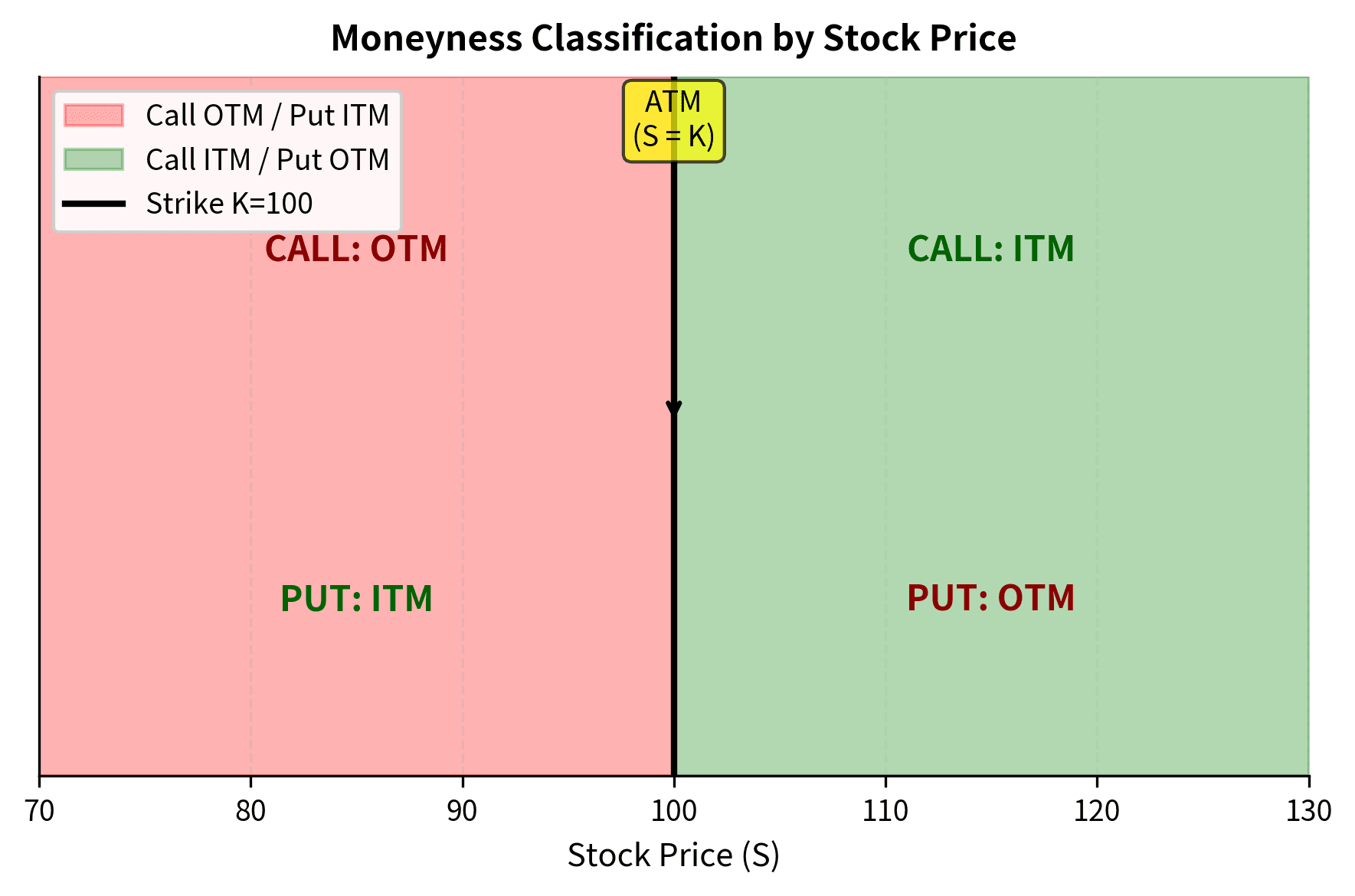
Moneyness affects both the option's price and its risk characteristics. Deep ITM options behave more like the underlying asset, with high sensitivity to price changes. Their value consists mostly of intrinsic value, and they move nearly dollar-for-dollar with the underlying. Deep OTM options are cheap but unlikely to pay off, making them speculative bets on large price movements. Their value is entirely time value, representing the small probability of a dramatic price move before expiration.
Intrinsic Value and Time Value
An option's price (premium) can be decomposed into two components: intrinsic value and time value. This decomposition provides insight into what you're actually paying for when you buy an option. Understanding this breakdown helps you make informed decisions about which options offer the best risk-reward for their market views and how option prices will evolve as time passes or the underlying moves.
Intrinsic Value
Intrinsic value represents the immediate exercise value of the option, assuming you could exercise right now. It's the "in-the-money" amount, capturing the concrete value embedded in the option if all uncertainty were resolved instantly. Intrinsic value answers a simple question: if this option expired this very moment, what would it be worth?
For a call option, intrinsic value equals the amount by which the stock price exceeds the strike, but it can never be negative because you would simply choose not to exercise:
where:
- : current price of the underlying asset
- : strike price of the option
The formula captures the payoff from immediate exercise. If the stock trades at $105 and your call has a strike of $100, you could exercise to buy stock at $100 and immediately sell it at $105, capturing $5 of value. If instead the stock were at $95, exercising would mean paying $100 for something worth only $95, a loss of $5. Since you would never voluntarily take this loss, you simply don't exercise, and the intrinsic value is zero rather than negative.
For a put option, the logic reverses because puts give the right to sell rather than buy:
where:
- : current price of the underlying asset
- : strike price of the option
With a put, you profit when the stock falls below the strike. If you hold a 100-strike put and the stock trades at $92, you could exercise to sell stock at $100 that's only worth $92, capturing $8 of value. Conversely, if the stock is at $108, you wouldn't exercise because you'd be selling at $100 something you could sell in the market for $108.
The function ensures intrinsic value is never negative. You wouldn't exercise an option at a loss, so OTM options have zero intrinsic value. This mathematical formulation elegantly captures the optionality: you take the better of two outcomes, either the exercise value or zero.
Time Value
Time value is the portion of the option premium that exceeds intrinsic value:
where:
- : the total market price of the option
- : the immediate exercise value of the option
Time value represents the market's assessment of the option's potential to become more valuable before expiration. It is sometimes called extrinsic value because it derives from external factors like time, volatility, and interest rates rather than the immediate relationship between stock price and strike.
Time value reflects the possibility that the option could become more valuable before expiration. Several factors contribute to time value:
- Time remaining: More time means more opportunity for favorable price movements. A stock that needs to rise $10 to push a call into the money has a better chance of doing so over six months than over six days. Time value decays as expiration approaches, a phenomenon called theta decay. This decay accelerates as expiration nears, with time value evaporating most rapidly in the final weeks.
- Volatility: Higher expected volatility increases the probability of large price moves, making options more valuable. If a stock typically moves 2% per month, the chance of a 20% move is small. But if it typically moves 10% per month, large moves become much more likely, and options that pay off on such moves deserve higher premiums.
- Interest rates: For calls, higher rates increase value because you delay paying the strike price. The present value of that future payment is lower when rates are higher. For puts, higher rates decrease value because you delay receiving the strike price, and that delayed receipt is worth less in present value terms.
ATM options have the highest time value because they have the most uncertainty about whether they'll finish ITM or OTM. A coin flip outcome carries maximum uncertainty. Deep ITM and deep OTM options have lower time value because their outcome is more predictable. A deep ITM call will almost certainly be exercised, while a deep OTM call will almost certainly expire worthless.
The call is $5 in-the-money (intrinsic value), meaning you could exercise now and buy stock worth $105 for only $100. The remaining $3.50 of the premium is time value, representing the potential for even greater gains before expiration.
Option Payoffs at Expiration
The payoff of an option is the value received upon exercise, ignoring the initial premium paid. Payoffs are the starting point for understanding option value because they define what the option delivers at expiration. By analyzing payoffs first, we establish the terminal conditions that any pricing model must satisfy. The premium you pay today must be justified by the expected value of these future payoffs, adjusted for time and risk.
Call Option Payoff
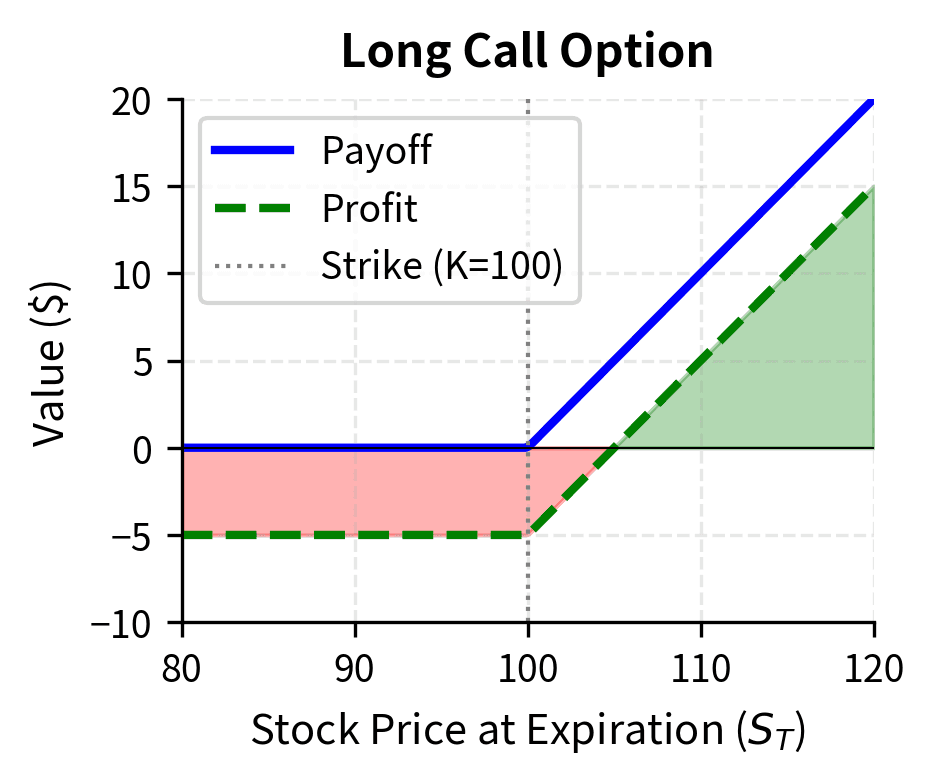
At expiration, a call option's payoff depends on whether the underlying price exceeds the strike price . The relationship is binary in nature: either the option is worth exercising or it isn't. This creates the characteristic hockey stick payoff shape that defines call options.
where:
- : price of the underlying asset at expiration
- : strike price
- : notation for
The notation means "the positive part of ," equivalent to . This mathematical shorthand appears frequently in derivatives literature and captures the essential asymmetry of options in a compact form.
The logic is straightforward and follows directly from your rational self-interest:
- If : Exercise the call, buy at , and own stock worth . Payoff = . You pay the strike price to acquire stock worth more than that amount, pocketing the difference as profit.
- If : Don't exercise. You wouldn't pay for stock worth less than . Payoff = 0. The option expires worthless, but you have lost nothing beyond the premium already paid.
Notice that the payoff function is piecewise linear. Below the strike, it's flat at zero. Above the strike, it increases dollar-for-dollar with the stock price. This kink at the strike price is what creates the asymmetric risk profile that makes options so useful for constructing targeted exposures.
Put Option Payoff
A put option's payoff is the mirror image of the call, reflecting its role as the right to sell rather than buy:
where:
- : price of the underlying asset at expiration
- : strike price
The reasoning follows the same logical structure as the call but in reverse:
- If : Exercise the put, sell at what's worth only . Payoff = . You deliver stock worth less than the strike price and receive the full strike price in return.
- If : Don't exercise. You wouldn't sell at what you could sell for or more. Payoff = 0. There's no point taking the strike price when the market offers more.
The put's payoff function is also piecewise linear, but the kink works in the opposite direction. Above the strike, the payoff is flat at zero. Below the strike, the payoff increases as the stock price falls, providing protection against declining prices.
Payoff vs. Profit
Payoff differs from profit in an important way. Profit accounts for the initial premium paid or received. While payoff tells you what the option delivers at expiration, profit tells you whether the overall transaction made money. An option can have a positive payoff but still result in a loss if the payoff doesn't exceed the premium paid.
For a long call and long put respectively:
where:
- : stock price at expiration
- : strike price
- : call option premium paid
- : put option premium paid
The premium appears as a subtraction because you pay this amount upfront to acquire the option. For a long call to be profitable, the stock must rise not just above the strike but above the strike plus the premium paid. This defines the breakeven point, the price at which the trade neither makes nor loses money.
Short positions have the opposite profit profile of long positions:
where:
- : stock price at expiration
- : strike price
- : call option premium received
- : put option premium received
The profit formulas for short positions show the premium as an addition because you receive this amount upfront. Options are a zero-sum game: what one party gains, the other loses. You achieve your maximum profit when the option expires worthless, but you face significant exposure when large price moves occur.
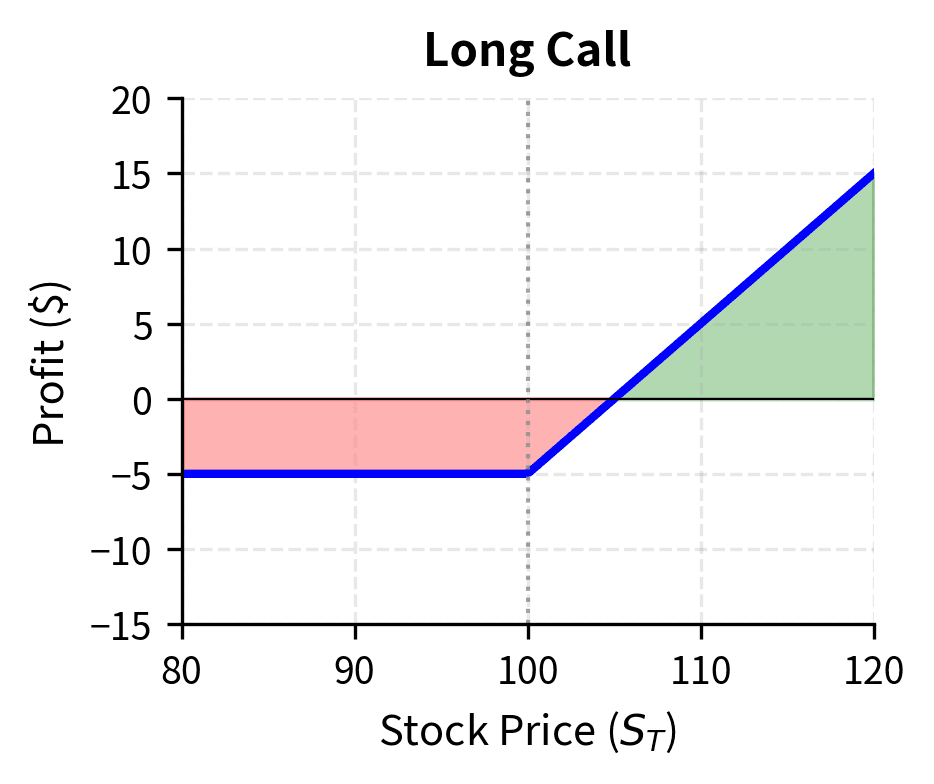
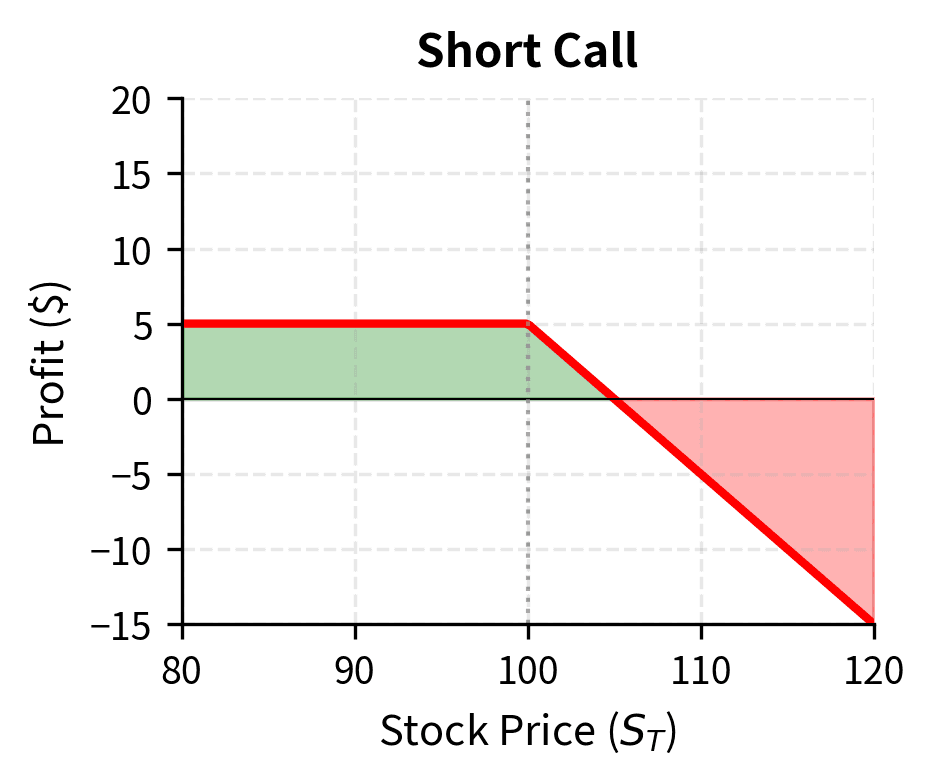
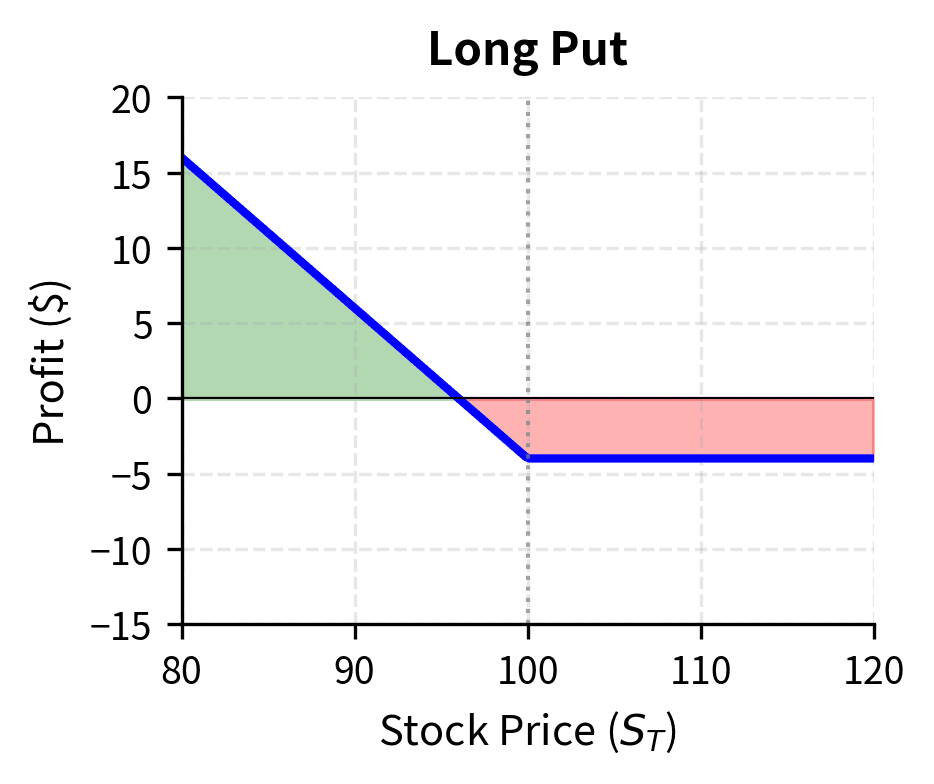
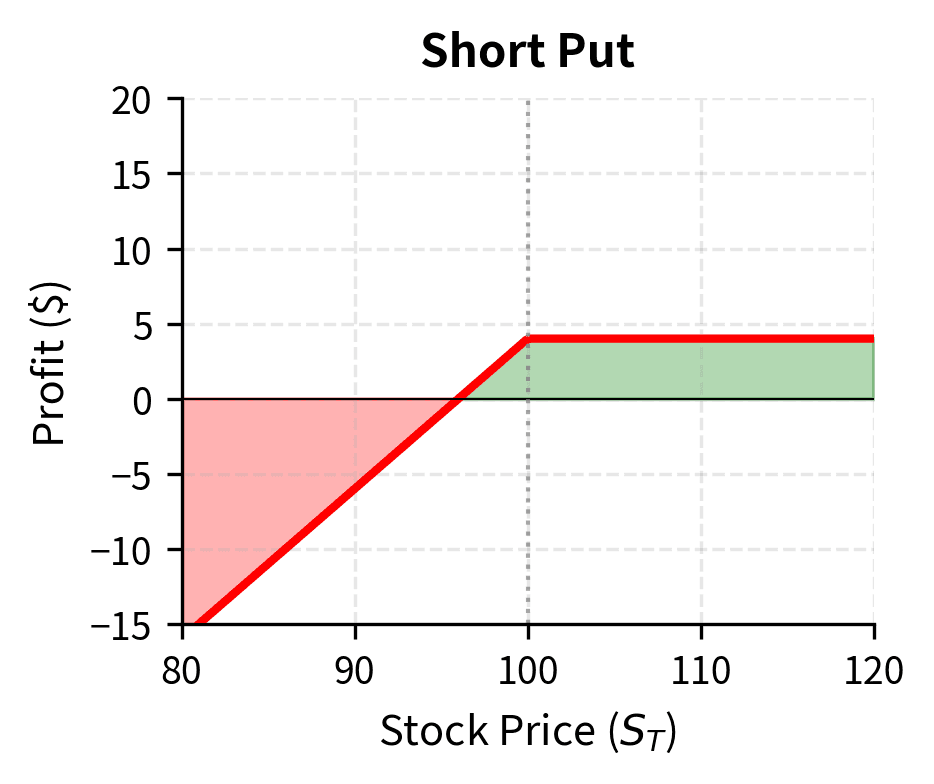
Let's visualize these payoff and profit functions:
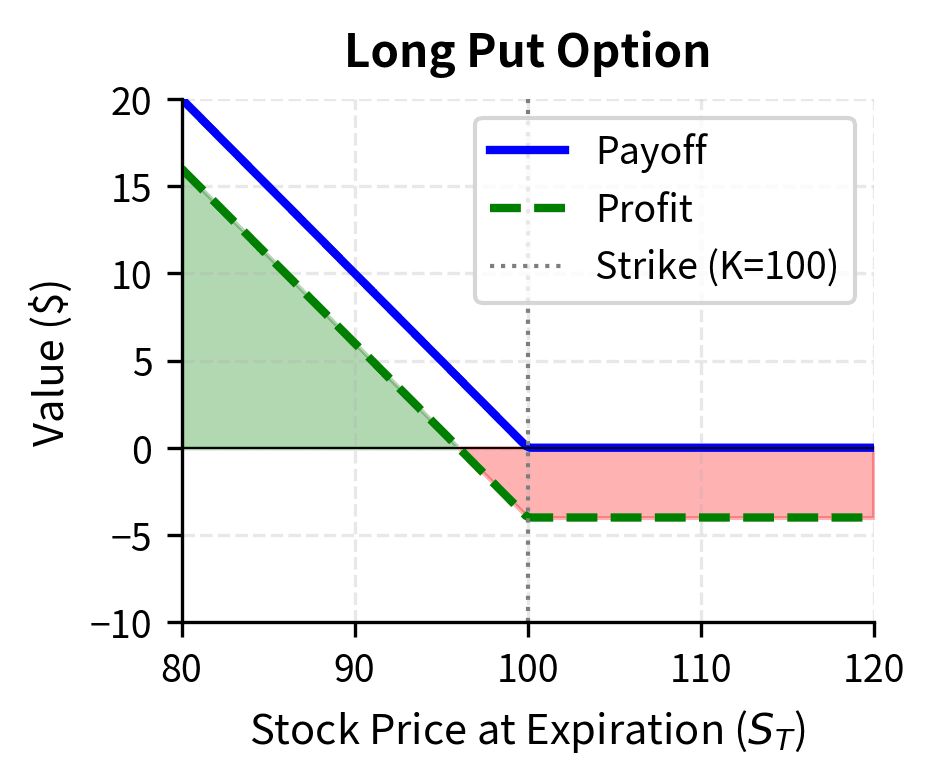
Several features are visible in these diagrams:
- Asymmetric payoff: The kinked shape at the strike price shows the non-linearity of options. Gains and losses are not symmetric. This is the fundamental property that distinguishes options from linear instruments like stocks or futures.
- Limited downside for buyers: The profit line flattens below the strike (for calls) or above the strike (for puts), showing that losses are capped at the premium paid. No matter how far the stock moves against you, your loss never exceeds the initial investment.
- Breakeven point: The call breaks even when . The put breaks even when . These points are where the payoff exactly equals the premium paid, resulting in zero profit.
- Leverage: A small premium controls exposure to a much larger position in the underlying. A $5 premium on a $100 stock represents only 5% of the stock's value but captures the full upside (for a call) above the strike.
Short Option Positions
Selling (writing) options generates immediate income from the premium but creates potentially large obligations. Short option positions have mirror-image payoffs to long positions. While you pay premium for limited-risk exposure in long positions, you collect premium in short positions in exchange for assuming risk that can be substantial.
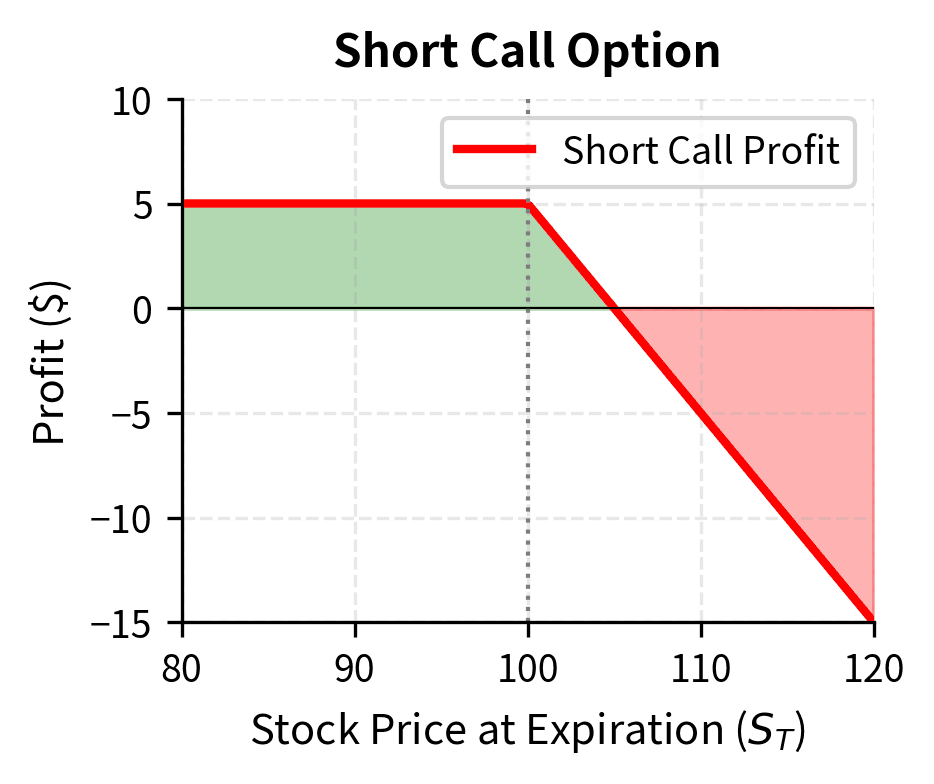
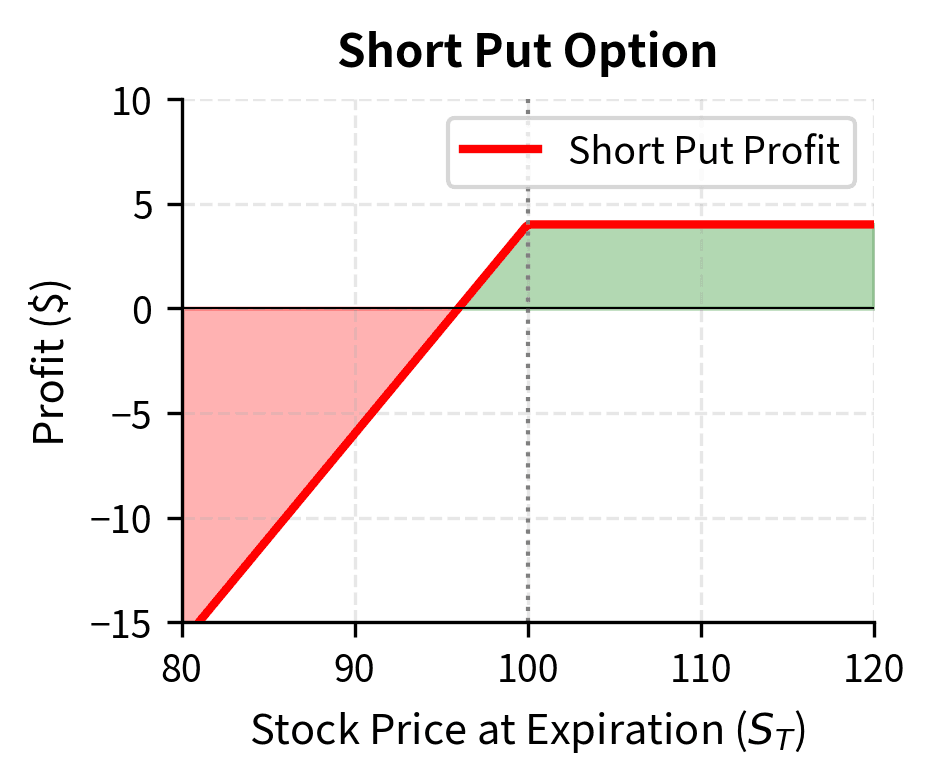
Short options have risk profiles that warrant careful attention:
- Short calls profit when the stock stays below the strike. Maximum profit equals the premium received. However, if the stock rises significantly, losses grow without bound. Writing naked (uncovered) calls is one of the riskiest strategies in options trading. Because stock prices have no theoretical upper limit, the potential loss is unlimited.
- Short puts profit when the stock stays above the strike. Maximum profit equals the premium. Losses are capped because the stock can only fall to zero, but this can still mean substantial losses (up to per share). A short put on a $100 strike with a $4 premium could lose up to $96 per share if the stock goes bankrupt.
As an option seller, you may hedge your exposure through delta hedging, which we'll explore in later chapters. If you write options, you should understand that the premium received is compensation for assuming potentially large risks.
Put-Call Parity
Put-call parity is a fundamental relationship that links the prices of European calls and puts with the same strike and expiration. It's not a pricing model; it's an arbitrage relationship that must hold in efficient markets. Unlike pricing models that make assumptions about volatility or price dynamics, put-call parity relies only on the absence of arbitrage, making it one of the most robust relationships in all of finance.
For European options on a non-dividend-paying stock, the relationship between call price , put price , stock price , strike price , risk-free rate , and time to expiration is:
where:
- : European call price
- : European put price
- : current stock price
- : strike price
- : risk-free interest rate
- : time to expiration
The equation states that the difference between call and put prices equals the difference between the current stock price and the present value of the strike price. The term represents the discounted value of the strike, acknowledging that receiving or paying in the future is worth less than receiving or paying today.
Deriving Put-Call Parity
To understand why this relationship must hold, consider two portfolios constructed from different instruments but designed to produce identical outcomes at expiration. If two portfolios always produce the same payoff regardless of what happens to the stock price, then they must have the same price today. If they didn't, we could buy the cheaper one and sell the more expensive one, locking in a risk-free profit.
Portfolio A: Long one call option plus cash equal to (the present value of the strike price)
This portfolio gives you the right to buy the stock at price , plus enough cash that, if invested at the risk-free rate, will grow to exactly by expiration.
Portfolio B: Long one put option plus one share of stock
This portfolio combines downside protection (the put) with direct ownership of the underlying asset.
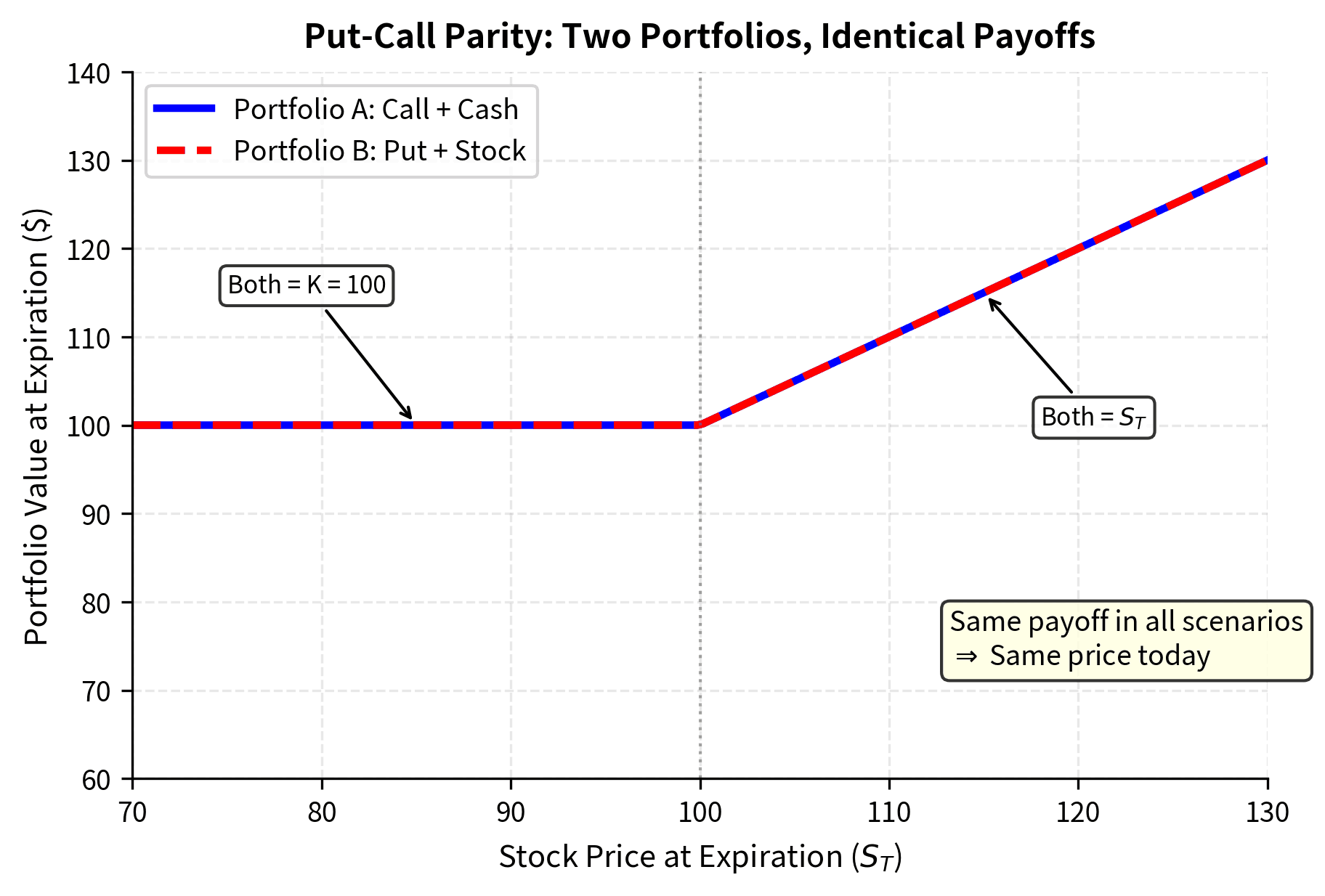
At expiration, both portfolios have identical values regardless of the stock price:
| Scenario | Portfolio A Value | Portfolio B Value |
|---|---|---|
In the first scenario where the stock finishes above the strike, Portfolio A exercises the call, paying from the cash (which has grown from to exactly ) to acquire stock worth , resulting in total value . Portfolio B has a worthless put and stock worth , also totaling .
In the second scenario where the stock finishes at or below the strike, Portfolio A lets the call expire worthless and holds cash worth , totaling . Portfolio B exercises the put to sell the stock for , also totaling .
Since both portfolios have the same payoff in every scenario, they must have the same price today (no arbitrage). Therefore:
where:
- : call price
- : put price
- : current stock price
- : present value of the strike price
This derivation demonstrates the power of no-arbitrage reasoning. Without making any assumptions about how prices move, volatility, or investor preferences, we've established a precise relationship that must hold between calls, puts, stock, and bonds.
Arbitrage Implications
If put-call parity is violated, you can earn risk-free profits. The specific trades depend on the direction of the violation:
- If : The call is overpriced relative to the put. Sell the call, buy the put, buy the stock, and borrow . Lock in a risk-free profit. At expiration, your obligations net to zero, but you started with cash in your pocket.
- If : The put is overpriced relative to the call. Buy the call, sell the put, short the stock, and invest . Lock in a risk-free profit. Again, your positions cancel at expiration, but you began with a positive cash flow.
Let's verify put-call parity numerically:
In practice, small deviations from put-call parity exist due to transaction costs, bid-ask spreads, and borrowing constraints. Larger deviations indicate either mispricing (an opportunity) or factors not accounted for (dividends, early exercise rights for American options).
Synthetic Positions
Put-call parity enables the creation of synthetic positions, replicating the payoff of one instrument using others. This capability proves invaluable when one instrument is more liquid, cheaper, or easier to trade than another:
- Synthetic long stock: Buy call, sell put (same strike), invest
- Synthetic short stock: Sell call, buy put (same strike), borrow
- Synthetic long call: Buy put, buy stock, borrow
- Synthetic long put: Buy call, short stock, invest
Synthetic positions are useful when one instrument is more liquid, cheaper, or easier to trade than another. For instance, if a stock is hard to borrow for shorting, you might create a synthetic short using options instead.
Combining Options: Basic Strategies
Individual options can be combined to create strategies with specific risk-reward profiles. Understanding these combinations reveals how options serve as building blocks for expressing nuanced market views. Rather than simply betting that a stock will go up or down, option strategies allow you to profit from volatility, benefit from time decay, or define precise profit zones.
Straddle
A straddle involves buying both a call and a put at the same strike price and expiration. It profits from large moves in either direction. In a straddle, you are essentially betting that the stock will move significantly but are uncertain about the direction. This makes straddles popular around earnings announcements, FDA decisions, or other binary events where large moves are expected.
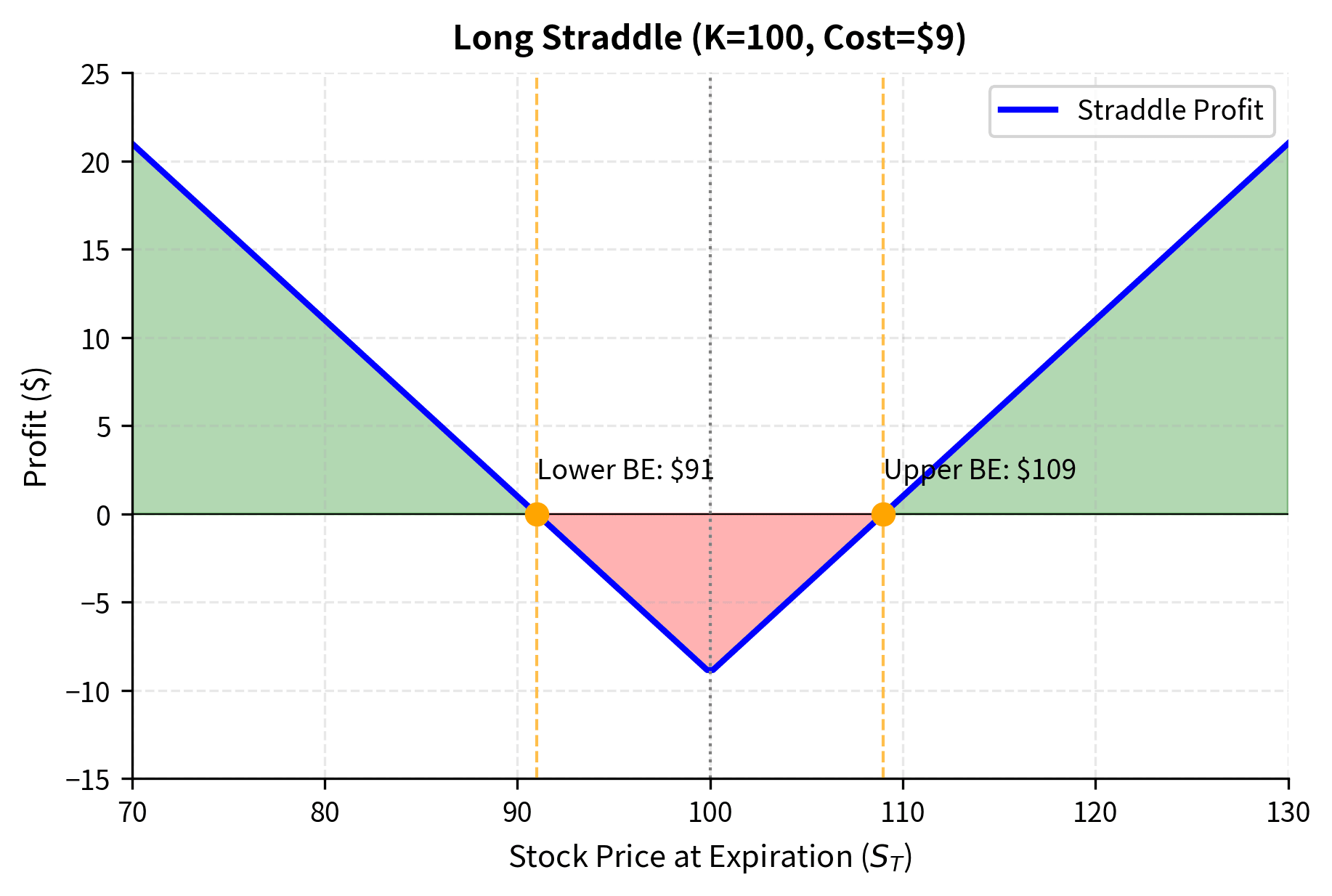
The straddle's V-shape shows its volatility bet. You pay a combined premium of and need the stock to move beyond the breakeven points () to profit. Maximum loss occurs if the stock finishes exactly at the strike, where both options expire worthless. The V-shape illustrates that the straddle buyer doesn't care which direction the stock moves, only that it moves enough to cover the combined premiums paid.
Bull Call Spread
A bull call spread involves buying a call at a lower strike (paying premium ) and selling a call at a higher strike (receiving premium ). It's a directional bet with limited risk and limited reward. By selling the higher-strike call, you reduce the cost of the position but also cap the potential upside.
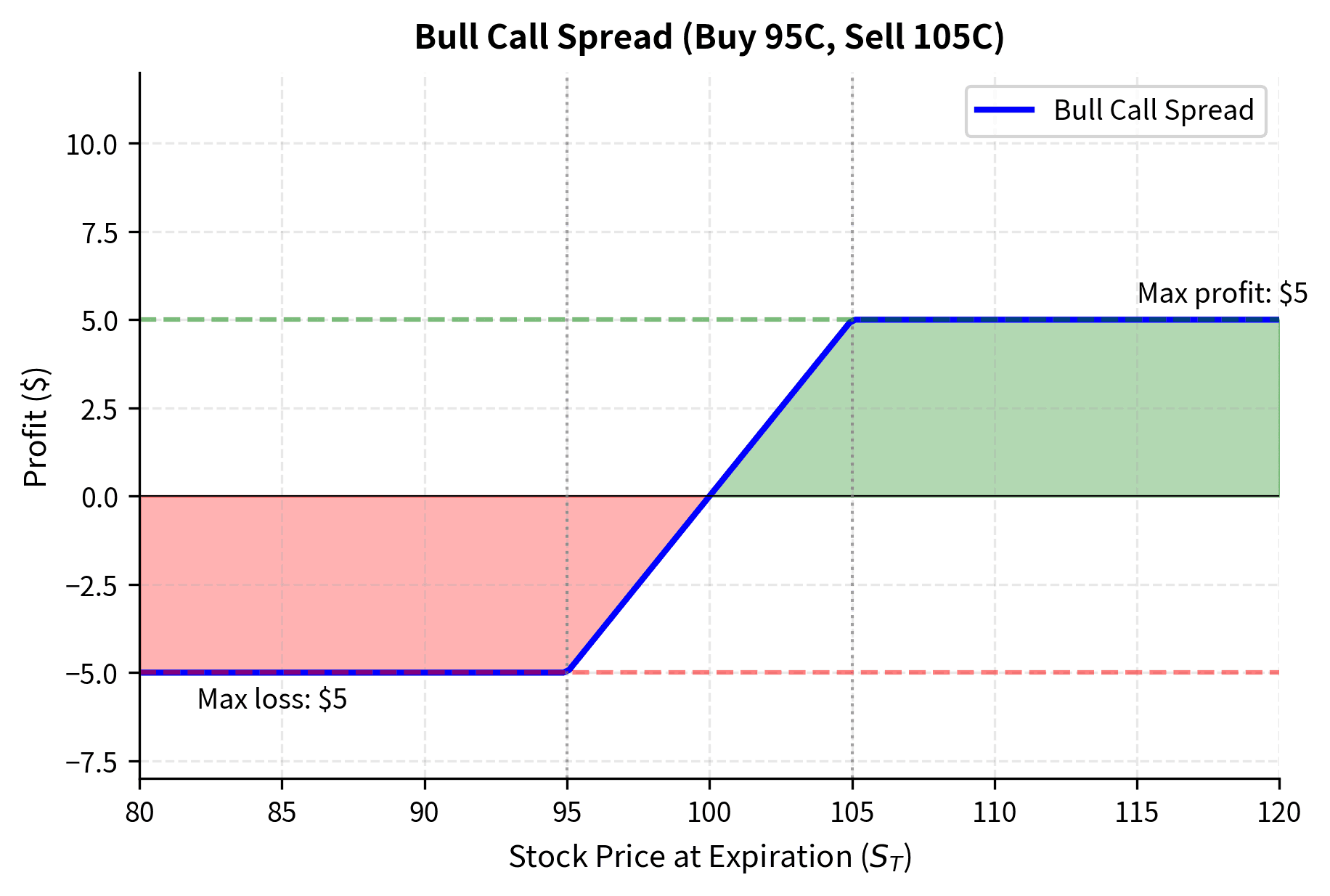
The spread's characteristics are:
- Maximum loss: Net premium paid (), occurring if
- Maximum profit: , occurring if
- Breakeven:
Spreads reduce cost (and risk) compared to outright calls but also cap potential gains. They're appropriate when you expect a moderate move rather than a dramatic one.
Leverage and Non-Linear Payoffs
Options provide substantial leverage because a small premium controls exposure to a much larger position. This leverage works both ways: profits can multiply quickly, but so can losses (for sellers). Understanding leverage is essential for position sizing and risk management.

The leverage cuts both ways. If the stock stays flat or declines, you lose your entire investment while the stock investor preserves most of their capital. This asymmetry makes options powerful tools for speculation and hedging, but they require careful position sizing and risk management.
Implementing a Payoff Calculator
Let's build a comprehensive payoff calculator that handles any combination of options and stock positions. This tool will help you analyze strategies before putting capital at risk.
Let's use this calculator to analyze an iron condor, a popular income-generating strategy:
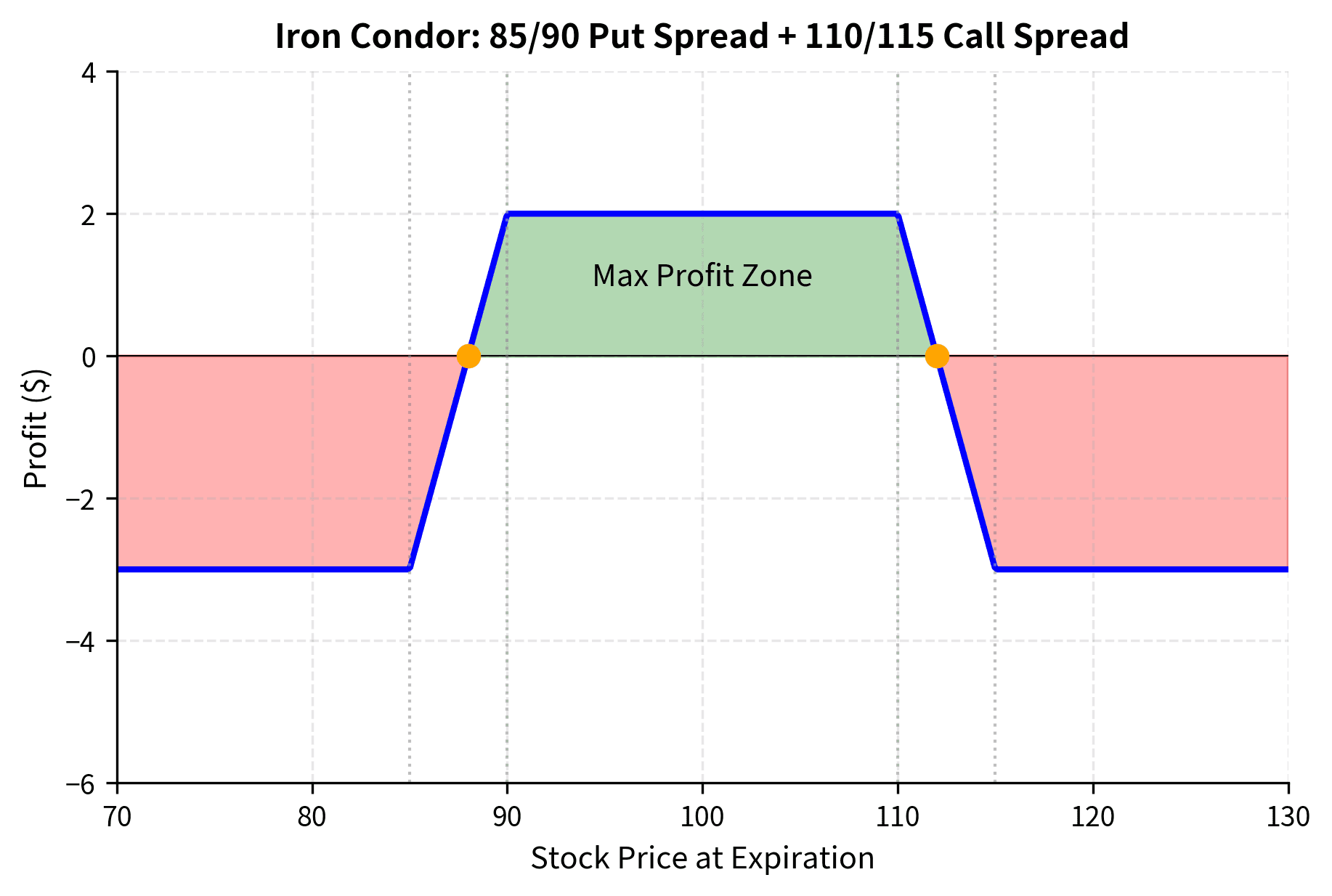
The iron condor collects a net credit of $2.00 (the maximum profit) and risks a maximum loss of $3.00. It demonstrates several key option concepts:
- Defined risk: Maximum loss is capped by the long options (protection)
- Income generation: Profits from time decay if the stock stays in the range
- Probability trade-off: High probability of small profit vs. low probability of larger loss
Key Parameters
The key parameters for the payoff calculator are:
- positions: A list of OptionPosition objects defining the portfolio.
- S_range: Array of potential stock prices at expiration used to simulate outcomes.
- strike: The exercise price for each option contract.
- premium: The cost (debit) or income (credit) associated with each position.
Limitations and Practical Considerations
While options offer powerful capabilities for hedging and speculation, several practical challenges complicate their use.
Liquidity and bid-ask spreads vary dramatically across strikes and expirations. ATM options near the front month typically have tight spreads, while deep OTM options or far-dated expirations may have spreads that consume a significant portion of the option's value. For a $0.20 option with a $0.10 spread, you're immediately underwater by 50% upon entering the position. You should focus on liquid strikes and use limit orders to minimize execution costs.
Time decay (theta) works against option buyers. Every day that passes without a favorable move erodes the option's time value. A weekly option might lose 5-10% of its value daily in its final days if the stock remains flat. This makes pure directional option buying a challenging strategy for consistent profitability. Successful option strategies often involve either selling options to collect theta or timing entries around specific catalysts where large moves are expected.
Early exercise considerations for American options add complexity that put-call parity doesn't capture. For American calls on dividend-paying stocks, early exercise may be optimal just before the ex-dividend date to capture the dividend. For deep ITM American puts, early exercise may be optimal because the time value of the exercise proceeds (invested at the risk-free rate) can exceed the remaining option time value. These considerations matter less for European-style index options but are essential for trading equity options.
Model assumptions underlying option pricing (constant volatility, no jumps, continuous trading) break down during market stress. The 1987 crash, 2008 financial crisis, and 2020 COVID crash all saw implied volatilities spike far beyond historical norms, and realized moves exceeded what standard models predicted. The fat tails of return distributions mean that OTM options may be systematically underpriced relative to their true probability of payoff.
Assignment risk affects short option positions, particularly for American-style options. Short call positions may be assigned early if the option is deep ITM before a dividend. Short put positions may be assigned if the underlying drops sharply. Assignment creates unexpected stock positions that must be managed, potentially at inconvenient times or prices.
Despite these challenges, options remain essential tools in modern finance. They enabled the development of portfolio insurance, created new ways to express market views, and provide the building blocks for structured products that transfer risk between market participants. The Black-Scholes model and subsequent advances in option pricing theory, covered in upcoming chapters, gave you a framework to think about and trade volatility itself, not just price direction.
Summary
This chapter introduced the fundamental concepts of options, providing the foundation for more advanced pricing and trading strategies:
Option basics: Calls give you the right to buy; puts give you the right to sell. You pay a premium for optionality while you collect premium in exchange for obligations. European options exercise only at expiration; American options can exercise any time.
Moneyness and value decomposition: Options are ITM, ATM, or OTM depending on the relationship between the underlying price and strike. Option prices decompose into intrinsic value (immediate exercise value) and time value (the potential for further gains).
Payoff mathematics: Call payoff is ; put payoff is . Profit accounts for the premium paid or received. The kinked payoff diagrams reveal the non-linear, asymmetric nature of option returns.
Put-call parity: The arbitrage relationship links call and put prices for European options with the same strike and expiration. Violations create arbitrage opportunities and enable synthetic position construction.
Strategy building: Individual options combine into spreads, straddles, and more complex structures that express specific market views with defined risk profiles. Understanding payoff diagrams for basic combinations provides intuition for analyzing any option strategy.
Practical realities: Liquidity, bid-ask spreads, time decay, and early exercise considerations all affect the viability of option strategies. Models are simplifications; real markets exhibit jumps, changing volatility, and transaction costs.
With these fundamentals established, the next chapter develops the mathematical framework for option pricing, beginning with the binomial model and building toward the celebrated Black-Scholes formula.
Quiz
Ready to test your understanding? Take this quick quiz to reinforce what you've learned about option basics, payoffs, and fundamental relationships.

Comments