Volume 16 of 20 · PDF edition
In progressAgents and AI Coding Systems
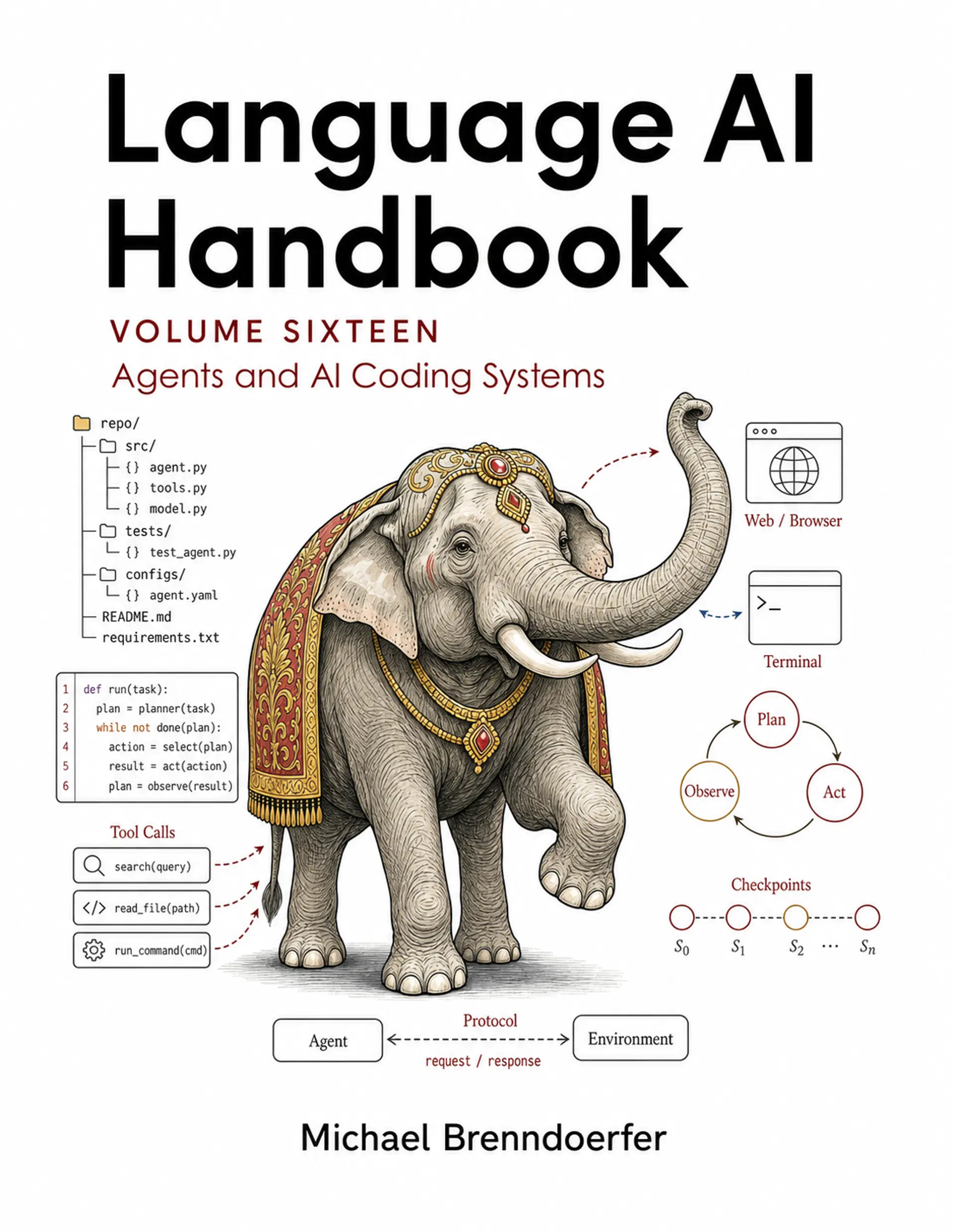
For builders of tool-using, coding, computer-use, and deep-research agents that must work safely over long horizons.
Read every available chapter online for free. The paid edition is a focused, carefully typeset volume PDF with future chapters, updates, and errata included.
- Written chapters
- 16 written chapters
- Planned chapters
- 8 planned chapters
- Approximate pages
- ~510 pages
- Edition
- Version 2026.08.0
- Price
- $24 one-time
Author and edition details
About the author and Volume 16 PDF edition

Michael Brenndoerfer
Michael has spent more than a decade working across software engineering, data, AI, and business. He writes to understand difficult ideas more deeply and to share what he learns in a clear, practical way.
- Edition
- Volume 16 PDF 2026.08.0
- Published
- Last reviewed
Focused learning path
What this volume covers
- Code Generation
- Tool Use and Agents
- Long-Horizon Agents and Interoperability
Audience and prerequisites
Where this volume fits
For builders of tool-using, coding, computer-use, and deep-research agents that must work safely over long horizons.
Prerequisites: Assumes decoder models from Volume 9; Volume 15 is recommended.
Free online preview
Start with “Code LLM Training”
Covers code training data, code tokenization, fill-in-the-middle training, code pre-training objectives.
Exact contents
16 chapters available now
The current PDF contains every linked chapter below. The remaining 8 planned chapters will be added through free volume updates.
Part XLVII: Code Generation
- 01Code LLM Training
Covers code training data, code tokenization, fill-in-the-middle training, code pre-training objectives.
- 02Code Understanding
Covers code explanation, bug detection, code review, code search.
- 03Code Completion
Covers completion context, completion ranking, completion latency, completion UX.
- 04Code Generation
Covers docstring-to-code, test-to-code, code generation strategies, generation quality.
- 05Code Execution
Covers sandboxed execution, execution feedback, iterative refinement, execution safety.
- 06Code Evaluation
Covers functional correctness, pass@k metric, code benchmarks, beyond correctness.
Part XLVIII: Tool Use and Agents
- 01Tool Use Motivation: Why LLMs Need External Tools for Accuracy
Discover why LLMs require external tools to overcome knowledge cutoffs, computational limits, and hallucinations. Learn about tool-augmented AI systems.
- 02Function Calling: Structured Tool Use for Large Language Models
Learn how function calling enables LLMs to invoke external tools and APIs through structured JSON schemas, bridging natural language and executable code.
- 03ReAct Pattern: Interleaving Reasoning and Action for LLM Agents
Learn how the ReAct pattern enables LLM agents to interleave reasoning with tool execution. Master thought-action-observation loops for autonomous AI systems.
- 04Tool Selection for LLM Agents: Routing Strategies and Implementation
Master LLM tool selection through embedding-based routing, hybrid strategies, and semantic interfaces. Learn to build scalable multi-tool agent systems.
- 05Agent Architectures: Control Loops, State & Planning
Master LLM agent architectures including control loops, state management strategies, planning mechanisms, and termination conditions for autonomous AI systems.
- 06Agent Memory Systems: From Context to Persistent Storage
Learn how AI agents manage short-term context and long-term memory. Explore vector databases, retrieval algorithms, and memory hierarchies that enable persistent, learning systems.
- 07Agent Evaluation: Metrics, Benchmarks and Safety Standards
Learn to evaluate AI agents with task completion metrics, trajectory analysis, and safety testing. Covers WebArena, SWE-bench, GAIA, and OSWorld benchmarks.
- 08Planning
Covers task decomposition, goal-directed planning, plan execution, plan revision and recovery.
- 09Multi-Agent Systems
Covers agent coordination, communication protocols, role assignment, multi-agent benchmarks.
- 10Agent Safety
Covers unsafe action prevention, agent alignment, sandboxing, monitoring and intervention.
Part XLIX: Long-Horizon Agents and Interoperability
- 01Computer-Use and Browser AgentsPlanned
Screenshots, accessibility trees, action spaces, grounding, recovery, and evaluation on real interfaces.
- 02Coding and Software-Engineering AgentsPlanned
Repository navigation, test-driven changes, execution feedback, code review, and long-running tasks.
- 03Deep-Research AgentsPlanned
Search, source selection, evidence synthesis, citation integrity, uncertainty, and reproducible research traces.
- 04Durable and Asynchronous Agent WorkPlanned
Checkpoints, resumability, queues, idempotency, retries, deadlines, and state across long-running workflows.
- 05Model Context ProtocolPlanned
MCP clients, servers, tools, resources, prompts, capability negotiation, transport, and trust boundaries.
- 06Agent-to-Agent ProtocolsPlanned
Discovery, task delegation, status, artifacts, interoperability, and failure semantics across agents.
- 07Human Approval and Control BoundariesPlanned
Approval gates, reversibility, escalation, authority, interruption, and clear ownership of consequential actions.
- 08Long-Horizon Agent EvaluationPlanned
Functional success, partial credit, recovery, cost, time, safety, and contamination-resistant task suites.
Volume 16 PDF
Own this focused edition
Get the carefully typeset PDF to keep, plus every future chapter, revision, and erratum for this volume.
- Carefully typeset standalone volume PDF
- Future chapters, updates, and errata included
- No oversized combined edition to render or download
Volume 16 of 20
$24
one-timeVersion 2026.08.0 · secure checkout via Stripe
Delivered by email · Free volume updates included
All-volume access
Every current and future volume
Get all 20 current volume slots, every future volume, and every update for $199. PDFs are always delivered as manageable individual volumes, never as one combined 12,500-page file.
$199 one-time
Get all-volume accessContinue through the library
Explore adjacent volumes
Version history
Kept current, not frozen in time
Each PDF purchase includes future editions. When the book changes, the updated copy appears in My books at no extra cost.
Current release
Edition 2026.08.0
Initial volume-library release with 19 written PDFs, a Volume 3 placeholder, and no combined edition.