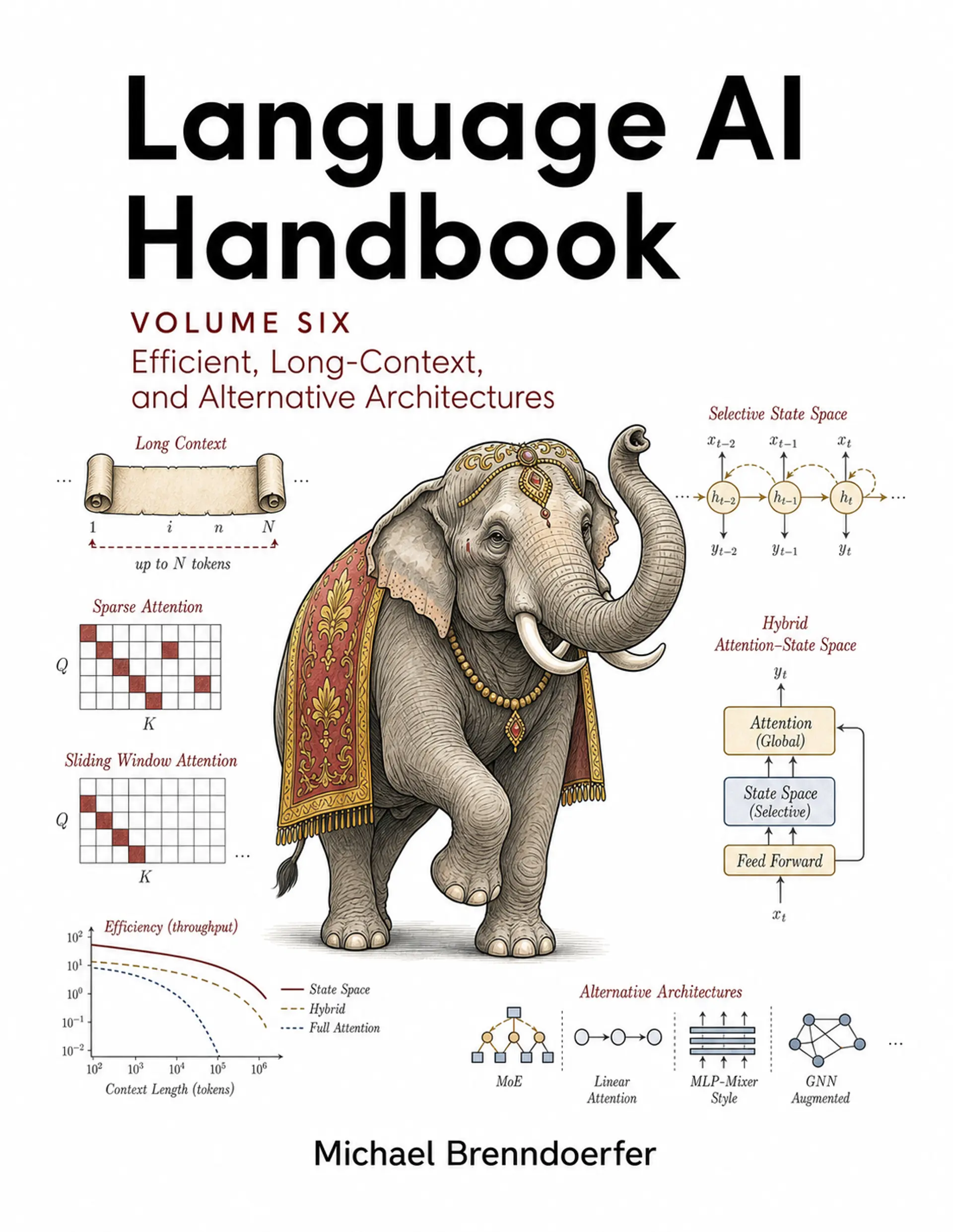
Efficient, Long-Context, and Alternative Architectures
For readers choosing or designing architectures under sequence-length, memory, latency, and hardware constraints.
Part of Language AI Handbook. The online chapters are free to read; the PDF edition is yours to keep, with future updates included.
Become a more confident language AI practitioner.
Build the understanding to explain how language models work and make more informed choices about using them. The handbook connects the foundations to the methods behind modern language AI, with explanations you can return to as you learn.
See what you’ll learnWhat you will learn
- Understand Efficient Attention.
- Understand Long Context.
- Understand Alternative Sequence and Generative Architectures.
Who this volume is for
- Engineers, researchers, students, AI enthusiasts, linguists, product managers, and anyone interested in understanding or building modern language AI systems, from foundational NLP to advanced large language models.
Prerequisites: Assumes Volume 5 or equivalent transformer knowledge.
Volume 6 PDF edition
Own this 510-page edition
Keep the PDF for offline reading, with future updates included. The corresponding chapters stay free online.
- Carefully typeset PDF
- Future updates and errata included
- Online chapters remain free to read
Volume 6 of 20 · In progress
$24
one-timeVersion 2026.08.0 · 510 pages · secure checkout via Stripe
Delivered by email · Free updates included
Want the complete library?
Access to every volume, delivered as separate PDFs. Save $257 vs. buying available volumes separately.
Get all-volume access · $199Reader verdict
5.0
out of 5
12 five-star reader reviews
Genuine feedback, with names abbreviated for privacy.
Meet the community“Really appreciate the way you have explained the concepts. Simple to understand, yet builds up knowledge exponentially, all while reinforcing it with examples repeatedly. I've read the last two chapters `74.Self-attention & 75.Q,K,V` and I've to admit, my concepts have never been clearer. You really are doing an amazing job breaking down maths and complex concepts like a story!”
“I would like to thank you for your work. Specifically, the chapter: 'LIME Explainability: Complete Guide to Local Interpretable Model-Agnostic Explanations' was extremely helpful for me in understanding LIME and communicating to colleagues. Your work is inspiring and valuable. Thank you for doing it.”
“I am enjoying reading your writings. I appreciate the effort you put into it. I want to drop a note of thanks. Thank you!”
“Your writing feels like a treasure trove of great material. So, thank you for compiling everything on your website!”
“I found your book Language AI Handbook's explanations of Transformer architectures and production deployment strategies to be exceptionally clear and insightful”
“Thanks so much for establishing such an amazing community. I appreciate the opportunity to be a learner and a contributor to the community.”
“Thank you Michael. It's top!”
“I came across your collection of online handbooks covering quantitative finance, AI, and machine learning. I wanted to reach out and thank you for making such high-quality material openly available. They are incredibly helpful for my CFA Level II review and for brushing up ahead of ML interviews.”
“I came across one of your books, Language AI Handbook, and man, I'm loving it. I've read many books but have never found such a comprehensive book on large models that covers everything from start to finish with such depth.”
“I just came across your website where your books are available for free to read. Thank you so much for making this available to the public. This will help a lot of people.”
“Thanks for putting cool stuff out into the world.”
“I read a few of your blogs on NLP and oh WOW, they really are something, now I exactly know how all of the terms Entropy, Cross-entropy and how it is connected to Perplexity, will definitely read more of your blogs.”
Read all 12 reader reviews
“I would like to thank you for your work. Specifically, the chapter: 'LIME Explainability: Complete Guide to Local Interpretable Model-Agnostic Explanations' was extremely helpful for me in understanding LIME and communicating to colleagues. Your work is inspiring and valuable. Thank you for doing it.”
“Really appreciate the way you have explained the concepts. Simple to understand, yet builds up knowledge exponentially, all while reinforcing it with examples repeatedly. I've read the last two chapters `74.Self-attention & 75.Q,K,V` and I've to admit, my concepts have never been clearer. You really are doing an amazing job breaking down maths and complex concepts like a story!”
“Thanks so much for establishing such an amazing community. I appreciate the opportunity to be a learner and a contributor to the community.”
“I just came across your website where your books are available for free to read. Thank you so much for making this available to the public. This will help a lot of people.”
“I am enjoying reading your writings. I appreciate the effort you put into it. I want to drop a note of thanks. Thank you!”
“Thank you Michael. It's top!”
“Thanks for putting cool stuff out into the world.”
“I found your book Language AI Handbook's explanations of Transformer architectures and production deployment strategies to be exceptionally clear and insightful”
“Your writing feels like a treasure trove of great material. So, thank you for compiling everything on your website!”
“I came across your collection of online handbooks covering quantitative finance, AI, and machine learning. I wanted to reach out and thank you for making such high-quality material openly available. They are incredibly helpful for my CFA Level II review and for brushing up ahead of ML interviews.”
“I read a few of your blogs on NLP and oh WOW, they really are something, now I exactly know how all of the terms Entropy, Cross-entropy and how it is connected to Perplexity, will definitely read more of your blogs.”
“I came across one of your books, Language AI Handbook, and man, I'm loving it. I've read many books but have never found such a comprehensive book on large models that covers everything from start to finish with such depth.”
Exact contents
16 chapters across 3 parts
Every linked chapter is free to read online. 6 further chapters are planned; unlinked titles are still in progress.
Part XVII: Efficient Attention
- 01Quadratic Attention Bottleneck
Covers O(n²) memory analysis, O(n²) compute analysis, attention matrix size, practical sequence limits, bottleneck visualization, motivation for efficiency.
- 02Sparse Attention Patterns
Covers local attention windows, strided attention patterns, block-sparse attention, combining sparse patterns, sparse attention implementation.
- 03Sliding Window Attention
Covers sliding window formulation, window size selection, dilated sliding windows, sliding window for long sequences, Mistral-style windowed attention.
- 04Global Tokens
Covers CLS token global attention, learned global tokens, global-local attention mixing, global token count, implementation strategies.
- 05Longformer
Covers Longformer attention pattern, global attention configuration, Longformer complexity, Longformer for documents, Longformer implementation.
- 06BigBird
Covers BigBird attention pattern, random attention benefits, BigBird theoretical guarantees, BigBird vs Longformer, BigBird applications.
- 07Linear Attention
Covers softmax attention reformulation, kernel feature maps, linear complexity attention, linear attention limitations, Performer and variants.
- 08FlashAttention Algorithm
Covers GPU memory hierarchy, tiling for SRAM, online softmax computation, recomputation strategy, FlashAttention complexity, FlashAttention benefits.
- 09FlashAttention Implementation
Covers CUDA kernel basics, memory access patterns, FlashAttention-2 improvements, using FlashAttention in PyTorch, FlashAttention limitations.
Part XVIII: Long Context
- 01Context Length Challenges
Covers training sequence length limits, attention memory scaling, position encoding extrapolation, long-range dependency learning, evaluation challenges.
- 02Position Interpolation
Covers linear position scaling, interpolation vs extrapolation, position interpolation implementation, fine-tuning for longer context, interpolation limitations.
- 03NTK-aware Scaling
Covers RoPE frequency analysis, high-frequency preservation, NTK-aware formula, dynamic NTK scaling, NTK vs linear interpolation.
- 04YaRN
Covers YaRN motivation, attention scaling factor, YaRN formula, YaRN training requirements, YaRN vs alternatives.
- 05Attention Sinks
Covers attention sink phenomenon, StreamingLLM approach, sink token design, streaming inference, infinite context generation.
- 06Memory Augmentation
Covers memory network concepts, memory retrieval mechanisms, memory writing and updating, memory-augmented transformers, Memorizing Transformers.
- 07Recurrent Memory
Covers Transformer-XL approach, segment-level processing, recurrent state passing, relative position in recurrence, recurrent memory limitations.
Part XIX: Alternative Sequence and Generative Architectures
- 01State Space Models for Language · In progress
Structured state spaces, selective state updates, Mamba-style sequence modeling, and linear-time claims.
- 02Hybrid Attention and State Space Models · In progress
Jamba-style hybrids, layer allocation, memory-throughput trade-offs, and architecture ablations.
- 03Token-Free and Byte-Level Language Models · In progress
Bytes, learned patches, dynamic segmentation, and the efficiency and robustness trade-offs of removing fixed tokenizers.
- 04Diffusion Language Models · In progress
Discrete diffusion, denoising objectives, parallel refinement, controllability, and likelihood evaluation.
- 05Blockwise and Semi-Autoregressive Generation · In progress
Generating multiple tokens per step, speculative blocks, verification, and quality-latency trade-offs.
- 06Comparing Architecture Families Fairly · In progress
Matched-compute experiments, hardware efficiency, memory scaling, long-context quality, and benchmark leakage.
Choose the edition that fits your next step
Volume 6: Efficient, Long-Context, and Alternative Architectures
510 pages focused on this subject, with future updates included.
$24
Choose this volumeThe complete Language AI Handbook library
All-volume access with separate volume PDFs and future updates. No combined PDF. Includes future volumes as they become available.
$199
Get all-volume accessExplore the other volumes
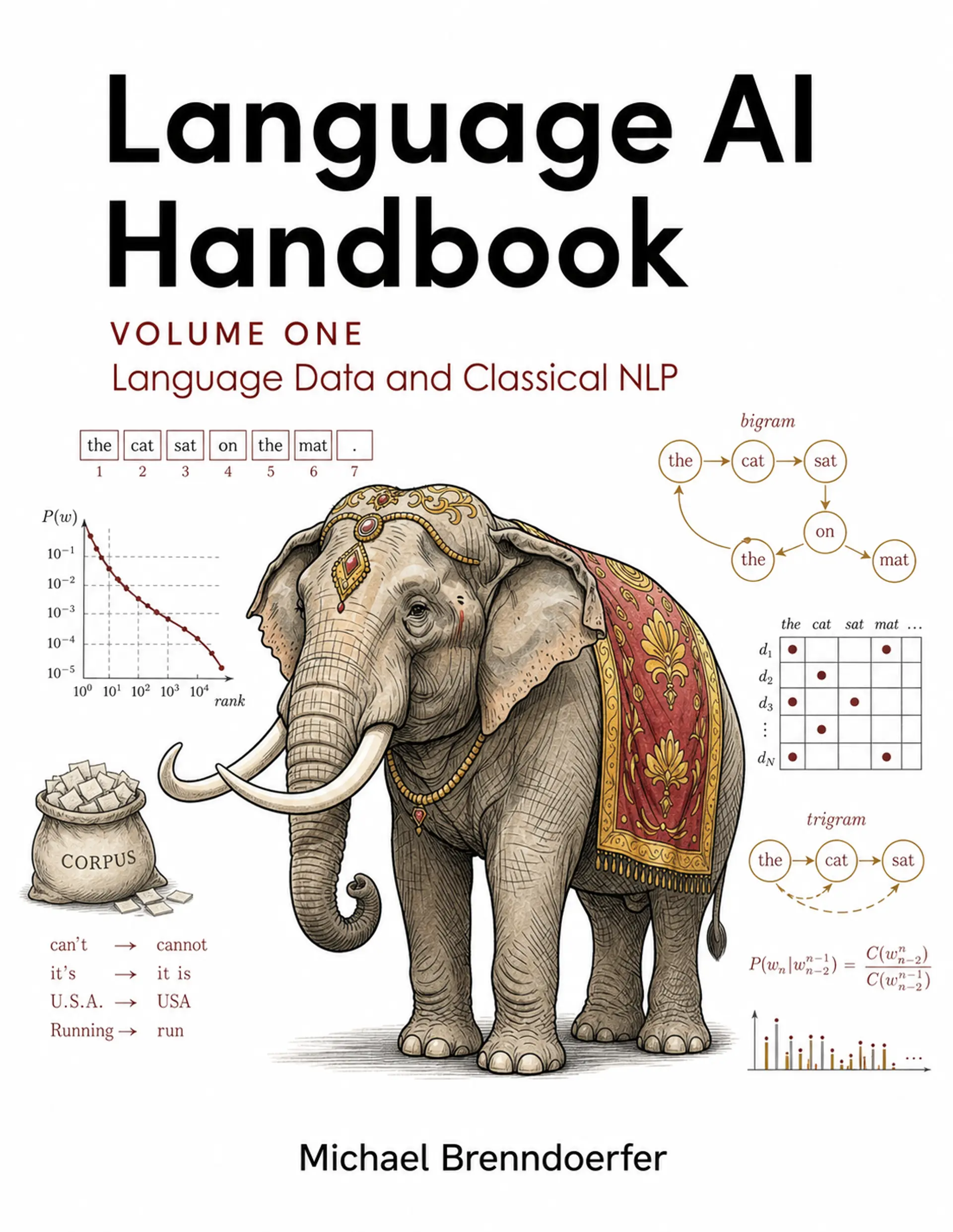
Volume 1 · 570 pages
Language Data and Classical NLP
Text as Data · Classical Text Representations · Distributional Semantics
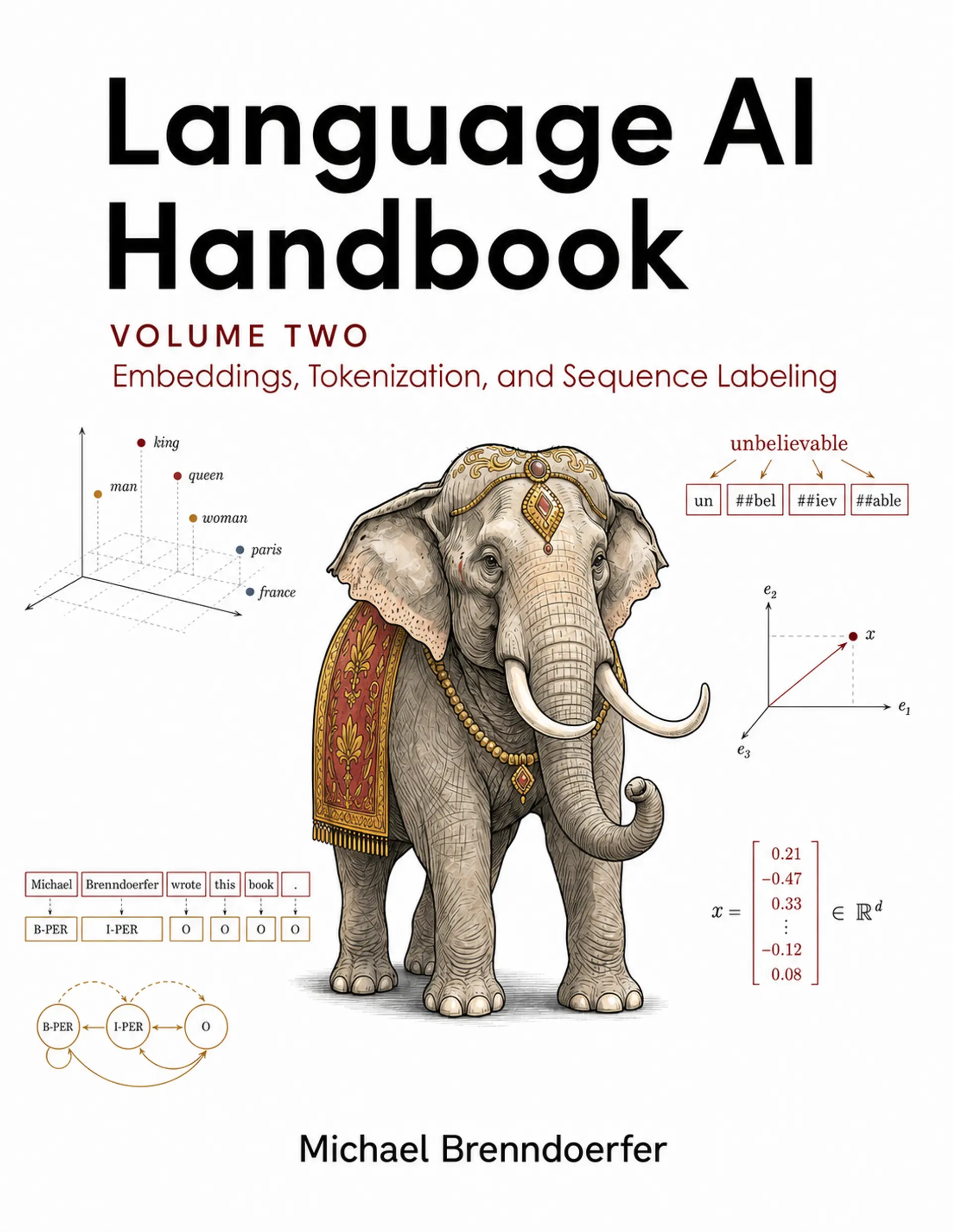
Volume 2 · 790 pages
Embeddings, Tokenization, and Sequence Labeling
Word Embeddings · Subword Tokenization · Sequence Labeling
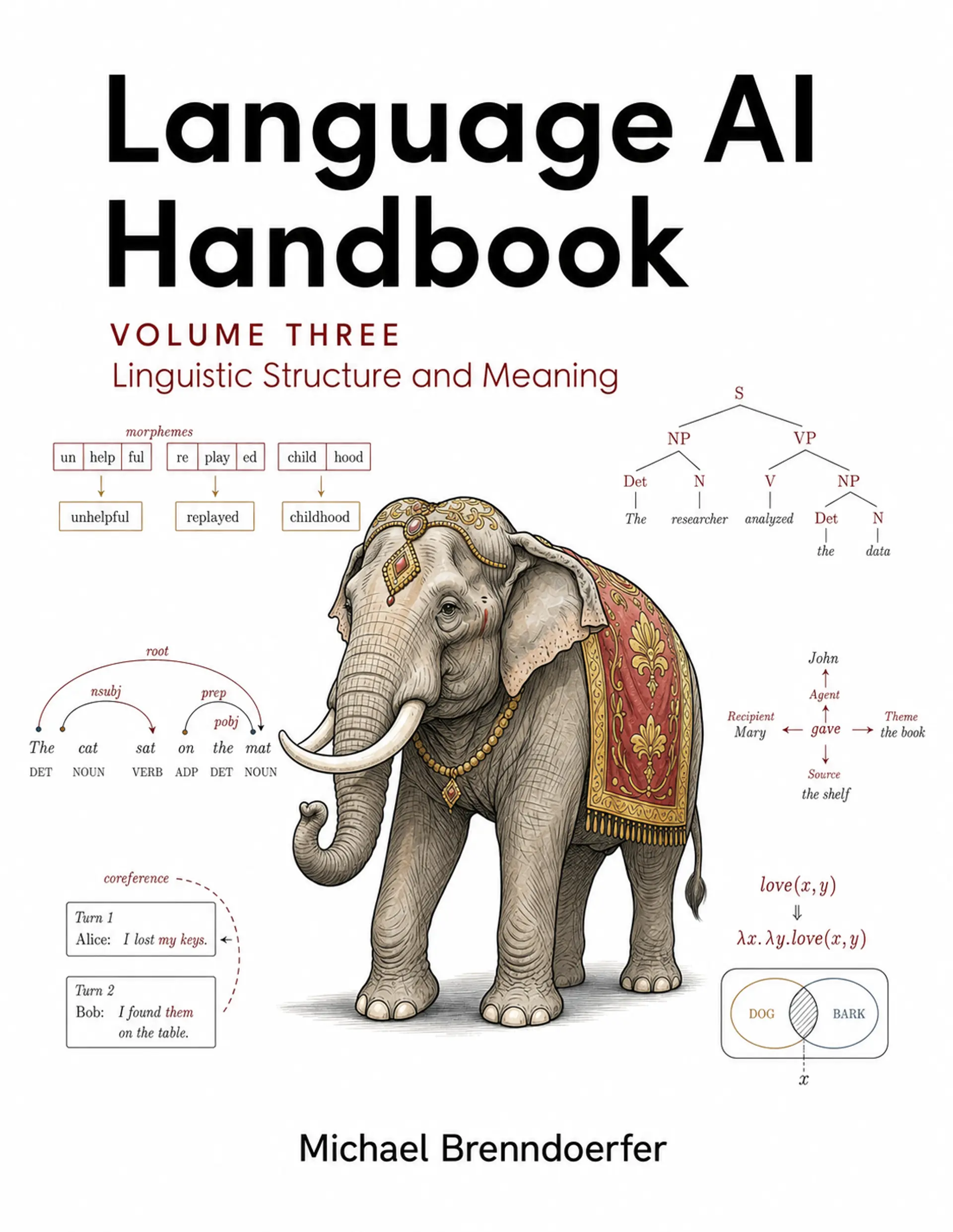
Volume 3 · Coming soon
Linguistic Structure and Meaning
Morphology · Syntax · Semantics · Discourse · Dialogue
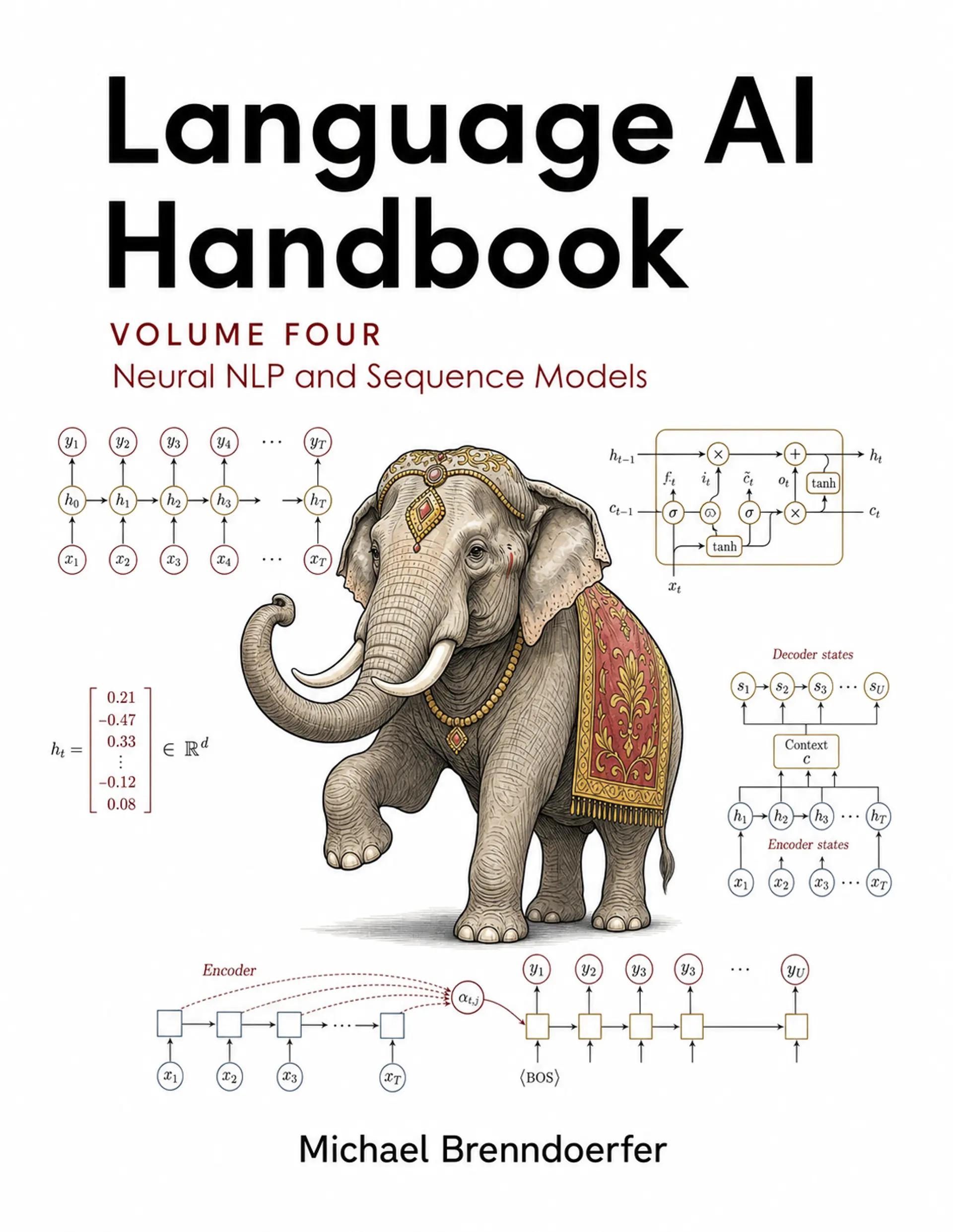
Volume 4 · 920 pages
Neural NLP and Sequence Models
Neural Network Foundations · Recurrent Neural Networks · Sequence-to-Sequence
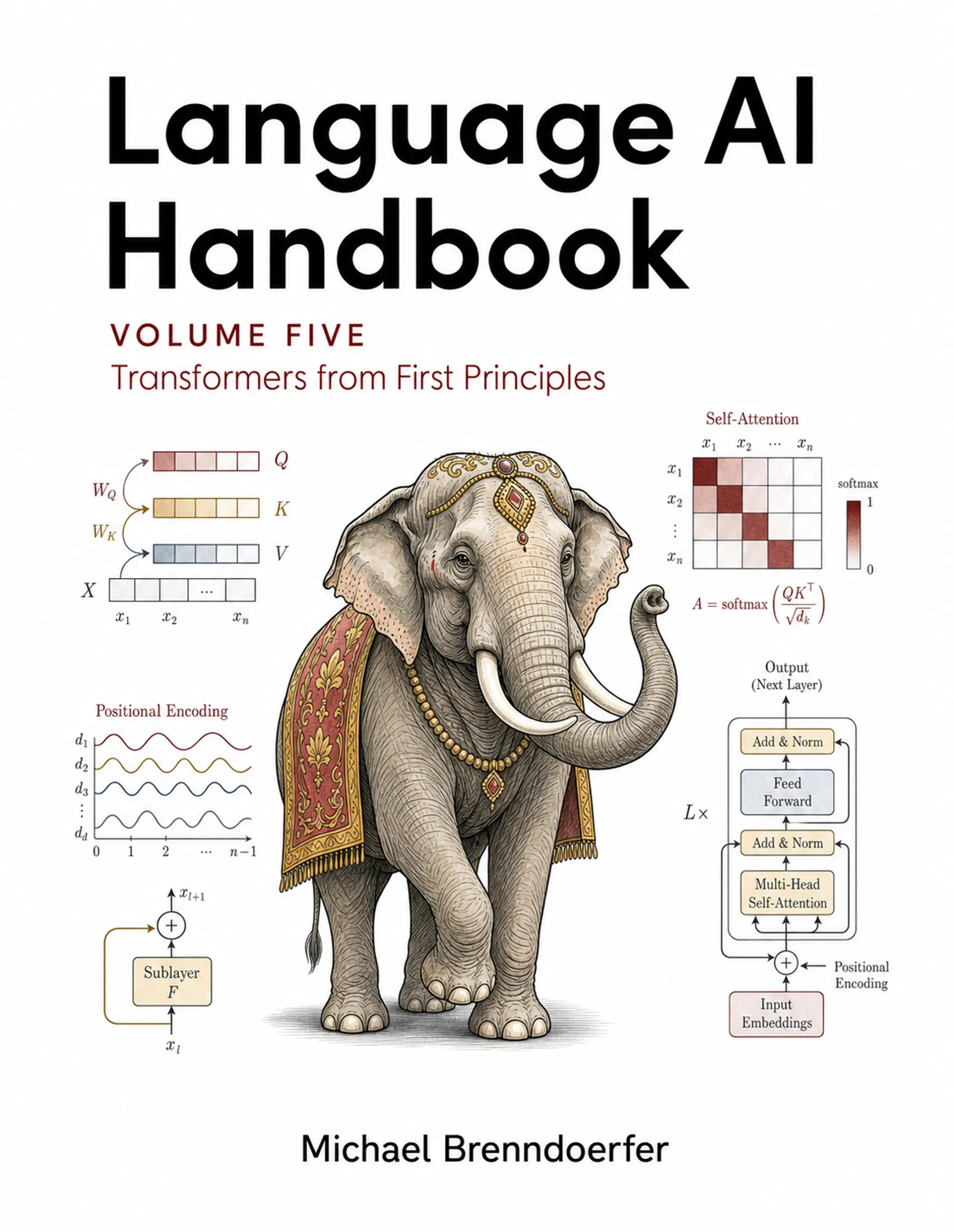
Volume 5 · 860 pages
Transformers from First Principles
Self-Attention · Positional Encoding · Transformer Blocks · Transformer Architectures
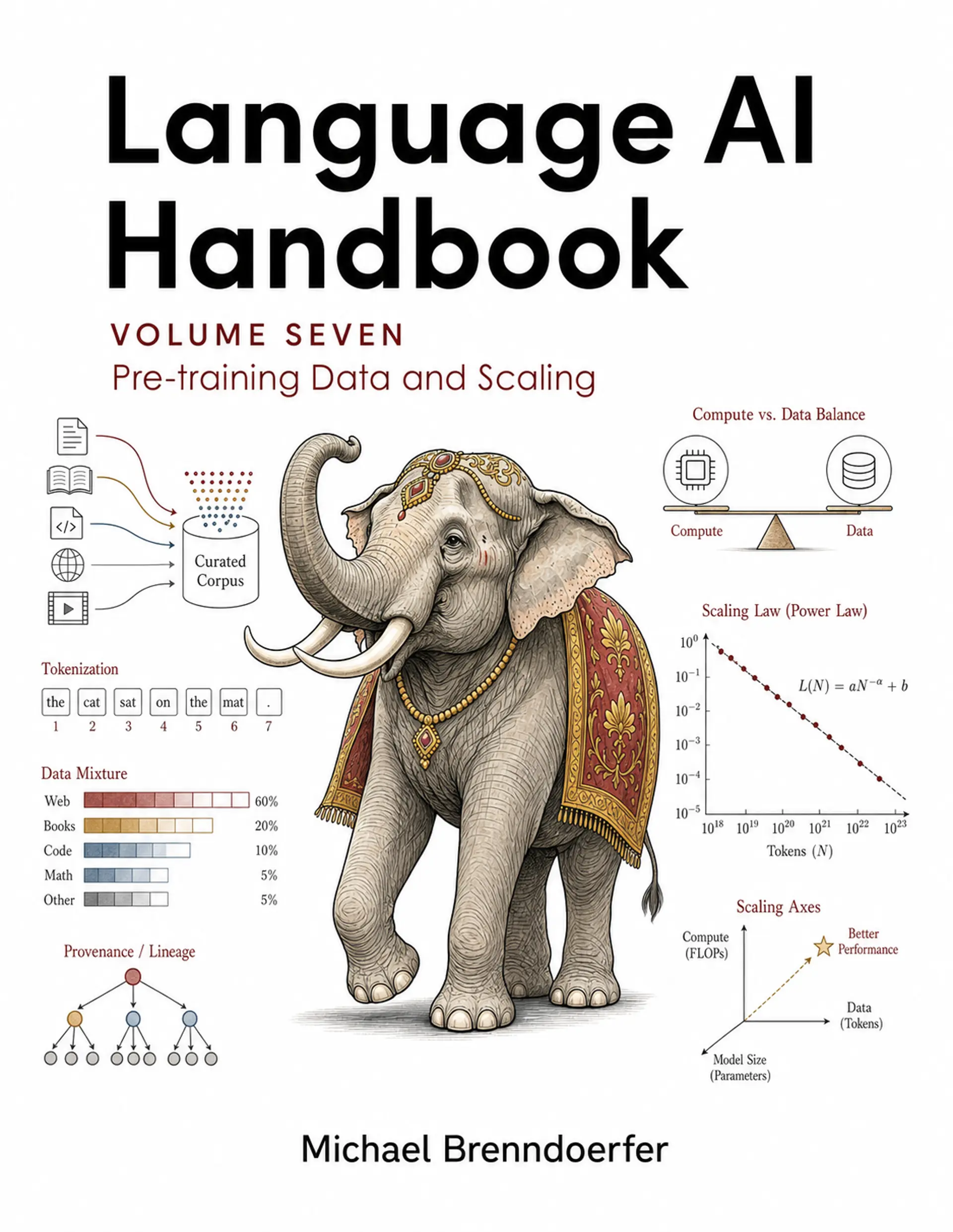
Volume 7 · 760 pages
Pre-training Data and Scaling
Data Curation · Pre-training Objectives · Scaling Laws
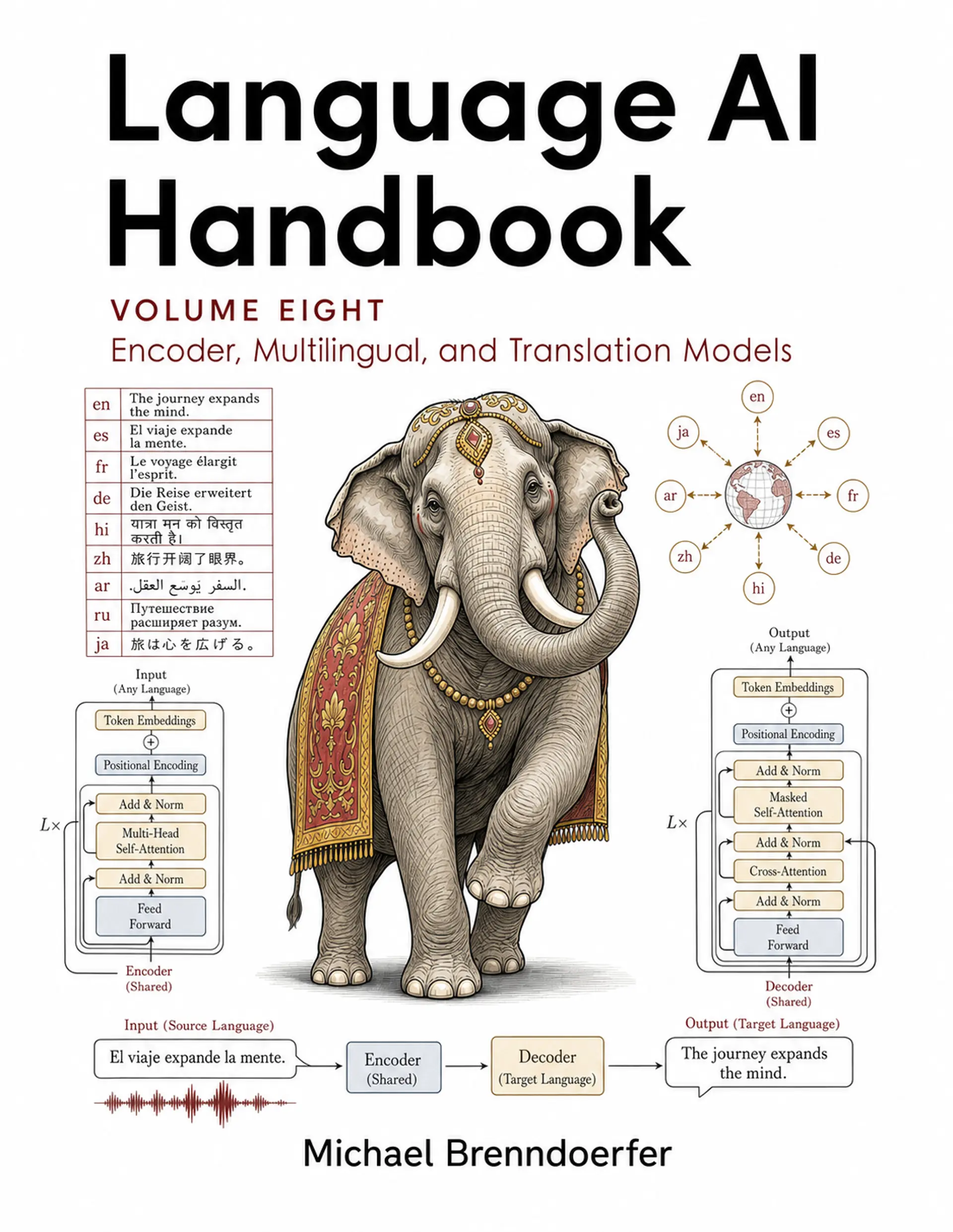
Volume 8 · 440 pages
Encoder, Multilingual, and Translation Models
BERT and Variants · Encoder-Decoder Models
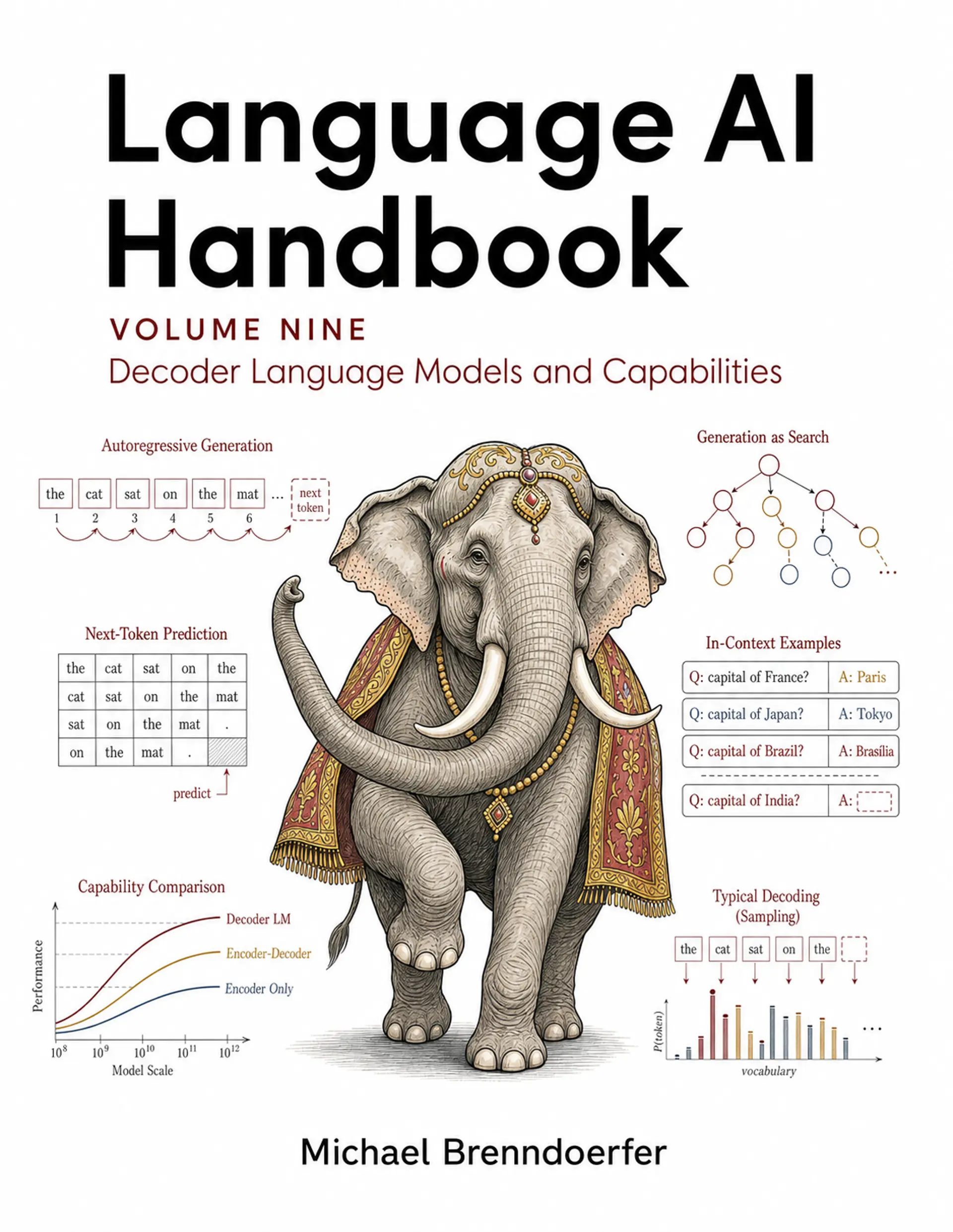
Volume 9 · 730 pages
Decoder Language Models and Capabilities
GPT Architecture · Modern Decoder Models · Emergent Capabilities
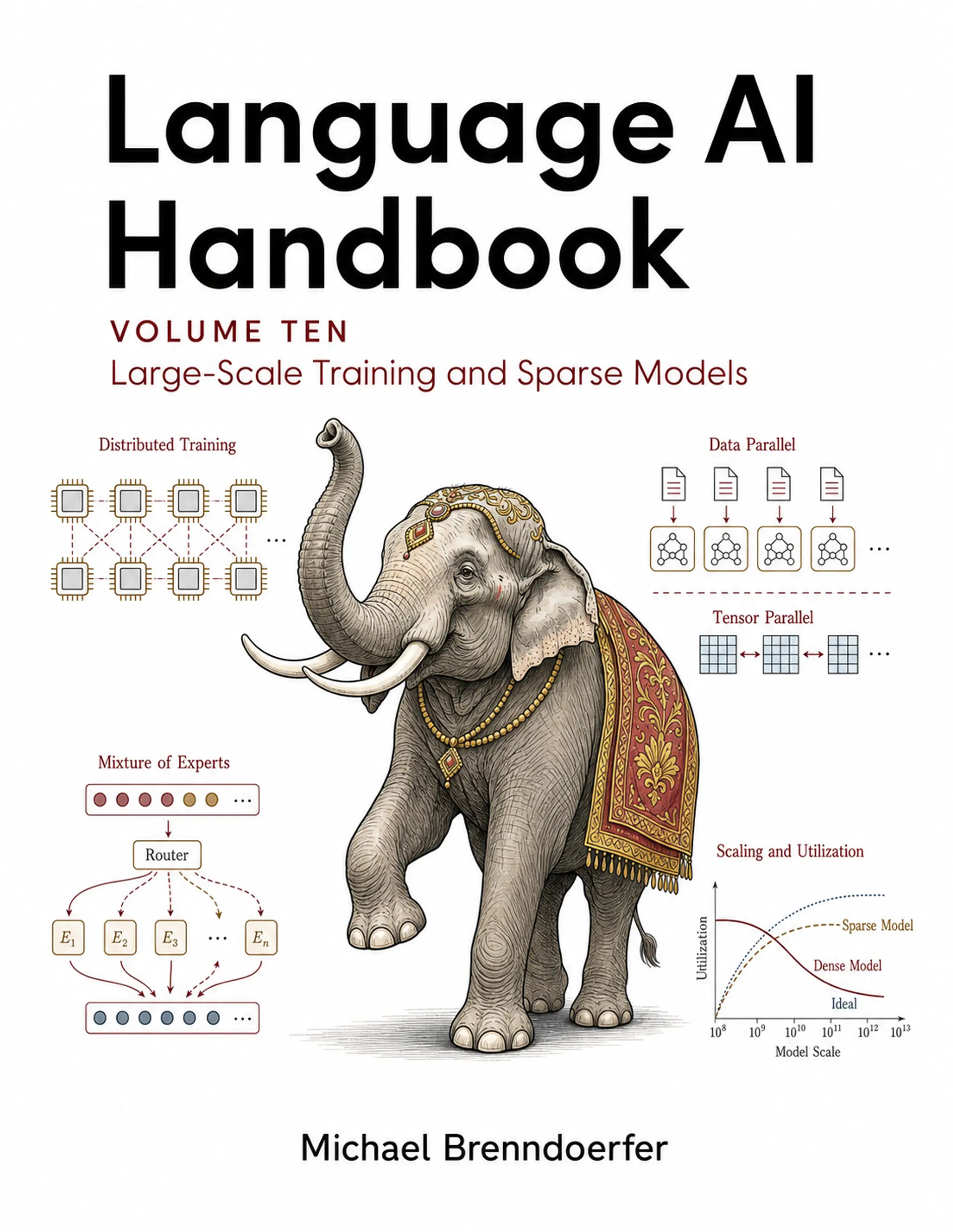
Volume 10 · 920 pages
Large-Scale Training and Sparse Models
Training Infrastructure · Training Optimization · Mixture of Experts
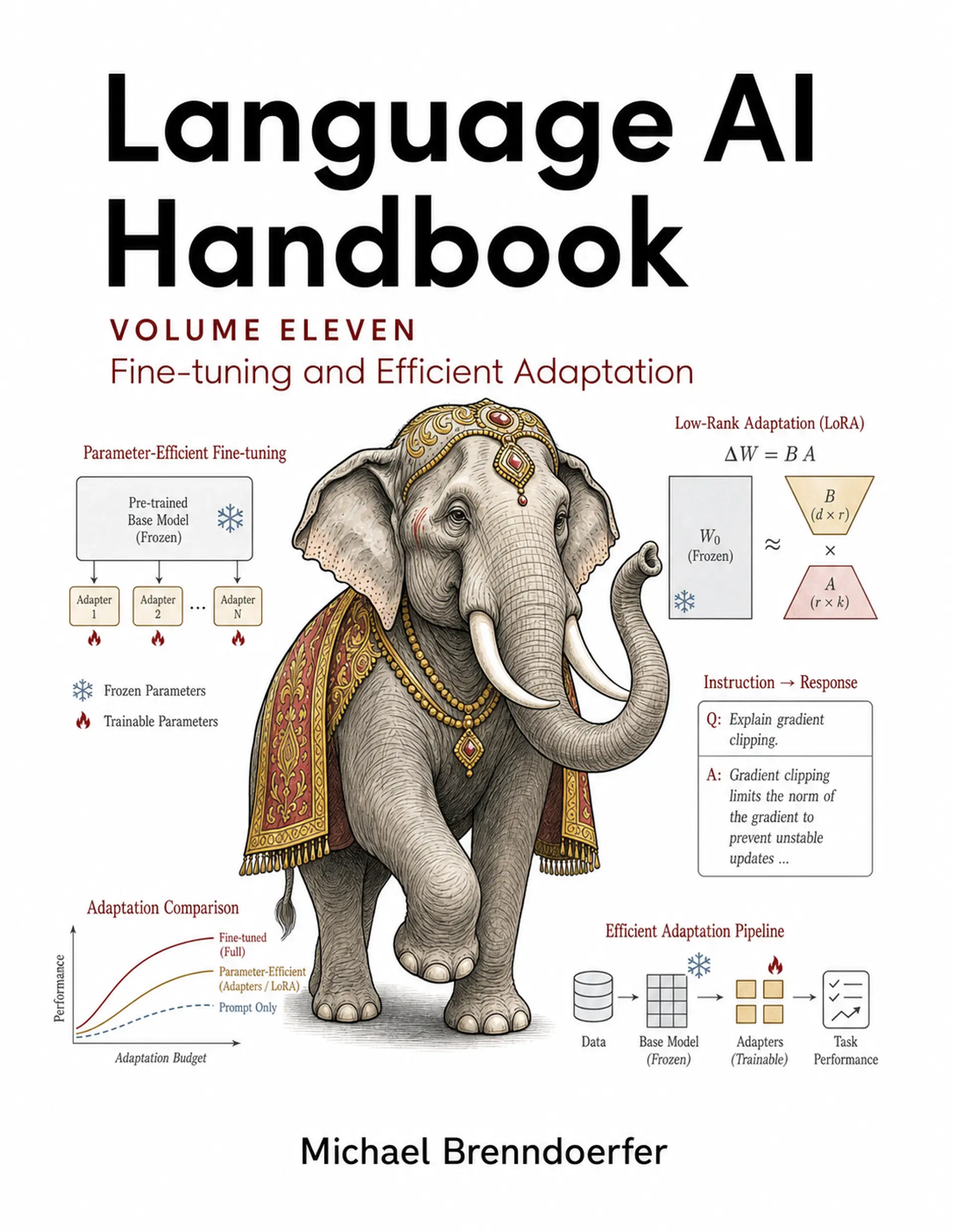
Volume 11 · 730 pages
Fine-tuning and Efficient Adaptation
Fine-tuning Fundamentals · Parameter-Efficient Fine-tuning · Instruction Tuning
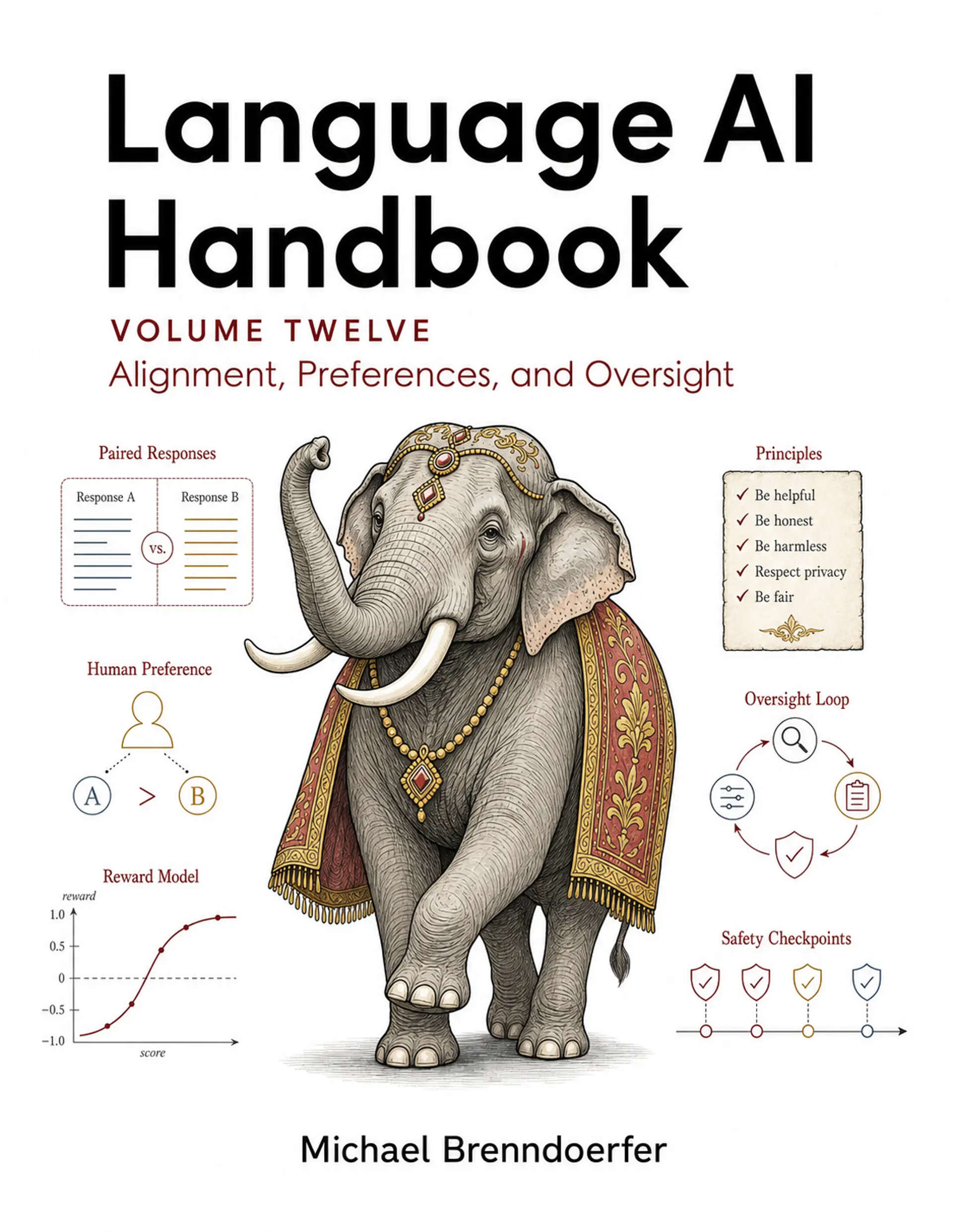
Volume 12 · 510 pages
Alignment, Preferences, and Oversight
Alignment and RLHF
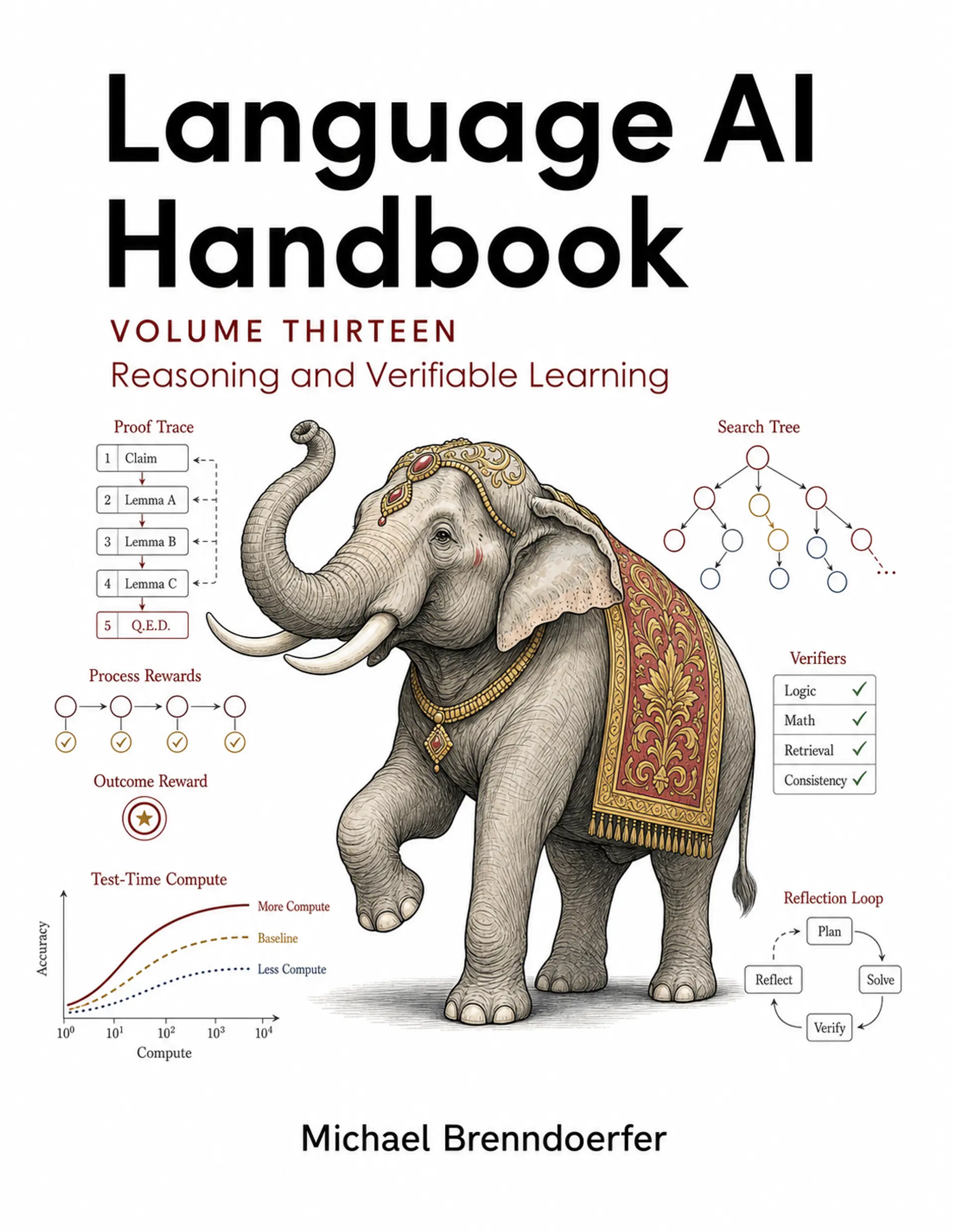
Volume 13 · 220 pages
Reasoning and Verifiable Learning
Reasoning
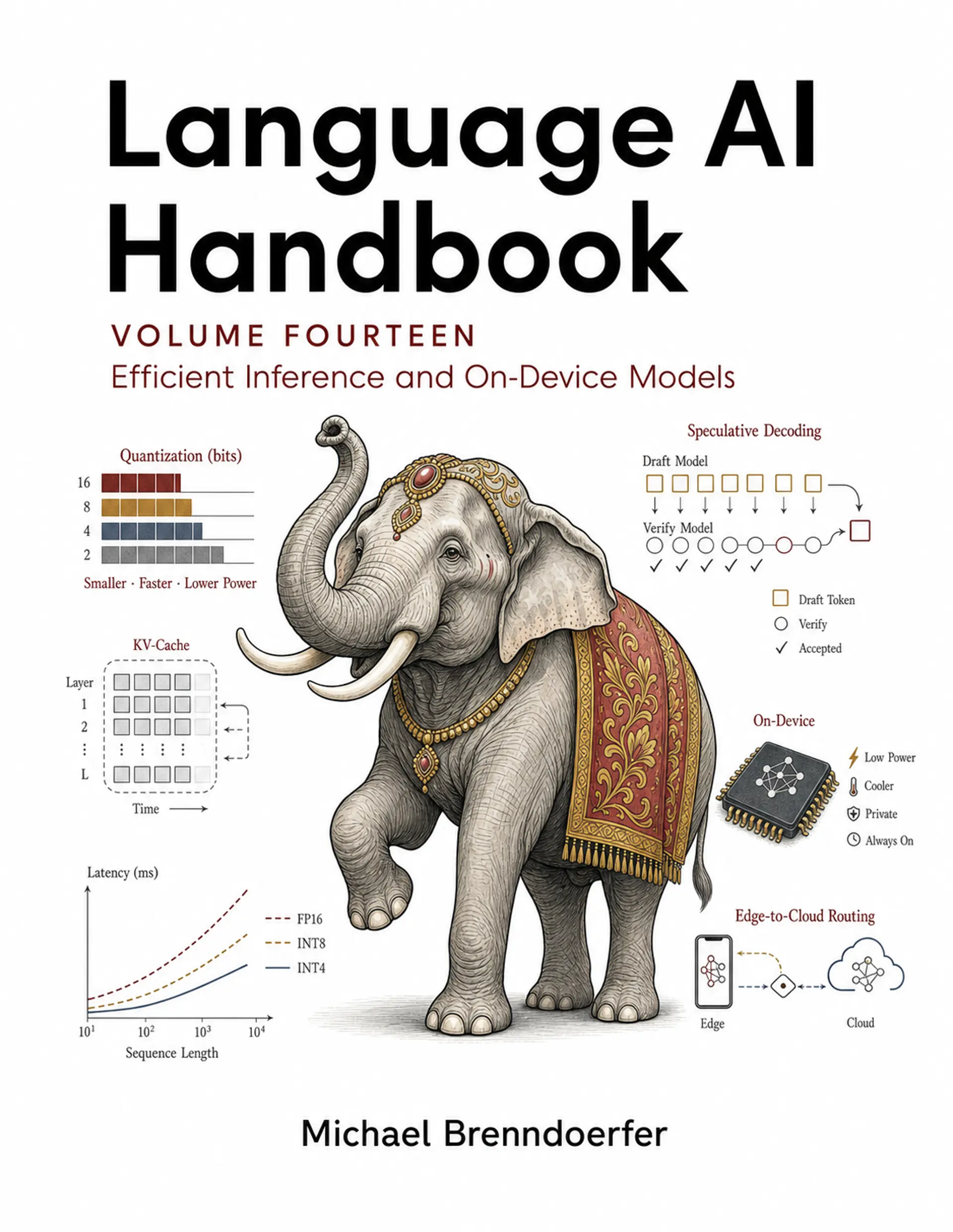
Volume 14 · 640 pages
Efficient Inference and On-Device Models
Model Compression · Inference Optimization
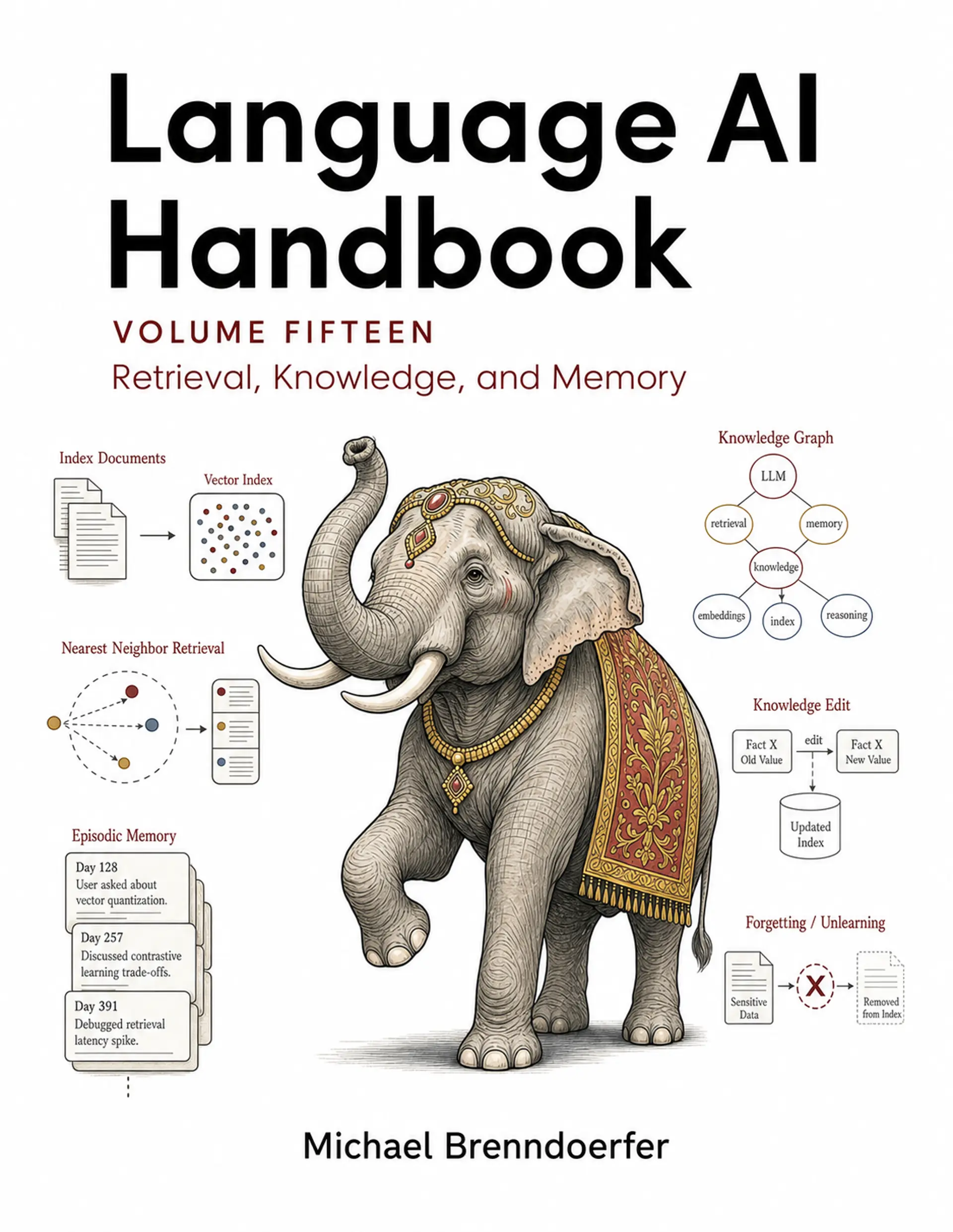
Volume 15 · 600 pages
Retrieval, Knowledge, and Memory
Retrieval-Augmented Generation · Continual Learning
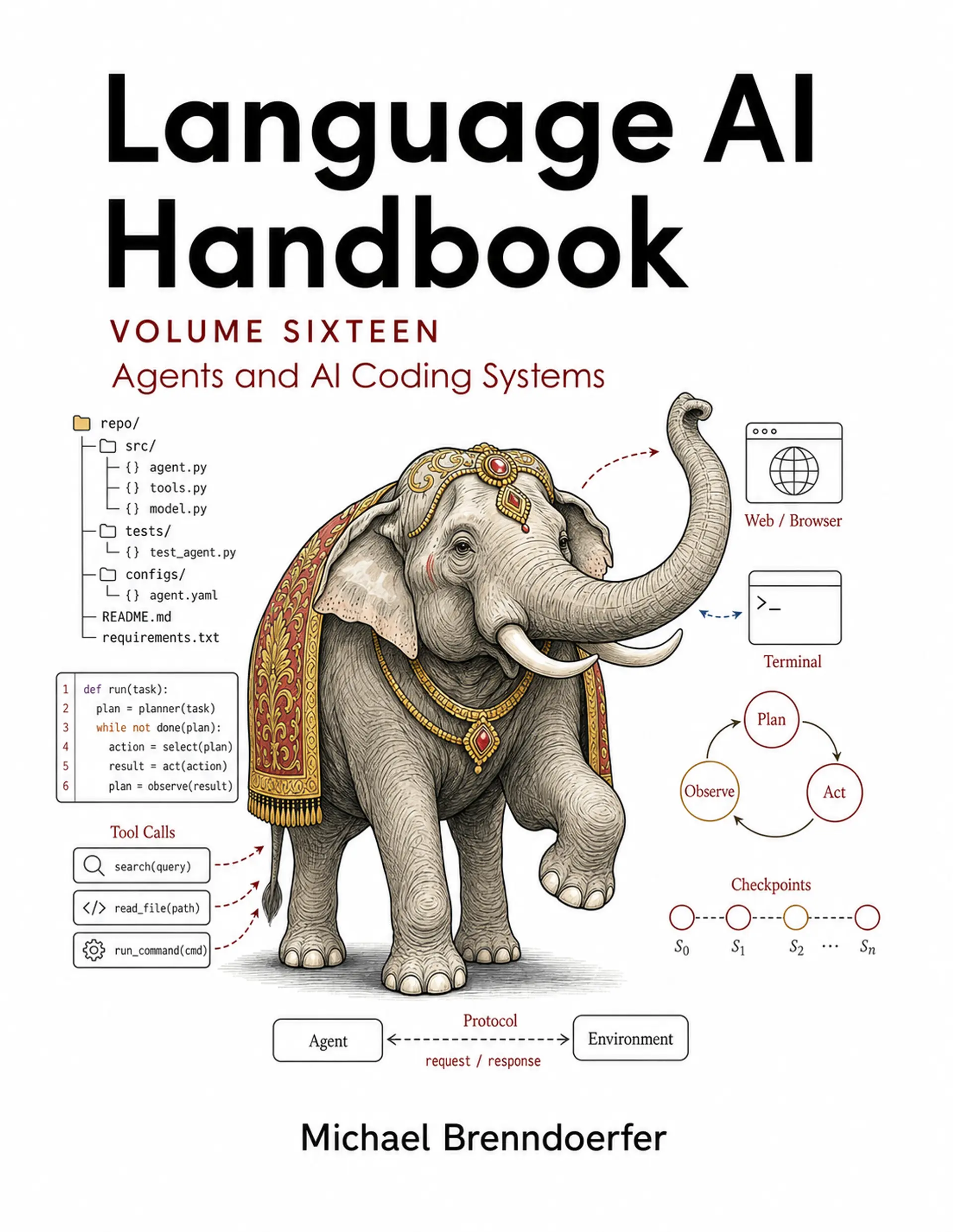
Volume 16 · 510 pages
Agents and AI Coding Systems
Code Generation · Tool Use and Agents
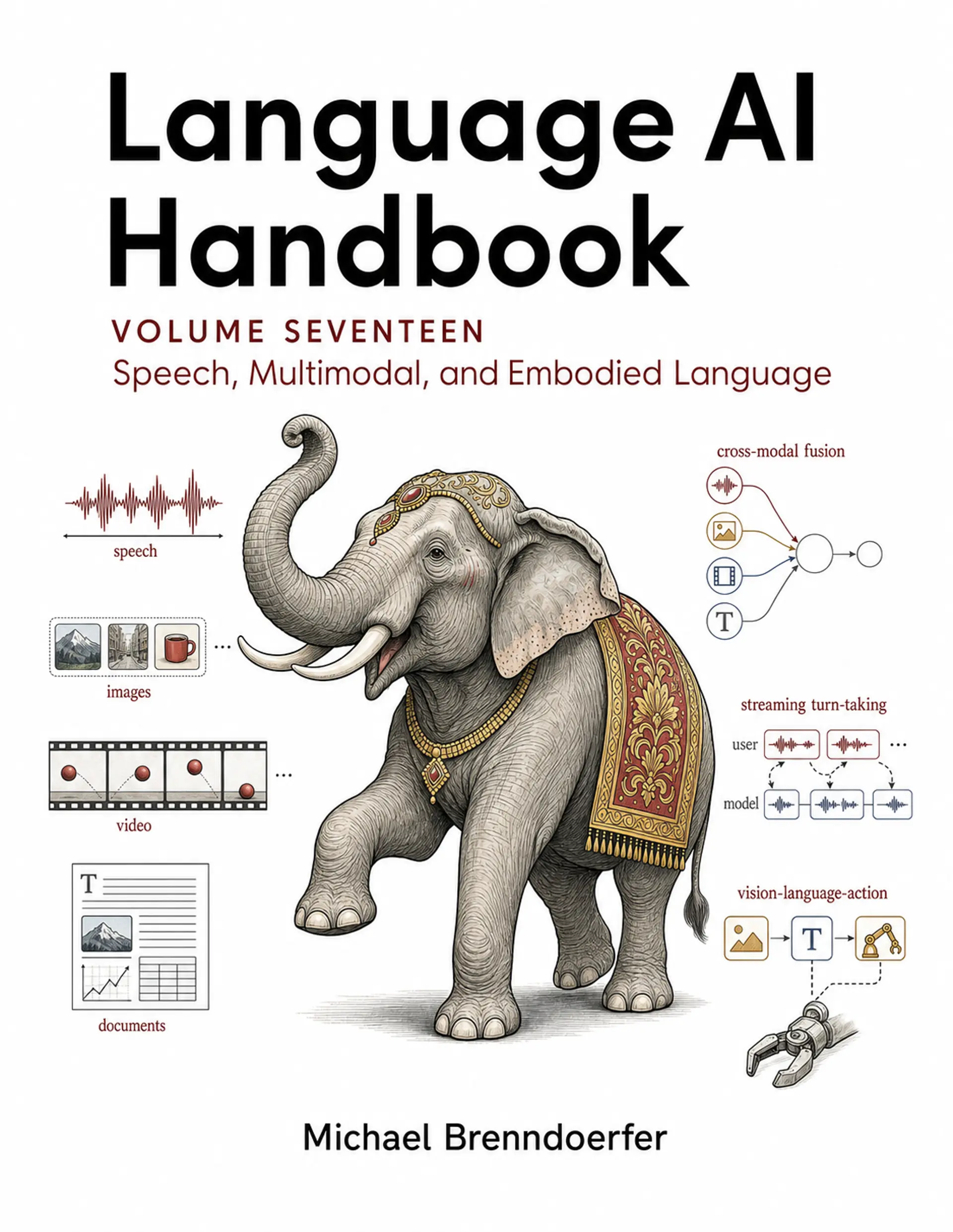
Volume 17 · 540 pages
Speech, Multimodal, and Embodied Language
Multimodal Models · Speech and Audio
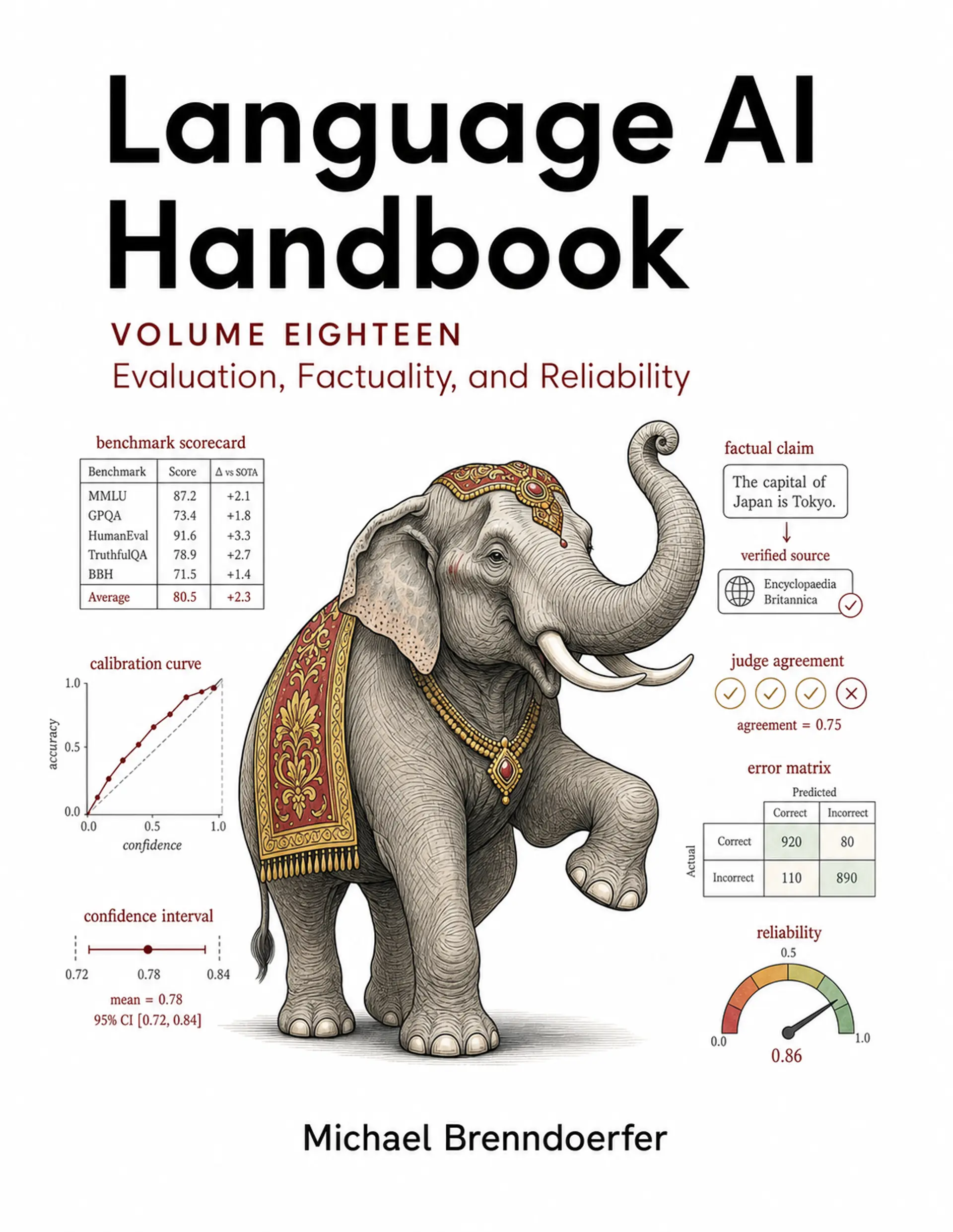
Volume 18 · 950 pages
Evaluation, Factuality, and Reliability
Evaluation Fundamentals · Benchmark Evaluation · Human and Model Evaluation · Hallucination and Factuality
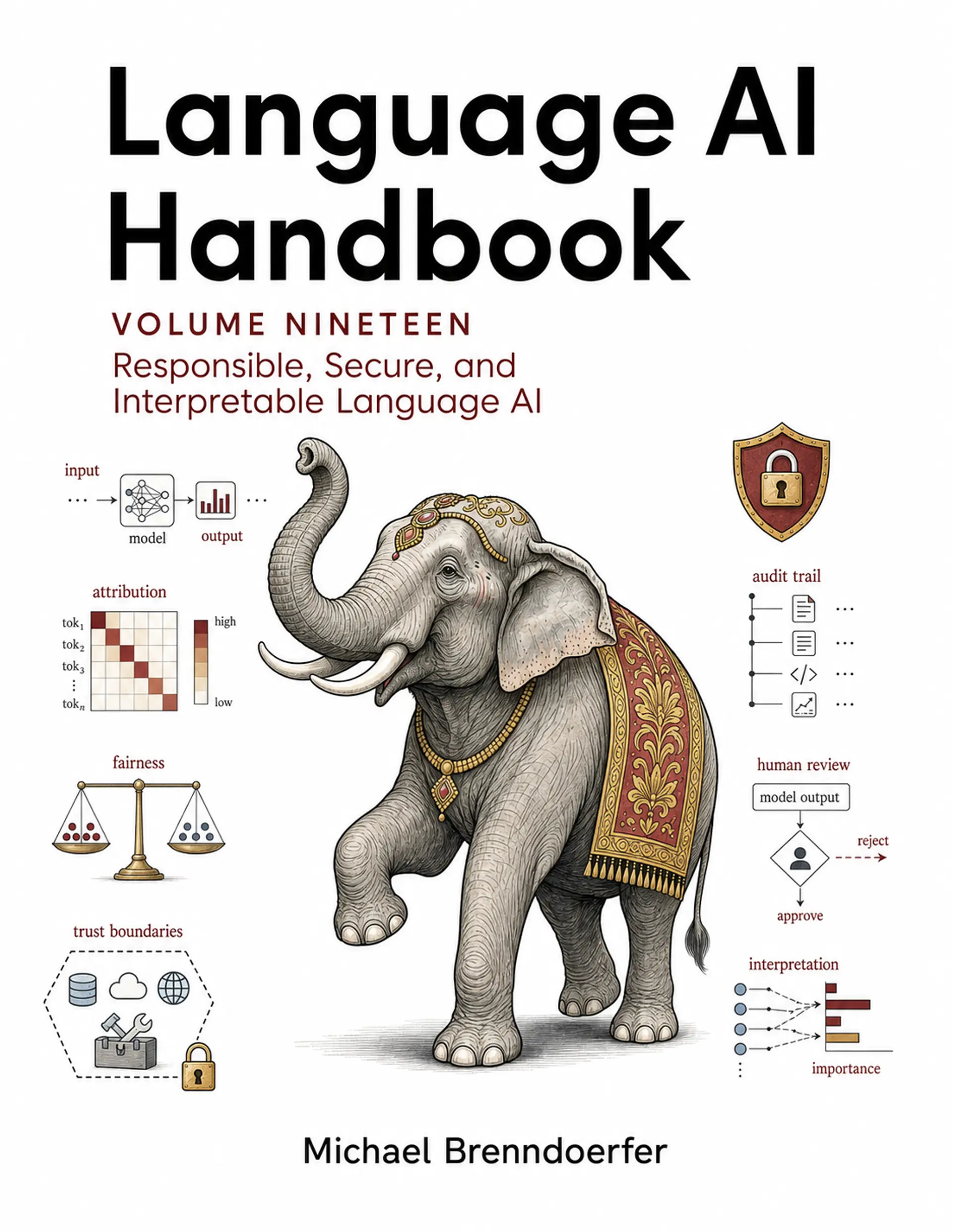
Volume 19 · 760 pages
Responsible, Secure, and Interpretable Language AI
Bias and Fairness · Interpretability · Safety and Security
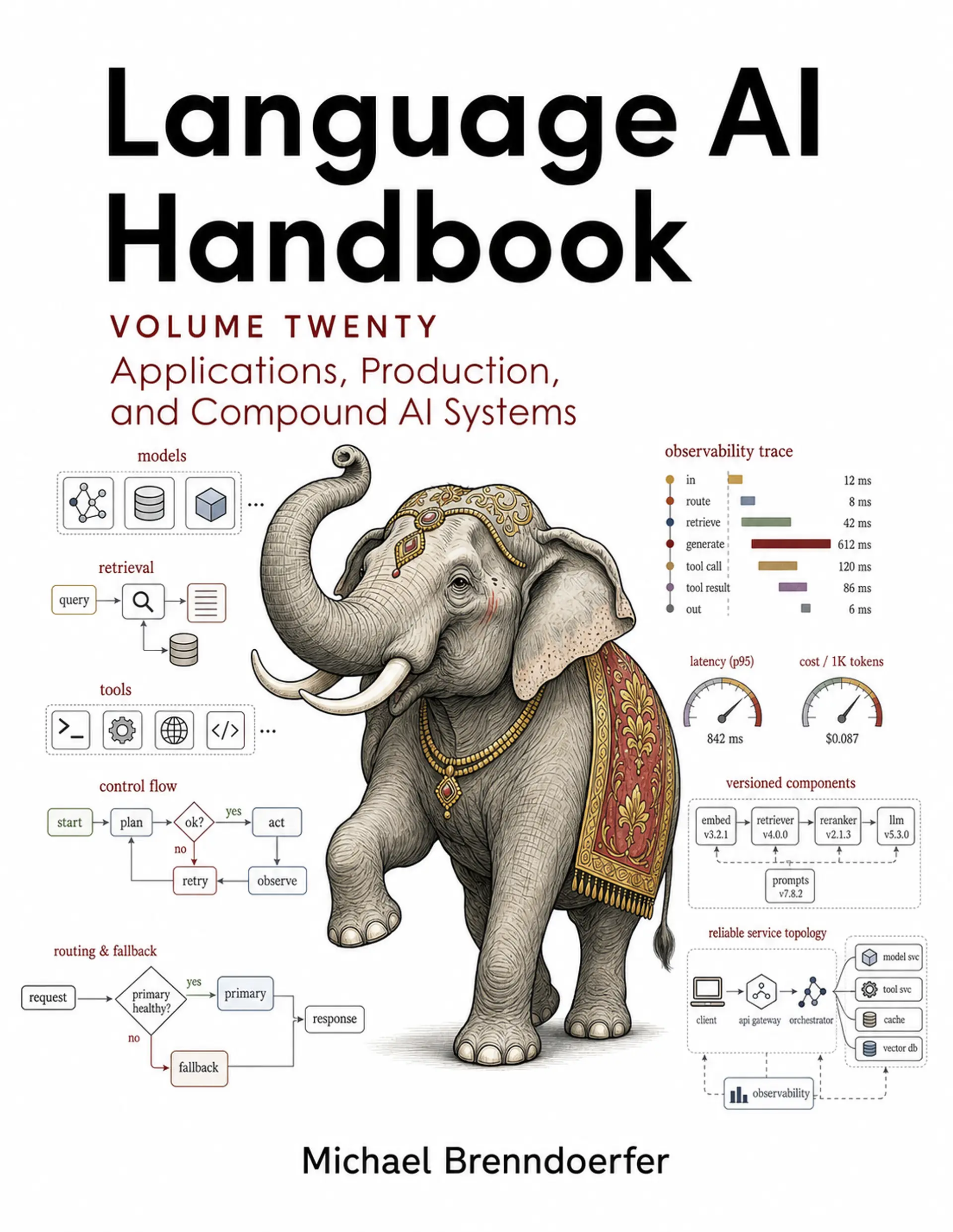
Volume 20 · 510 pages
Applications, Production, and Compound AI Systems
LLM Applications · Production Systems
Author and edition details
About the author and this edition

Michael Brenndoerfer
Michael has spent more than a decade working across software engineering, data, AI, and business. He writes to understand difficult ideas more deeply and to share what he learns in a clear, practical way.
- Edition
- First edition
- Published
- Last reviewed
Version history
Kept current, not frozen in time
Library access includes every future volume and update. When a volume changes, its updated PDF appears in My books at no extra cost.
Current release
Edition 2026.08.0
Initial volume-library release with 19 written PDFs, a Volume 3 placeholder, and no combined edition.