Volume 20 of 20 · PDF edition
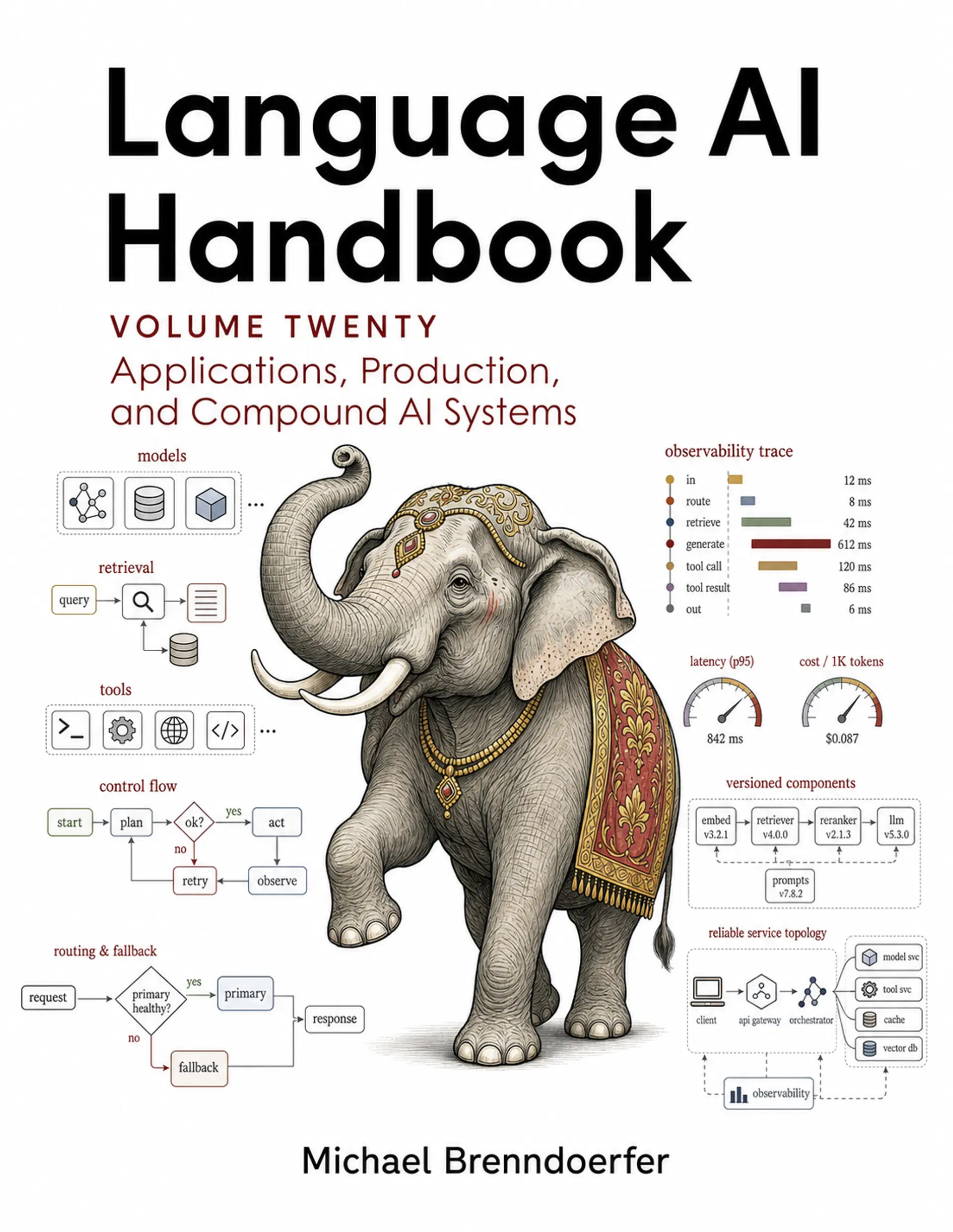
In progressApplications, Production, and Compound AI Systems
For practitioners turning models into reliable products through orchestration, observability, evaluation, and production engineering.
Read every available chapter online for free. The paid edition is a focused, carefully typeset volume PDF with future chapters, updates, and errata included.
- Written chapters
- 16 written chapters
- Planned chapters
- 6 planned chapters
- Approximate pages
- ~510 pages
- Edition
- Version 2026.08.0
- Price
- $24 one-time
Author and edition details
About the author and Volume 20 PDF edition

Michael Brenndoerfer
Michael has spent more than a decade working across software engineering, data, AI, and business. He writes to understand difficult ideas more deeply and to share what he learns in a clear, practical way.
- Edition
- Volume 20 PDF 2026.08.0
- Published
- Last reviewed
Focused learning path
What this volume covers
- LLM Applications
- Compound AI System Design
- Production Systems
Audience and prerequisites
Where this volume fits
For practitioners turning models into reliable products through orchestration, observability, evaluation, and production engineering.
Prerequisites: Assumes at least one model-family volume; Volumes 14–19 are useful by application.
Free online preview
Start with “Text Generation Applications”
Covers creative writing, content generation, text transformation, generation quality control.
Exact contents
16 chapters available now
The current PDF contains every linked chapter below. The remaining 6 planned chapters will be added through free volume updates.
Part LXIII: LLM Applications
- 01Text Generation Applications
Covers creative writing, content generation, text transformation, generation quality control.
- 02Summarization
Covers extractive vs abstractive, length control, faithfulness, multi-document summarization.
- 03Question Answering
Covers open-domain QA, reading comprehension, knowledge-intensive QA, QA evaluation.
- 04Information Extraction
Covers named entity recognition, relation extraction, event extraction, structured output generation.
- 05Classification Applications
Covers sentiment analysis, intent detection, topic classification, zero-shot classification.
- 06Conversational AI
Covers dialogue management, context tracking, persona consistency, conversation evaluation.
- 07Creative Applications
Covers story generation, poetry, code creativity, creative constraints and control.
Part LXIV: Compound AI System Design
- 01Models, Retrieval, Tools, and Control FlowPlanned
Decomposing systems into components, explicit orchestration, typed interfaces, and failure boundaries.
- 02Routing, Fallbacks, and Graceful DegradationPlanned
Model cascades, confidence-based routing, deterministic fallbacks, abstention, and partial service.
- 03Evaluation-Driven DevelopmentPlanned
Task suites, traces, regression gates, error taxonomies, and improving systems without benchmark theater.
- 04Tracing and Observability for AI SystemsPlanned
Prompt, retrieval, tool, latency, cost, and quality traces with privacy-aware retention.
- 05Versioning Models, Prompts, Data, and ToolsPlanned
Coordinated releases, compatibility, reproducibility, canaries, rollback, and artifact lineage.
- 06Reliability and Cost EngineeringPlanned
Service objectives, retries, idempotency, concurrency, capacity, caching, budgets, and failure testing.
Part LXV: Production Systems
- 01Model Serving
Covers serving frameworks, model loading, request handling, serving configuration.
- 02Latency Optimization
Covers latency breakdown, batching latency, streaming responses, latency monitoring.
- 03Throughput Optimization
Covers batch size tuning, GPU utilization, concurrent requests, throughput measurement.
- 04Auto-scaling
Covers scaling metrics, horizontal scaling, scale-up vs scale-out, scaling policies.
- 05Model Routing
Covers model selection, A/B testing, model cascades, routing strategies.
- 06Caching
Covers prompt caching, semantic caching, cache invalidation, cache hit rates.
- 07Monitoring
Covers metrics collection, alerting, logging, dashboards.
- 08Quality Monitoring
Covers output quality metrics, drift detection, regression detection, quality alerts.
- 09Cost Management
Covers cost modeling, cost optimization, cost allocation, cost monitoring.
Volume 20 PDF
Own this focused edition
Get the carefully typeset PDF to keep, plus every future chapter, revision, and erratum for this volume.
- Carefully typeset standalone volume PDF
- Future chapters, updates, and errata included
- No oversized combined edition to render or download
Volume 20 of 20
$24
one-timeVersion 2026.08.0 · secure checkout via Stripe
Delivered by email · Free volume updates included
All-volume access
Every current and future volume
Get all 20 current volume slots, every future volume, and every update for $199. PDFs are always delivered as manageable individual volumes, never as one combined 12,500-page file.
$199 one-time
Get all-volume accessContinue through the library
Explore adjacent volumes
Version history
Kept current, not frozen in time
Each PDF purchase includes future editions. When the book changes, the updated copy appears in My books at no extra cost.
Current release
Edition 2026.08.0
Initial volume-library release with 19 written PDFs, a Volume 3 placeholder, and no combined edition.