Volume 2 of 20 · PDF edition
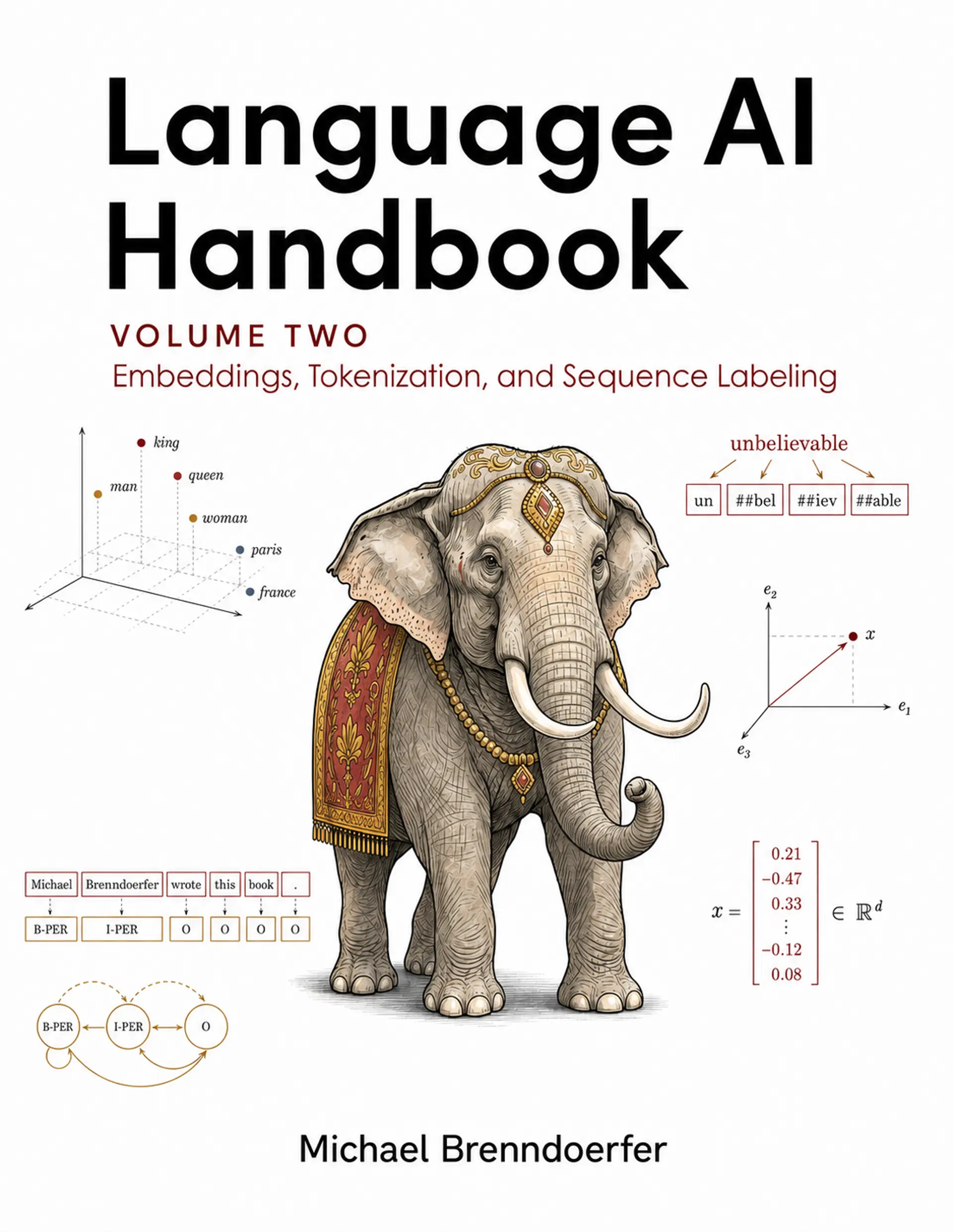
Available nowEmbeddings, Tokenization, and Sequence Labeling
For practitioners building representations, tokenizers, taggers, and entity extraction systems from first principles.
Read every available chapter online for free. The paid edition is a focused, carefully typeset volume PDF with future chapters, updates, and errata included.
- Written chapters
- 25 written chapters
- Approximate pages
- ~790 pages
- Edition
- Version 2026.08.0
- Price
- $24 one-time
Author and edition details
About the author and Volume 2 PDF edition

Michael Brenndoerfer
Michael has spent more than a decade working across software engineering, data, AI, and business. He writes to understand difficult ideas more deeply and to share what he learns in a clear, practical way.
- Edition
- Volume 2 PDF 2026.08.0
- Published
- Last reviewed
Focused learning path
What this volume covers
- Word Embeddings
- Subword Tokenization
- Sequence Labeling
Audience and prerequisites
Where this volume fits
For practitioners building representations, tokenizers, taggers, and entity extraction systems from first principles.
Prerequisites: Builds on Volume 1 or equivalent NLP fundamentals.
Free online preview
Start with “Skip-gram Model”
Covers skip-gram architecture diagram, input/output representations, softmax over vocabulary, skip-gram objective function, training data generation, window size hyperparameter, skip-gram vs CBOW intuition.
Exact contents
25 chapters available now
Part IV: Word Embeddings
- 01Skip-gram Model
Covers skip-gram architecture diagram, input/output representations, softmax over vocabulary, skip-gram objective function, training data generation, window size hyperparameter, skip-gram vs CBOW intuition.
- 02CBOW Model
Covers CBOW architecture, context word averaging, CBOW objective function, CBOW vs skip-gram training speed, CBOW for frequent words, implementing CBOW forward pass, CBOW gradient derivation.
- 03Negative Sampling
Covers softmax computational bottleneck, negative sampling objective derivation, sampling distribution (unigram^0.75), number of negatives hyperparameter, negative sampling gradient computation, NCE vs negative sampling, implementing efficient sampling.
- 04Hierarchical Softmax
Covers binary tree construction (Huffman coding), path probability computation, hierarchical softmax objective, gradient computation along paths, tree structure impact on learning, hierarchical softmax vs negative sampling, when to use each approach.
- 05Word2Vec Training
Covers data preprocessing pipeline, subsampling frequent words, learning rate scheduling, minibatch vs online training, convergence monitoring, gensim Word2Vec usage, training from scratch in PyTorch.
- 06Word Analogy
Covers vector arithmetic for analogies, parallelogram model, analogy evaluation datasets, 3CosAdd vs 3CosMul methods, analogy accuracy metrics, limitations of analogy evaluation, what analogies reveal about embeddings.
- 07GloVe
Covers GloVe objective function derivation, weighted least squares formulation, relationship to matrix factorization, weighting function design, bias terms in GloVe, GloVe vs Word2Vec comparison, training GloVe efficiently.
- 08FastText
Covers character n-gram representation, word vector as n-gram sum, FastText architecture, handling OOV words, morphological awareness, FastText for morphologically rich languages, training FastText models.
- 09Embedding Evaluation
Covers intrinsic vs extrinsic evaluation, word similarity datasets (SimLex, WordSim), analogy accuracy, embedding visualization (t-SNE, UMAP), downstream task evaluation, embedding bias detection, evaluation pitfalls.
Part V: Subword Tokenization
- 01The Vocabulary Problem
Covers OOV word problem, vocabulary size explosion, rare word representation, morphological productivity, compound words, code and technical text, the case for subword units.
- 02Byte Pair Encoding
Covers BPE algorithm step-by-step, merge rules learning, vocabulary size control, BPE encoding procedure, BPE decoding procedure, BPE implementation from scratch, BPE hyperparameters.
- 03WordPiece
Covers WordPiece vs BPE differences, likelihood objective for merges, greedy tokenization algorithm, ## prefix notation, WordPiece in BERT, training WordPiece tokenizers, handling unknown characters.
- 04Unigram Language Model Tokenization
Covers unigram LM formulation, EM algorithm for training, Viterbi decoding for tokenization, sampling multiple segmentations, subword regularization, unigram vs BPE comparison, SentencePiece unigram mode.
- 05SentencePiece
Covers treating text as raw bytes, whitespace handling (▁ prefix), BPE and unigram modes, training from raw text, pretokenization elimination, SentencePiece in production, multilingual tokenization.
- 06Tokenizer Training
Covers corpus preparation, vocabulary size selection, special tokens configuration, training with HuggingFace tokenizers, saving and loading tokenizers, tokenizer versioning, domain-specific tokenizers.
- 07Special Tokens
Covers [CLS], [SEP], [PAD], [MASK], [UNK] tokens, beginning/end of sequence tokens, custom special tokens, special token embeddings, token type IDs, handling special tokens in generation.
- 08Tokenization Challenges
Covers number tokenization issues, code tokenization, multilingual text mixing, emoji and Unicode edge cases, tokenization artifacts, adversarial tokenization, measuring tokenization quality.
Part VI: Sequence Labeling
- 01Part-of-Speech Tagging
Covers POS tag sets (Penn Treebank, Universal), POS tagging as classification, contextual disambiguation, POS tagging accuracy metrics, POS tagging for downstream tasks, rule-based vs statistical taggers.
- 02Named Entity Recognition
Covers entity types (PER, ORG, LOC, etc.), NER as sequence labeling, nested entity challenges, entity boundary detection, NER evaluation (exact vs partial match), NER datasets and benchmarks.
- 03BIO Tagging
Covers BIO scheme explanation, BIOES/BILOU variants, converting spans to BIO tags, BIO decoding to spans, handling tagging inconsistencies, BIO for multi-label scenarios, implementing BIO utilities.
- 04Chunking
Covers noun phrase chunking, chunk types (NP, VP, PP), IOB tagging for chunks, chunking vs full parsing, chunking evaluation, chunking as preprocessing, regex chunking with NLTK.
- 05Hidden Markov Models
Covers HMM components (states, observations, transitions), emission and transition probabilities, HMM assumptions (Markov, independence), HMM for POS tagging, HMM parameter estimation, HMM limitations for NLP.
- 06Viterbi Algorithm
Covers optimal path problem formulation, Viterbi recursion derivation, backpointer tracking, Viterbi complexity analysis, log-space computation, implementing Viterbi efficiently, Viterbi for beam search foundation.
- 07Conditional Random Fields
Covers CRF vs HMM comparison, CRF feature functions, log-linear formulation, partition function computation, CRF for NER, CRF inference complexity, neural CRF layers.
- 08CRF Training
Covers CRF log-likelihood objective, forward-backward algorithm, gradient computation, L-BFGS optimization, feature template design, CRF regularization, CRF training convergence.
Volume 2 PDF
Own this focused edition
Get the carefully typeset PDF to keep, plus every future chapter, revision, and erratum for this volume.
- Carefully typeset standalone volume PDF
- Future chapters, updates, and errata included
- No oversized combined edition to render or download
Volume 2 of 20
$24
one-timeVersion 2026.08.0 · secure checkout via Stripe
Delivered by email · Free volume updates included
All-volume access
Every current and future volume
Get all 20 current volume slots, every future volume, and every update for $199. PDFs are always delivered as manageable individual volumes, never as one combined 12,500-page file.
$199 one-time
Get all-volume accessContinue through the library
Explore adjacent volumes
Version history
Kept current, not frozen in time
Each PDF purchase includes future editions. When the book changes, the updated copy appears in My books at no extra cost.
Current release
Edition 2026.08.0
Initial volume-library release with 19 written PDFs, a Volume 3 placeholder, and no combined edition.