Volume 11 of 20 · PDF edition
Available nowFine-tuning and Efficient Adaptation
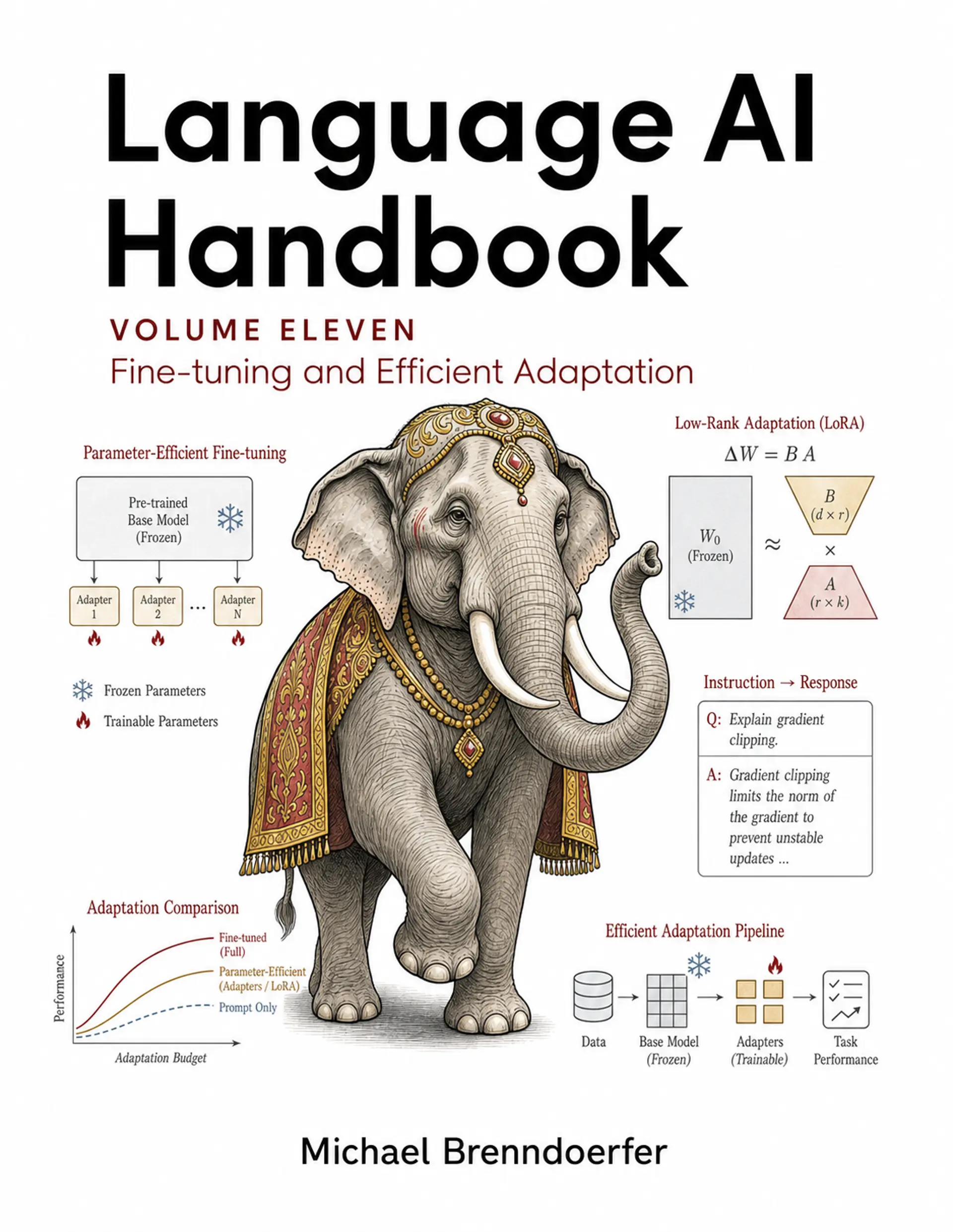
For practitioners adapting foundation models with full fine-tuning, LoRA-family methods, adapters, and instruction data.
Read every available chapter online for free. The paid edition is a focused, carefully typeset volume PDF with future chapters, updates, and errata included.
- Written chapters
- 23 written chapters
- Approximate pages
- ~730 pages
- Edition
- Version 2026.08.0
- Price
- $24 one-time
Author and edition details
About the author and Volume 11 PDF edition

Michael Brenndoerfer
Michael has spent more than a decade working across software engineering, data, AI, and business. He writes to understand difficult ideas more deeply and to share what he learns in a clear, practical way.
- Edition
- Volume 11 PDF 2026.08.0
- Published
- Last reviewed
Focused learning path
What this volume covers
- Fine-tuning Fundamentals
- Parameter-Efficient Fine-tuning
- Instruction Tuning
Audience and prerequisites
Where this volume fits
For practitioners adapting foundation models with full fine-tuning, LoRA-family methods, adapters, and instruction data.
Prerequisites: Assumes familiarity with a pretrained encoder or decoder from Volumes 8–9.
Free online preview
Start with “Transfer Learning”
Covers transfer learning paradigm, pre-training/fine-tuning split, what transfers, transfer learning efficiency.
Exact contents
23 chapters available now
Part XXXIV: Fine-tuning Fundamentals
- 01Transfer Learning
Covers transfer learning paradigm, pre-training/fine-tuning split, what transfers, transfer learning efficiency.
- 02Full Fine-tuning
Covers full fine-tuning procedure, fine-tuning hyperparameters, learning rate selection, batch size effects.
- 03Catastrophic Forgetting
Covers forgetting phenomenon, forgetting measurement, forgetting mitigation, pre-trained capability preservation.
- 04Fine-tuning Learning Rates
Covers discriminative fine-tuning, layer-wise learning rates, warmup for fine-tuning, learning rate decay.
- 05Fine-tuning Data Efficiency
Covers few-shot fine-tuning, data augmentation, sample efficiency patterns, small data strategies.
Part XXXV: Parameter-Efficient Fine-tuning
- 01PEFT Motivation
Covers parameter storage costs, multi-task deployment, PEFT efficiency, PEFT quality trade-offs.
- 02LoRA Concept
Covers weight update decomposition, low-rank assumption, LoRA efficiency gains, LoRA flexibility.
- 03LoRA Mathematics
Covers LoRA formulation W + BA, rank selection, initialization scheme, LoRA gradient computation.
- 04LoRA Implementation
Covers LoRA module design, merging weights, LoRA training loop, LoRA in PyTorch, HuggingFace PEFT usage.
- 05LoRA Hyperparameters
Covers rank selection guidelines, alpha/rank ratio, which layers to adapt, LoRA dropout.
- 06QLoRA
Covers 4-bit quantization for base model, NF4 data type, double quantization, QLoRA memory savings.
- 07AdaLoRA
Covers importance-based pruning, SVD-based adaptation, dynamic rank, AdaLoRA training procedure.
- 08IA3
Covers IA3 formulation, learned rescaling vectors, IA3 parameter efficiency, IA3 vs LoRA.
- 09Prefix Tuning
Covers prefix tuning formulation, prefix length selection, prefix tuning for generation, prefix vs LoRA.
- 10Prompt Tuning
Covers prompt tuning formulation, prompt initialization, prompt tuning scaling, prompt length effects.
- 11Adapter Layers
Covers adapter architecture, adapter placement, adapter dimensionality, adapter fusion.
- 12PEFT Comparison
Covers performance comparison, parameter efficiency comparison, task suitability, practical recommendations.
Part XXXVI: Instruction Tuning
- 01Instruction Following
Covers instruction tuning motivation, instruction format design, instruction diversity, instruction quality.
- 02Instruction Data Creation
Covers human annotation, template-based generation, seed task expansion, quality filtering.
- 03Self-Instruct
Covers self-instruct procedure, instruction generation, response generation, filtering strategies.
- 04Instruction Format
Covers prompt templates, system messages, multi-turn format, chat templates, role definitions.
- 05Instruction Tuning Training
Covers instruction tuning data mixing, training hyperparameters, loss masking, multi-task learning.
- 06Instruction Following Evaluation
Covers instruction following benchmarks, human evaluation, automatic evaluation, instruction difficulty.
Volume 11 PDF
Own this focused edition
Get the carefully typeset PDF to keep, plus every future chapter, revision, and erratum for this volume.
- Carefully typeset standalone volume PDF
- Future chapters, updates, and errata included
- No oversized combined edition to render or download
Volume 11 of 20
$24
one-timeVersion 2026.08.0 · secure checkout via Stripe
Delivered by email · Free volume updates included
All-volume access
Every current and future volume
Get all 20 current volume slots, every future volume, and every update for $199. PDFs are always delivered as manageable individual volumes, never as one combined 12,500-page file.
$199 one-time
Get all-volume accessContinue through the library
Explore adjacent volumes
Version history
Kept current, not frozen in time
Each PDF purchase includes future editions. When the book changes, the updated copy appears in My books at no extra cost.
Current release
Edition 2026.08.0
Initial volume-library release with 19 written PDFs, a Volume 3 placeholder, and no combined edition.