Volume 15 of 20 · PDF edition
In progressRetrieval, Knowledge, and Memory
For teams building grounded, updateable, personalized systems with retrieval, editing, memory, continual learning, and unlearning.
Read every available chapter online for free. The paid edition is a focused, carefully typeset volume PDF with future chapters, updates, and errata included.
- Written chapters
- 19 written chapters
- Planned chapters
- 6 planned chapters
- Approximate pages
- ~600 pages
- Edition
- Version 2026.08.0
- Price
- $24 one-time
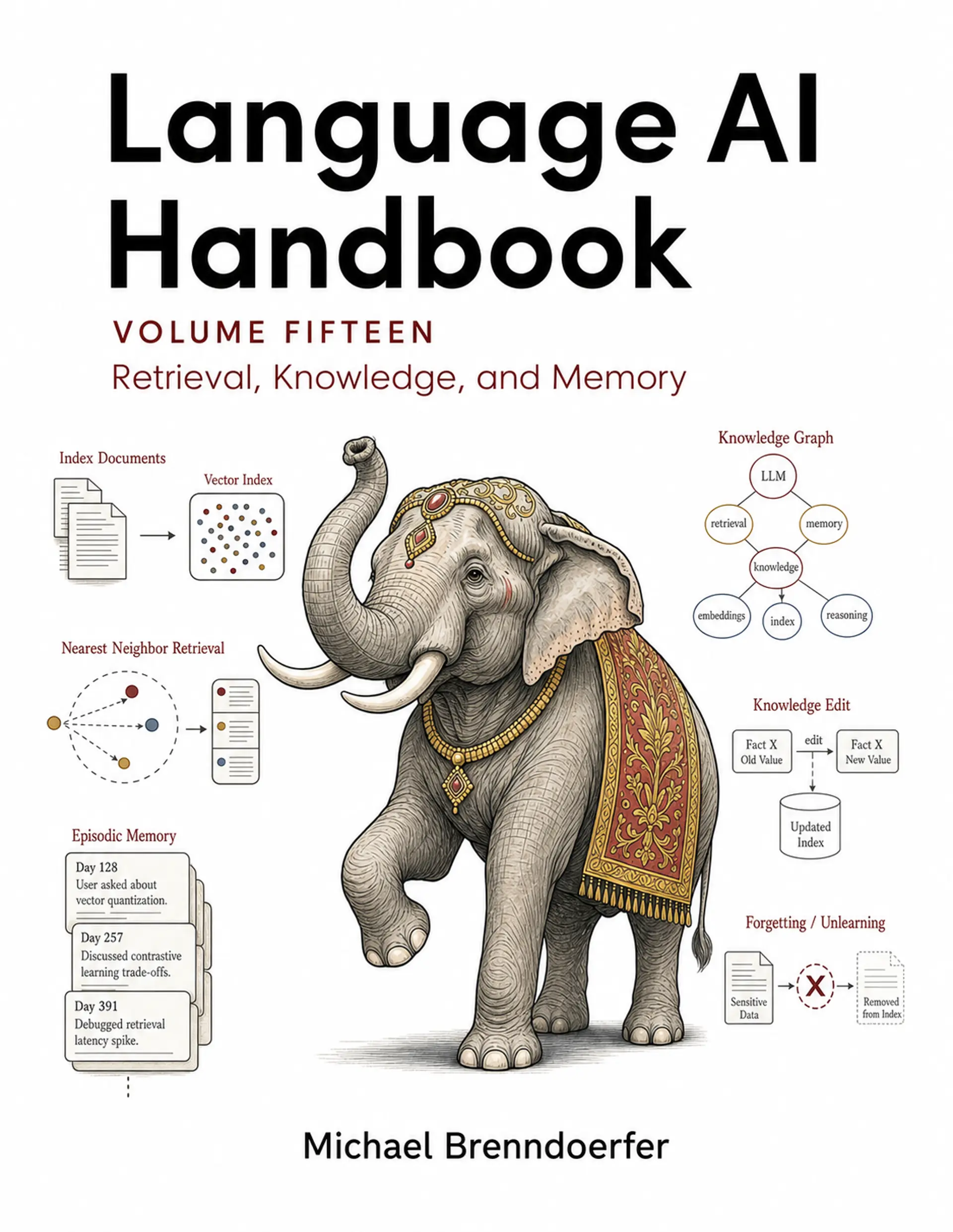
Author and edition details
About the author and Volume 15 PDF edition

Michael Brenndoerfer
Michael has spent more than a decade working across software engineering, data, AI, and business. He writes to understand difficult ideas more deeply and to share what he learns in a clear, practical way.
- Edition
- Volume 15 PDF 2026.08.0
- Published
- Last reviewed
Focused learning path
What this volume covers
- Retrieval-Augmented Generation
- Knowledge, Memory, Editing, and Unlearning
- Continual Learning
Audience and prerequisites
Where this volume fits
For teams building grounded, updateable, personalized systems with retrieval, editing, memory, continual learning, and unlearning.
Prerequisites: Assumes embeddings from Volume 2 and model fundamentals from Volumes 8–9.
Free online preview
Start with “RAG Motivation: Solving Hallucinations & Knowledge Gaps”
Discover why LLMs need Retrieval-Augmented Generation. Learn how RAG bridges knowledge gaps, reduces hallucinations, and enables non-parametric memory.
Exact contents
19 chapters available now
The current PDF contains every linked chapter below. The remaining 6 planned chapters will be added through free volume updates.
Part XLIV: Retrieval-Augmented Generation
- 01RAG Motivation: Solving Hallucinations & Knowledge Gaps
Discover why LLMs need Retrieval-Augmented Generation. Learn how RAG bridges knowledge gaps, reduces hallucinations, and enables non-parametric memory.
- 02RAG Architecture: Components, Timing & Design Patterns
Master RAG system design by exploring retriever-generator interactions, timing strategies like iterative retrieval, and architectural variations like RETRO.
- 03Dense Retrieval: Semantic Search & Bi-Encoder Implementation
Master dense retrieval for semantic search. Explore bi-encoder architectures, embedding metrics, and contrastive learning to overcome keyword limitations.
- 04Contrastive Learning for Retrieval: InfoNCE & DPR Guide
Master contrastive learning for dense retrieval. Learn to train models using InfoNCE loss, in-batch negatives, and hard negative mining strategies effectively.
- 05Document Chunking: Optimizing RAG Retrieval Pipelines
Master document chunking for RAG systems. Explore fixed-size, recursive, and semantic strategies to balance retrieval precision with context window limits.
- 06Embedding Models: Architecture, Pooling & Selection
Learn how embedding models convert text to vectors for RAG. Covers bi-encoder architecture, pooling strategies, dimensionality trade-offs, and model selection.
- 07Vector Similarity Search: Metrics & Approximate Methods
Explore vector similarity search for RAG systems. Compare cosine, dot product, and Euclidean metrics, and implement exact vs. approximate search with FAISS.
- 08HNSW Index: Architecture for Fast Vector Search
Master Hierarchical Navigable Small World (HNSW) graphs for vector search. Learn graph architecture, construction, and tuning for high-speed retrieval.
- 09IVF Index: Clustering-Based Vector Search & Partitioning
Master IVF indexes for scalable vector search. Learn clustering-based partitioning, nprobe tuning, and IVF-PQ compression for billion-scale retrieval.
- 10Product Quantization: Vector Compression for ANN Search
Learn how Product Quantization compresses embeddings up to 100x using learned codebooks and asymmetric distance computation for scalable vector search.
- 11Hybrid Search: BM25 and Dense Retrieval Combined
Learn how hybrid search fuses BM25 keyword retrieval with dense vector retrieval using reciprocal rank fusion and weighted score combination to improve recall.
- 12Reranking: Cross-Encoders for Precise Information Retrieval
Learn how reranking with cross-encoders solves bi-encoder limitations. Master two-stage retrieval, training strategies, and latency optimization for production search systems.
- 13RAG Prompt Engineering: Context Placement & Citation Strategies
Master RAG prompt engineering with strategic context placement, citation formats, and truncation strategies to improve LLM accuracy and reduce hallucinations.
- 14RAG Evaluation: Metrics for Retrieval and Generation Quality
Master RAG evaluation with metrics for retrieval quality (Precision@K, NDCG, MRR) and generation faithfulness using the RAGAS framework for AI systems.
Part XLV: Knowledge, Memory, Editing, and Unlearning
- 01Parametric and External KnowledgePlanned
What models store, what retrieval stores, and how to choose among prompting, RAG, editing, and retraining.
- 02Knowledge EditingPlanned
Localized weight updates, memory-based editors, specificity, generalization, and multi-hop consistency.
- 03Knowledge Freshness and Temporal UpdatesPlanned
Time-sensitive facts, temporal benchmarks, update propagation, versioning, and rollback.
- 04Personalization and Long-Term MemoryPlanned
User models, episodic and semantic memory, consent, retention, conflict resolution, and forgetting.
- 05Machine UnlearningPlanned
Forget sets, retraining baselines, approximate removal, privacy goals, and the limits of verification.
- 06Evaluating Knowledge InterventionsPlanned
Efficacy, locality, generalization, side effects, privacy leakage, and auditable change histories.
Part XLVI: Continual Learning
- 01Continual Learning Problem
Covers continual learning definition, catastrophic forgetting, continual learning scenarios.
- 02Regularization Methods
Covers elastic weight consolidation, synaptic intelligence, parameter importance, regularization trade-offs.
- 03Replay Methods
Covers replay buffer design, pseudo-rehearsal, generative replay, replay selection.
- 04Architecture Methods
Covers progressive networks, expert expansion, architecture search, modular approaches.
- 05Continual Learning Evaluation
Covers forward transfer, backward transfer, evaluation protocols, continual benchmarks.
Volume 15 PDF
Own this focused edition
Get the carefully typeset PDF to keep, plus every future chapter, revision, and erratum for this volume.
- Carefully typeset standalone volume PDF
- Future chapters, updates, and errata included
- No oversized combined edition to render or download
Volume 15 of 20
$24
one-timeVersion 2026.08.0 · secure checkout via Stripe
Delivered by email · Free volume updates included
All-volume access
Every current and future volume
Get all 20 current volume slots, every future volume, and every update for $199. PDFs are always delivered as manageable individual volumes, never as one combined 12,500-page file.
$199 one-time
Get all-volume accessContinue through the library
Explore adjacent volumes
Version history
Kept current, not frozen in time
Each PDF purchase includes future editions. When the book changes, the updated copy appears in My books at no extra cost.
Current release
Edition 2026.08.0
Initial volume-library release with 19 written PDFs, a Volume 3 placeholder, and no combined edition.